Recognize you have control of this, if nothing else — Michael Marcus Jan 10 By JESHOOTScom on Pixabay I rem...
Business
5/Cars/feat-tab
Search This Blog
Author Details
Templatesyard is a blogger resources site is a provider of high quality blogger template with premium looking layout and robust design. The main mission of templatesyard is to provide the best quality blogger templates.
The
quality of mobile design can be measured simply. When the process of
usage is so smooth and effortless that people don’t even think about it,
it is the sign of the professional design work. On the other hand, if
there are some problems in the interaction system, users will definitely
notice them and won’t be pleased about it.
Mobile
apps are expected to be clear and easy to operate so that they could be
effectively used anytime and anyplace. Designers’ task is to create an
intuitive interface which will guide users within the app helping them
operate its functionality without problems. In this article, we describe
the essential aspects of the effective mobile interaction system along
with the tips helping designers to create intuitive design.

Every
designer strives at creating a unique product with original
interactions and navigation systems. Such an approach allows standing
out a crowd and being noticeable on the market. However, creating
absolutely new environment designers have to think how users will adjust
to it.
If
the interaction system of a mobile application has no logic and
sequence or it doesn’t respond to needs of the target audience, it may
be frustrating and annoying. That condition is critical for UX, so
people will simply give up on trying to decipher an app and quit it.
To avoid this kind of outcome, designers need to care about learnability of the interactive elements. Learnability
stands for how easy tasks can be attained during the first usage and
how quickly users learn from the previous experience. To increase
learnability, designers need to keep it simple and clear helping
quickly adjust to it. Also, the system should be consistent and logical
so that users could identify the repeating patterns and use a mobile app
intuitively.
Consider multiple holds
We
all are different in many ways, even how we hold smartphones. The way
of holding smartphones depends on various factors including the
situation and conditions in which the app is used as well as the task we
need to accomplish.
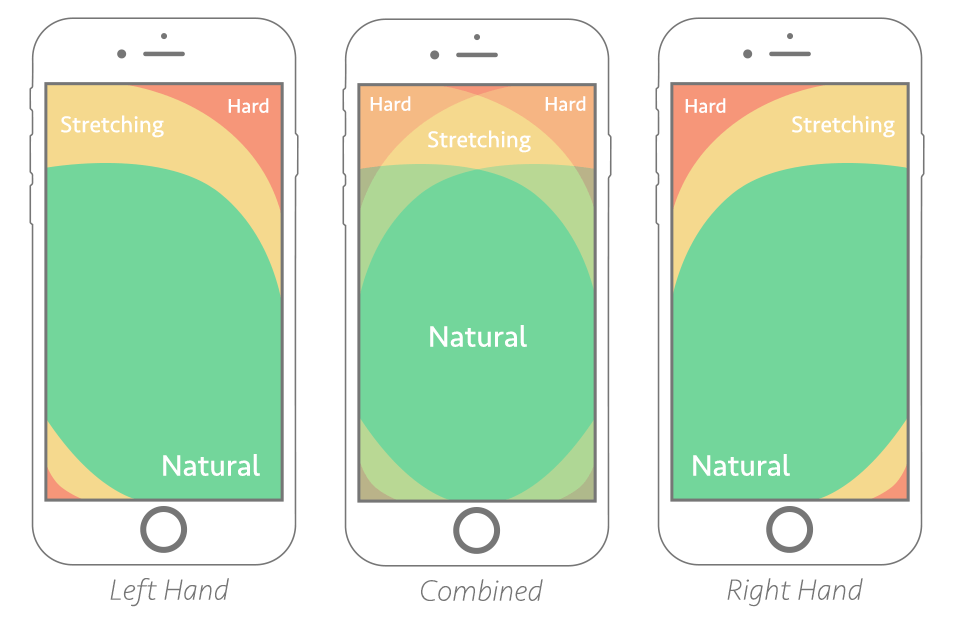
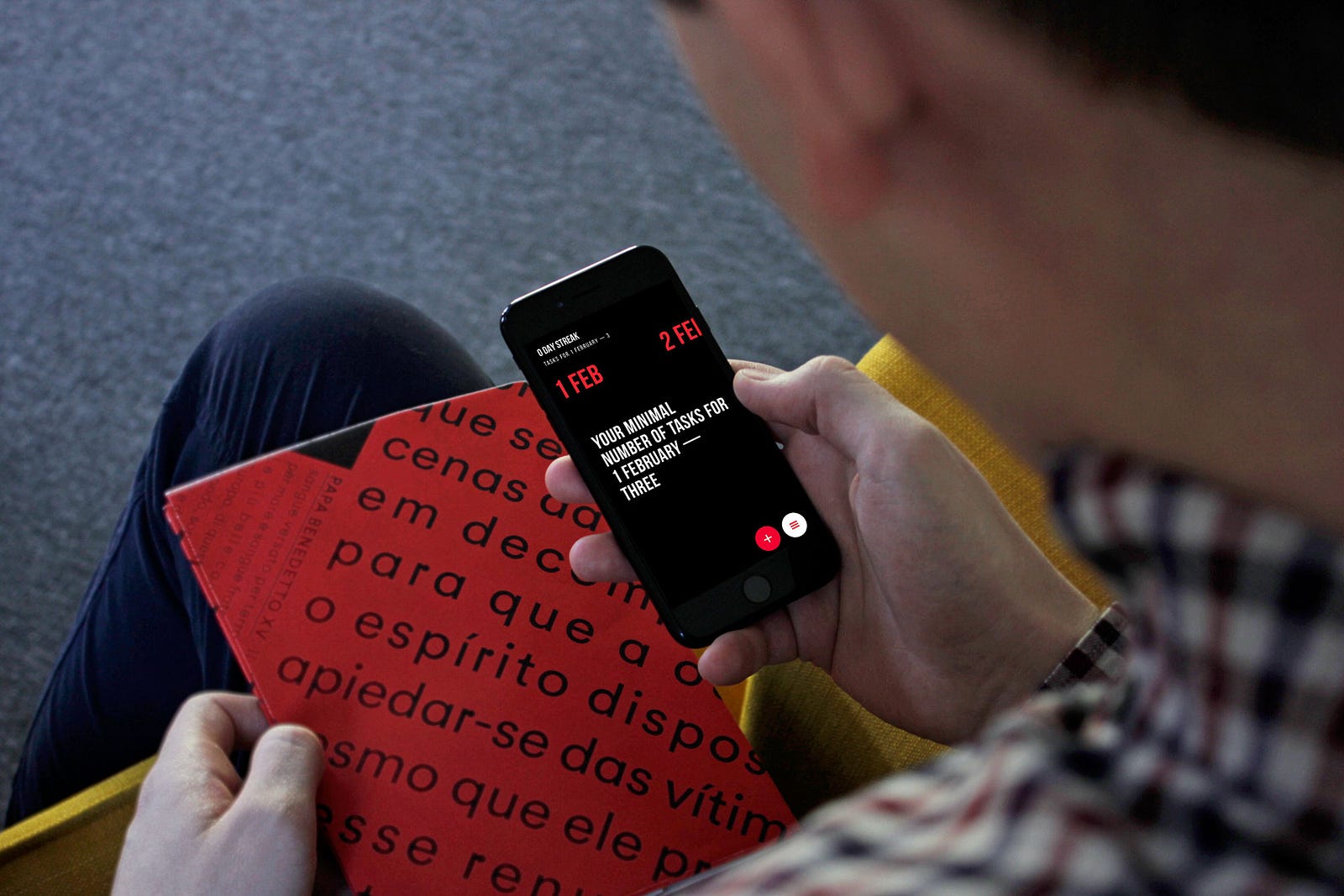
There
are three common types of holding a mobile. The first is when we take
it with one hand and navigate it with a thumb. Another way is to hold a
smartphone in one hand and interact with it with the forefinger of the
other hand. Also, the type which is common for chatting people is
holding a phone in two hands using both thumbs for actions. Of course,
there are other types of holds but these three are thought to be the
most common.

Considering
this fact, designers have to figure out if the layout elements placed
effectively for different holds. One-handed hold requires special
attention since it has the most limited space of reach. To make the
interaction process within a mobile app effortless it may be a good idea
to put the key components at the bottom of the screen so that users
would be able to reach tap areas easily. In addition, the interactive
elements should be big enough so there would be no chance for a mistap.
When
a new app can be used intuitively it means that the designer did a good
job. To provide intuitive interactions, UI design has to contain
recognition patterns. They are the elements which users are already
familiar with and those which give slight hints on how an app works. The
thing is that using an application we are expecting to see certain
things associated with the definite kind of product. For example,
working with e-commerce apps we are used to seeing cart icons along with
CTA buttons “Buy”. Familiar elements in a new app make people feel more
confident in their actions.
Users
become accustomed to things quickly and their absence makes them feel
uncomfortable. That’s why, if you plan to use custom interactive
elements, don’t forget to add some standard components. This way a new
application won’t overwhelm with an absolutely unfamiliar environment
and will help to learn quickly.

A
big pitfall of mobile UI design is small screens of the devices.
Designers have to figure out how to include all content in a short space
without turning user interface into clutter. Clean UI design helps
effectively interact with a product since all the core elements can be
easily reached.
To
create neat mobile UI it is recommended to use icons as interactive
components. Copy elements often can be too big for the small screen, so
icons are a sufficient alternative. They can explain a function
visualizing it with simple shapes and it helps to save the space on the
screen. However, during usability testing, it should be thoroughly
checked if the icons are perceived appropriately and transfer the right
message.
Decrease the number of actions
Probably,
many of us have the experience of using an annoying mobile app which
made us take a long way before we could finally accomplish the task. It
may often be caused by ineffective interaction system which employs too
many actions and the unnecessary functionality.
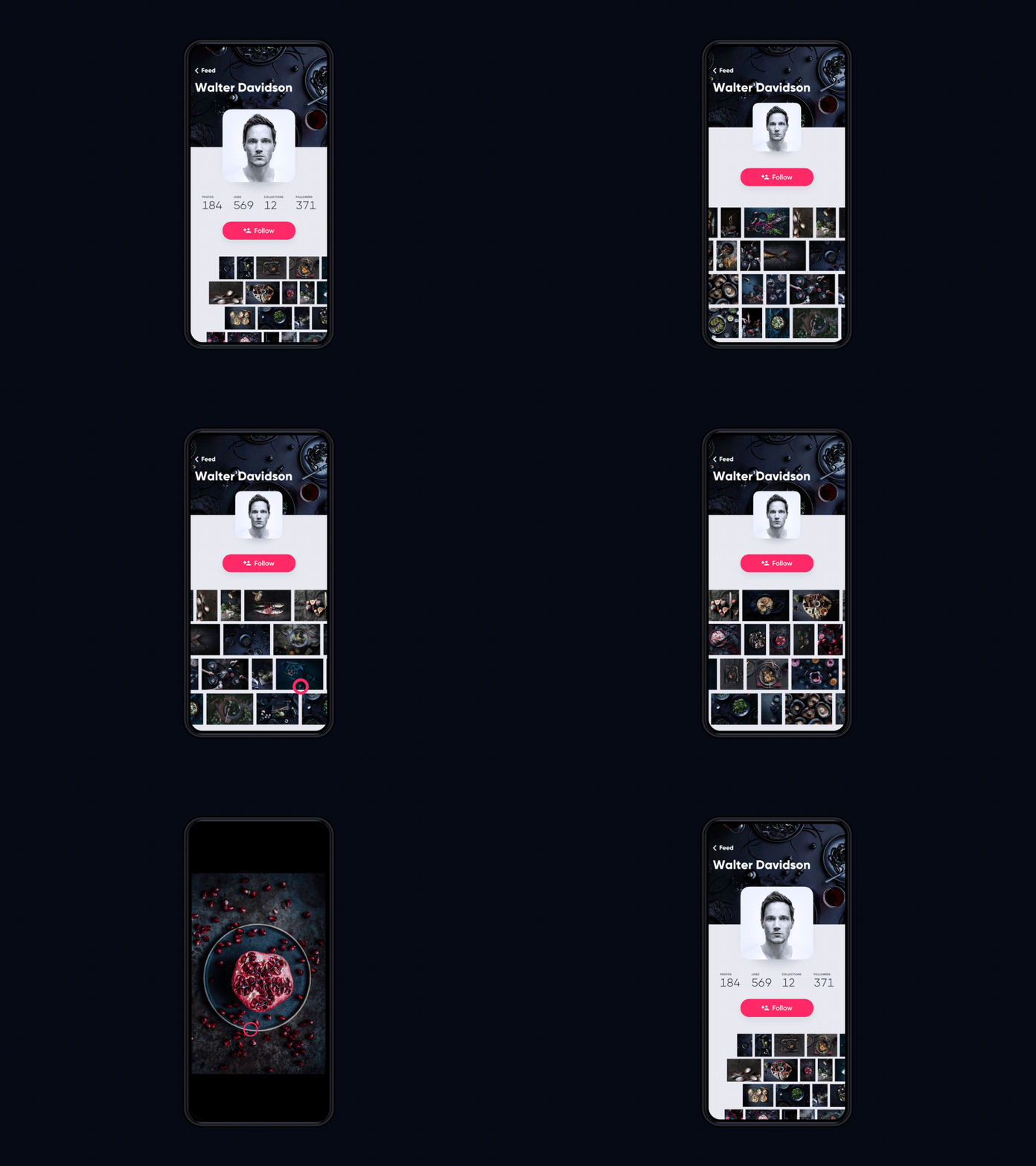
Mobile
apps usually serve as problem-solving assistants, so it’s vital for
them to be designed ergonomically. It means that designers have to apply
only core functional elements which will get the users right to the
point they needed. Minimum of actions won’t make your product look
primitive. It will help a mobile app be effective and pleasing in usage.
Remember that people mostly rate the quality of an application not by
extraordinary features but how helpful it is.
Based
on the facts described above, we can say that an effective mobile
interaction system should be simple and clear to use so that it could be
operated without problems.
However,
simplifying the interface it’s vital not make it boring. Apps which
seem ordinary have fewer chances to gain users’ attention. That’s why
it’s important to bring some emotional aspects into applications that
look standard at the first glance.
To
make the process interesting and catchy, it may be a good idea to use
gamification. It is the technique of exerting game mechanics into the
non-game environment like mobile applications. Various challenges and
leaderboards along with the awards and stickers motivate users to
interact with a product more and come back to it constantly.
What’s
more, implementing a game mechanic called a user journey is an
effective way to create clear layout and transitions. A journey is
user’s progression stages at the time of usage. Designers create UX that
way so that people could go step-by-step through the various features
which gradually change depending on needs of the target audience. An
approach helps to avoid problems with incomprehensible interactions and
functions.
Last
but not least, gamification adds the element of fun. Users enjoy
entertainment, challenges, and competitive spirit similar to video
games, so they are encouraged to go back. People always need some kind
of recreational activity so that they could escape from everyday routine
for a bit. By adding the fun element into a casual application, you
help to reduce some stress and relax for a moment.

Mobile
interaction design aims at creating a user-friendly product which will
be pleasant to use under different circumstances. But how can a designer
define if an app is usable enough and distinguish possible problems in
UX? This is when usability testing comes into play.
Usability
testing is an essential stage in creating mobile apps helping to
evaluate it by testing on the potential audience. It is usually
conducted at the UX building stage before a project goes to the
development team so that inefficient solutions could be changed easier
and faster.
Various
usability testing methods allow identifying problems and bugs and
quickly eliminate them. This way designers can improve all the aspects
of UX ensuring user satisfaction.
So,
before you deliver a project to the development team remember to handle
testing. Test it by yourself, on your colleagues, on the potential
users and then you’ll get the desired outcome.

A
simple mobile interaction system is not that easy to create. It
requires hard work, concentration and lots of practice before you
receive sufficient results. Stay tuned!

Note:
Some of these courses are free, but if you decide to purchase anything
(using the links below) you’ll be financially supporting the Personal
Growth publication. Thanks for your support.
This course combines4
different courses. As you participate in each of the courses you will
master Excel tools that will clear away the pain of stumbling through
your daily tasks. You will start with the basics, building a solid
foundation that will give you further knowledge as you progress into
intermediate and advanced level topics.
This
series of courses will help you build, develop and hone the essential
skills needed to improve your employability and advancement in today’s
dynamic workforce. The Specialization concludes with a project that will
give you the opportunity to integrate and apply the skills you have
gained throughout the courses to your individual and organizational
needs.
In this course you’ll learn the skills that make up the entire Product Managementjob and process: from ideation to market research, to UX wireframing to prototyping, technology, metrics,and finally to building the product with user stories, project management, scoping, and leadership.
This
comprehensive course is based on the innovative strategies of the
career management offices at the University of California at Berkeley.
Each module leverages cutting-edge research from top-flight
organizations like Harvard Business School, the McKinsey Consulting
Group, and Duke University.
You
already understand the basics of HTML and CSS, but you don’t
necessarily feel qualified for the web developer jobs you want. This
course will help bridge that gap. You’ll learn the modern skill-set that
companies are looking for in developers.
This
course provides 35-contact hours of project management education and is
taught by project management author and expert Joseph Phillips. If you
complete all the videos and interactive sessions, you can claim these
educational hours for your PMP exam application.
Whether
you are completely new to the job market, re-entering the workforce or
looking to advance your career, this course will empower you with the
knowledge and skills necessary to dazzle during your next interview.
This
course combines the essential elements of Project Management and Team
Leadership into one course. Through class engagement and reflection, you
will acquire further understanding of the responsibilities of
leadership and become better prepared to apply this knowledge to the
project environment.
Learn
the core concepts of business analysis to land a Business Analysis job.
If you are an aspiring Business Analyst or one that is new to the role,
this course can help lay the foundation you will build all future
knowledge and experience on top of.
This
course is built so that you can immediately use PowerPoint once you
finish the first section. It contains all the basic elements you need to
build and present your presentation. Following that section, each
section will get progressively harder until you become an expert.
Data
has become the hottest topic in technology and a company’s biggest
asset is their data. Oracle is the most popular relational database in
the world. This course will prepare you to be job-ready in just 1 month
of study and practice. You don’t need any prior experience in
programming.
Writing
a great resume for yourself will be the stepping stone that lands you a
job interview and you will want one that sets you apart from the rest.
In this course you will learn the tools and techniques which will enable
you to create a master piece resume for yourself.
Understand
how Access is constructed and how to use the major objects within it.
Be confident in moving around within Access and be able to build
effective database solutions for their unique data needs.
This
comprehensive complete career course is 12 hours, contains more than
250 lectures, 67 easy to complete exercises and 29 templates/other
downloads to help you get your dream job.
If
you want to get a Help Desk, Systems Admin, IT Support Specialist, or
other IT related job, this is the course you have been looking for. This
course will give you the critical skills necessary to succeed in the
Information Technology field.
This
course is designed for non-native English speakers who are interested
in advancing their careers in the global marketplace. In this course,
you will learn about the job search, application, and interview process
in the United States, while comparing and contrasting the same process
in your home country.
In
this course you’ll learn how play can (and should) inform your career
choice and steer you towards a career you love. You’ll explore how
personality and lifestyle can guide you towards the career that’s right
for you.
We
tend to think of life in terms of accomplishments, rather than
experiences. But life is meant to be live with the “goal” of being
present in the moment.
This
is how to live a meaningful life. Not by having goals and doing things
merely to reach those goals, but to live in awareness.
For the most part, society is distracted from this principle. Society tries to derive meaning through status, material wealth, and arbitrary goals.
Take the pressure off. Forget about your goals and plans and just be in the moment. Let each moment guide you.
This
isn’t about being undisciplined. That’s a different type of letting go.
This is about not trying to control everything. It’s about allowing
inner wisdom to guide you.
Goals
and plans are often disrupted by reality anyway. Having a general
direction makes sense, but details written in stone don’t.
I
didn’t have any sort of connection with the man sadly. I went though,
because it meant something to my Dad. I didn’t even go up to my
grandfather’s body to pay last respects.
I feel horrible for that in hindsight.
Even though the whole ordeal meant nothing to me, something happened at that funeral that I’ll always remember.
Some
man who wasn’t related to me in any way got up to speak about my
grandfather. He started slow, but then told a funny story about a time
when Mr. Kuegler played with him and his friends one afternoon.
He
said they were all acting like superheroes, or something, and that my
grandfather was the “bad guy” and kept trying to tie him and his friends
to a chair to “defeat” them.
But my grandfather was witty.
He
didn’t tie a knot at all with the ropes, but made it seem jussttt tight
enough to give the boys a little resistance/belief that they actually
did something to escape.
The man said that, since he was the “hulk,” he busted through the ropes every time and saved everybody else.
He
said he loved those afternoons, and that my grandfather would oblige
everybody and really spend some quality time making their dreams of
being superheroes a reality.
As
he got to the end of the story his eyes filled with tears. And then
mine did. And then he didn’t say much more and sat down in his chair.
I didn’t know who that guy was — I still don’t — but I’ll always remember that story.
The Time My Article Hit The Front Page of The Huffington Post
It was 4 AM in San Francisco.
I got back at 1 AM, but I couldn’t sleep a wink.
A
date I had with somebody went awry (what a great word), and I felt
terrible about it. I didn’t feel understood; I felt like life wasn’t
fair.
I wanted to take my brain out and throw it across the room, but sadly that would’ve killed me (making my situation even worse).
Then I thought about writing, remembering my laptop was two feet away, and I begrudgingly began typing at 4 AM.
I hit “publish” one hour later.
It went viral by the time I woke up at 9 AM, hitting the front page of the Huffington Post and everything.
Getting into the right mindset to create your best content of all time, however, IS.
It’s excruciatingly hard.
That’s
because not only do you have to be in the right mindset to tear through
a page, you also have to have something crippling happen to you.
Like the death of a loved one, or an existential crisis, or a moment where your best friend won’t even stick up for you.
All
of these moments are tough. They’re brutal. They dramatically throw
your world off-kilter and put your mind into some sort of “survival”
mode.
If you think about it, all of these moments end in a safety net getting ripped out from under you.
You
can’t replace a loved one. You can’t replace a best friend’s support.
You can’t easily revert back to the comfort you felt BEFORE an
existential crisis.
In short, things sort of need to happen to you in order to write something truly, truly profound.
To
be clear, you can write viral articles without having a loved one pass
away. You can write a best-selling book without having a loved one pass
away.
I’m not saying these things need to happen to write something good.
What I’m saying is, things similar to this need to happen for you to write the best words you’ve ever put on paper.
I’ll stand by that until I die.
And
if your “best” isn’t associated with any crippling event RIGHT NOW, you
simply haven’t lived long enough/tried hard enough to express what you
feel in these life-changing moments.
You need to try.
Not for the views, or the fans, or being remembered.
You need to try because your soul deserves to express itself.
There’s
a very particular song your heart sings in moments of dramatic
change — you owe it to yourself to put that feeling on paper.
It
will be your finest hour, and more importantly it will help you cope in
ways a conversation with a counselor, a best friend, or a parent
couldn’t replicate.
How A Disney Screenwriter Created A Scene I’ll Remember Forever
One
of the coolest things that ever happened to me was getting the
opportunity to interview Rob Edwards, the guy who wrote Disney’s Treasure Planet and Princess and The Frog.
In
“Treasure Planet,” Rob wrote a scene where a cyborg chef comforts the
main character and tells him, as well as he can, that he loves him.
It’s a scene I’ll never forget, and I always wanted to know the story behind it — how it was written and everything.
Rob told me it was the most difficult thing he’s ever had to write, and that he basically cried the entire time writing it.
Then he showed it to somebody and they both cried reading it.
When’s the last time something you wrote made YOU cry?
More
importantly, when’s the last time you had the guts to face an emotional
topic, begin writing about it, and play a game of literary chicken with
your heart when you’re five seconds away from publishing it?
It’s
been a long time for me personally. It’s hard to push yourself to these
extremes as a creative person, but oddly enough these extremes are
where we produce our best work.
Stop Being Scared Of What Everybody Is Going To Think About You
Perfect writing is often grounded in an act of defiance.
“Oh, I can’t talk about this? F*ck you.”
Exhibit A: The Declaration of Independence.
There’s a lot of things we as creatives can defy:
Caring about the opinions of others.
Our comfort zones.
Social norms.
Writing
about something that seems taboo/is terrifying to publish can actually
pull the best content we’ve ever written out of our souls.
When things get pent up, it’s only natural we have to blow off some steam at some point.
The
same is true for writing. Topics that slowly eat at our soul are the
ones we most need to write about. Oddly enough they’re the ones that
also do the best because we’re honestly, unequivocally inspired to
FINALLY write about them and let loose.
That’s a great recipe for writing something worth remembering.
The Best Thing I Ever Wrote
My
best work will never be published anywhere online. It lives on the last
page of a journal I filled out during an internship at Disney.
On that program I made lifelong friends, worked for the best company on the planet, and got to go to Disney whenever I wanted.
It was easily the best experience I’ve ever had.
On
my last day in the airport I decided to fill out that last page. I knew
I was leaving Orlando, a beautiful place filled with so much magic in
places you’d never expect.
I wrote about my friends. I wrote about how I was scared to go home. I wrote about why I loved the person I was writing to.
I cried in the middle of the airport.
Don’t be afraid to show your emotions.
I waited until the last day because I knew my emotions would run me over like a bulldozer.
Be
on the lookout for a writing window. Good writing can be created
whenever, but perfect writing can only be created once in a blue moon.
I sat in an airport, as a man, writing in a diary.
F*ck
your norms. Say that as many times as it takes. Something truly worth
remembering can’t be created/shown while holding on to your comfort
zone.
I
hope you all experience this perfect storm one day. When it comes, give
yourself to it and don’t ask any questions. It doesn’t matter what time
it is, where you are, or who you’re with.
There
is an appalling amount of real misery and suffering in the world. It is
not far away from us. It lies at our very doors. All of us need a
feeling of deep sympathy or sorrow for another who is stricken with
misfortune, accompanied by the strong desire to alleviate the suffering.
Let
your feelings be at hand, and feel and commiserate as soon as touched.
Let your tenderest feelings come in contact with the miseries of the
distressed as soon as ever they present themselves.
A
feeling of their sorrows and weaknesses. A benevolence, which excludes
no person, not even strangers or enemies, from its tender regards, which
disdains no condescension, grudges no cost, in its labors of love!
Inward pity and compassion to distressed objects, the most tender regard
to persons in misery, and such compassion as is free from all hypocrisy
and deceit is the need of the hour.
The heart, even more than the brain, determines you.
Real
strength or weakness is closely linked with moral nature. One may have
the beauty of Venus and the charms of Cleopatra, and another the figure
of Adonis and still be void of “good” manners. Stand by the weak and
defenseless. There is no nobler feature in anyone’s character than a
determination to do this.
There
is no good in a sour, misanthropic temper. None in rudeness, stiffness,
and repulsiveness. None in violating the rules of good breeding.
Compassion
prompts us to do good to all, to forget all national or sectional
distinctions, and to aid all those who are in circumstances of poverty
and want. It would be the most lovely and desirable principle on earth,
and all, especially in their early years, should seek it. Nothing that a
young person can gain will be so valuable as the feeling that regards
all the world as one great family, and to learn early to do good to all.
Be even to thy enemy in distress as kind, humane, and merciful. Let a
young person have a large mental capacity, it will not weigh for much if
that be all.
Compassion Heals.
All
who are afflicted know how much it diminishes their sorrow to see
others sympathizing with them. How sad would be a suffering world if
there were none who regarded our griefs with interest or with tears! It
would be miserable if every sufferer were left to bear their sorrows
unpitied and alone and if all the ties of human sympathy were rudely cut
at once, and people were left to suffer in solitude and unbefriended.
We
owe sympathy to others because it is an effective means of contributing
to their moral perfection, and because by withholding it we inflict on
them a grave moral inquiry. We are tenderhearted or compassionate when
we feel affection for someone else, when we look beyond our pain to see
the pain of others. It not only lessens the misery of humanity but also
unites humans to each other as to make them responsible for the good and
comfort of one another.
While
we differ in “opinions”, we should still treat each other kindly, that
we should aid each other in necessity. A good thing done 3,000 years ago
works now, and will work through all endless times and years. No good
effort has ever been lost, or ever can be.
The
amount of bad writing advice out there is astounding. People who have
never published anything selling courses on how to make a career as a
writer. Terribly written Medium articles telling you how to improve your
prose. Marketing books from writers who not only haven’t sold many
books — but their own marketing books don’t sell. All this bad advice
adds up and makes a harder thing — an already difficult industry to
navigate — even harder.
Over the last year, I’ve been lucky enough to interview some of the best writers on the planet for WritingRoutines.com. It was the opportunity of a lifetime to be able to ask Pulitzer Prize winners, #1 New York Times
best-selling authors, brilliant novelists, talented journalists and
expert communicators about how they practice their craft. I got valuable
lessons from each one. I’ve collected a few of the best below,
alongside some of the insights — or hacks as we call them today to get
more people to click — from writers I wish were still alive to interview
or ones I wish to interview someday if the opportunity presents itself.
I hope you learn as much from them as I did. Enjoy!
***
Devote Yourself to Someone Greater First
“If
I am asked today to advise a young writer who has not yet made up his
mind what way to go, I would try to persuade him to devote himself first
to the work of someone greater, interpreting or translating him. If you
are a beginner there is more security in such self-sacrifice than in
your own creativity and nothing you ever do with all your heart is done
in vain.”
— Stefan Zweig, author of The World of Yesterday and in the 1920’s and 1930’s was one of the most popular authors in the world
Wake Up Early And Read, Read, Read
“I
wake up around 5am. I have 2–3 cups of coffee. I read and read and read
for two hours. I read high quality literary fiction to be inspired,
high quality non-fiction about a topic I am fascinated by in order to
learn, I read inspirational or spiritual writing to feel that special
something inside, and often I will spend some time studying a game. Then
I might read the literary fiction some more. At some point, I get the
urge or the itch to put the books away. I go to my computer and start to
write.”
“It
was a time everyone was pressing wonderful houses on us. ‘I have a
perfectly marvellous house for you to write in,’ they’d say. Of course
no one needs marvellous houses to write in. I still knew that much. All
you needed was one room. But somehow the next house always beckoned.”
— Budd Schulberg, author of What Makes Sammy Run? and the Academy Award-winning screenplay for On the Waterfront
Edit Ten Times
“I
repeatedly edit it many times, at least ten. I just keep on doing it,
until I can’t think of further improvements. I can’t say that is a
process in any formal sense, simply a recognition that the “process” to
date hasn’t worked very well and so it must continue. I don’t pretend
this is efficient.”
— Tyler Cowen, economics professor, author of Average Is Over and contributor to the New York Times, Wall Street Journal, Newsweek and many other publications
Nobody Gets Talker’s Block
“No
one ever gets talker’s block. No one wakes up in the morning, discovers
he has nothing to say and sits quietly, for days or weeks, until the
muse hits, until the moment is right, until all the craziness in his
life has died down.”
— Seth Godin, New York Times bestselling author of Purple Cow and more than 20 other books
Do the Three Passes of Editing
“[My
editing] rests on three passes. The first pass is when you write the
best chapter you can. The second pass comes later once the whole book
(or whole part of the book containing the chapter) is done. During this
pass, I come back to the chapter on my computer and cut and tighten. The
final pass is when I read through a printed version of the chapter on
paper. Reading on paper is necessary if you’re going to root out odd
constructions or minor errors.”
“The
way out of this mess is through. A friend of mine who used to do
long-distance running gave me some advice on dealing with pain as a
writer. “What do you do about the cramps?” I asked. I was noticing they
hit my in the gut usually at the three or four mile mark. I thought he’d
have some great advice on how to avoid them altogether. In fact, I
assumed this was the case. His answer surprised me, though. ‘Cramps?
What do I do? I keep running, and eventually they go away. I run through
the cramps.’ What do I do when I feel blocked? I write through the
block.”
“I’m
an “absolute quiet” kind of person. If I’m writing at home, and there’s
any noise at all, such as my wonderful hubby puttering around and
coincidentally clearing his throat, I wear my Peltor Sport Ultimate 10 Hearing Protector Earmuffs.
I’m so used to them that when I need to concentrate, I put them on even
when there isn’t any noise. Earmuffs are like a signal to my
brain — Okay, focus! On planes, I often wear noise canceling
headphones.”
“It
really depends on the genre of work I’m doing–I always try to keep
models in mind, though the model will change depending on what I’m
working on. For the book on Cato the Younger, Jimmy Soni and I were constantly referring to Tom Holland’s book on the Roman Republic, Rubicon; for our book on Claude Shannon, to James Gleick’s The Information and Sylvia Nasar’s A Beautiful Mind.For my academic work, people like Danielle Allen are great models.”
“Don’t
lament so much about how your career is going to turn out. You don’t
have a career. You have a life. Do the work. Keep the faith. Be true
blue. You are a writer because you write. Keep writing and quit your
bitching. Your book has a birthday. You don’t know what it is yet.”
“Writer’s
block is miserable and part of it can be just being in a really bad
place. Sometimes if you’re just in a bad mental place, it doesn’t matter
what work you put in. You have to fix bigger things than your writing.”
— Hari Kondabolu, the comic who the New York Times called “one of the most necessary political comedians working today.”
Get a Giant Sketchpad
“Notebooks
have always been big for me, both in the early stages of a new project
and as a way to get myself unstuck if I’m struggling. But I have giant,
chicken-scratch handwriting, and would always end up jotting down
thoughts over half a dozen pages and then never really looking at them
again. I have probably fifty illegible notebooks sitting in desk
drawers, and I would easily have filled fifty more had I not been
introduced to the most elegant solution by a friend, the author Ashley
Cardiff: A sketchpad. A 9-by-12-inch artist’s sketchpad. This has been
my great revelation. It’s unlined so I can read my bad handwriting and
large enough that I can group several ideas together on the same page.
Plus, it gives me an excuse to buy fancy mechanical pencils.”
— Liana Maeby, author of South on Highland, which actor/writer BJ Novak called “the kind of book kids will steal from each other.”
It’s All Material
“I’m
never not working on material. Every second of my existence, I am
thinking, ‘Can I do something with that?’” [By the way, this advice echoes a phrase I’ve learned from author Robert Greene,
“It’s all material.” Meaning everything bad that happens, everything
frustrating or delayed or disappointing — all of it can be fuel for a
book. It can teach you something that helps you improve your business,
it can become a story you pass along to a friend.]
— Jerry Seinfeld, creator of Seinfeld and named by Comedy Central the “12th Greatest Stand-up Comedian of All Time.”
Understand How the Pieces Fit Together
“To
write a clean and fluent piece of any kind, you have to understand how
its various parts fit together — how a change here will affect something
over there. With a short piece, you never lose sight of the whole
because you can read and reread it many times as you work. That’s what I
do. I make a change and then I read the whole piece to see how it
works. But I can’t do that with a book, so I have to find other ways to
stay oriented. I reread or skim sections of the book that I know relate
to the part I’m working on, I keep notes about the larger structure, and
I use Word’s phrase-search function to move around and check up on
things. I also make a huge effort to commit as much of the book as I can
to memory. It’s exhausting and it seems psychologically damaging in
some way, but it helps me to understand when jokes need to be repeated,
how much space needs to intervene between similar kinds of scenes, how
ideas should be patterned, etc.”
— Aaron Thier, author of Mr. Eternity and recipient of a literature fellowship from the National Endowment for the Arts
Run to Keep Yourself Sane
“The
twin activities of running and writing keep the writer reasonably sane
and with the hope, however illusory and temporary, of control.” [This is
not unlike many other writers — including Murakami and Malcolm
Gladwell — who use running as a coping mechanism.]
— Joyce Carol Oates, author of over 40 novels, including Them, winner of the National Book Award
Before You Write, Crystallize Your Thinking
“If
I’m just starting, I never consider the page blank. I’ve been writing
in my head long before I sit down at the keyboard. In fact, I sometimes
start inadvertently, by describing to someone what I’m doing.
Conversation often crystallizes my own thinking far more effectively
than solitary reflection. When I put the first words down, I know
they’re likely to change, which I find liberating — no need to get it
perfect the first time. But I want the first sentence to set a tone or
indicate a theme for that chapter, so I have to start with a clear sense
of the meaning of the events that follow, and how I want the reader to
feel.”
“Don’t
start writing the play at once, but get a little notebook and put down
everything you think about your play in the notebook, just as the ideas
come to you without rhyme or reason especially. Let the play accumulate,
as I call it; let it percolate and stew in your mind; and write down
any ideas, bits of dialogue, descriptions, words — anything you think
you might be able to use. Many of these things will come to you
unconsciously while you are walking home from school, bathing, mowing
the lawn; be sure to get them all into your notebook.”
— E.P. Conkle, professor emeritus of drama whose plays have been produced on Broadway
Take the Necessary Medicine
“I
tend to edit heavily and repeatedly as I go along, so I don’t make the
distinction, at least by myself. For the books that I’ve written for a
larger public, however, I’ve had the help of an immensely gifted editor
(Alane Mason, at Norton), so there I do separate out the tasks: in
effect my own writing/editing; and then a further editing after
receiving her suggestions. I tend to hate the latter experience, though I
recognize that it is almost invariably good — a bit like swallowing
disagreeable but essential medicine.”
“When
I have writer’s block it is because I have not done enough research or I
have not thought hard enough about the subject about which I’m writing.
That’s a signal for me to go back to the archives or to go back into my
thoughts and think through what it is I am supposed to be doing.”
“What
am I trying to say? What words will express it? What image or idiom
will make it clearer? Is this image fresh enough to have an effect?”
Then finish with these final two questions: ‘Could I put it more
shortly? Have I said anything that is avoidably ugly?’”
“Writers
are usually encouraged to write a “vomit draft” and just get something
out, however terrible it is, in order to overcome The Fear, get some
momentum, and move to more of an editing mindset, where’s it’s less
scary to make progress. I don’t do that. I think that’s just a trick to
try and lower the stakes so you can overcome procrastination and The
Fear. And while it’s good for that, I think it’s bad in the long haul
because you’re producing a lot of junk and that’s going to be hard to
fully clean up. I treat writing a lot more like architecture. You
wouldn’t work without a blueprint, construct a crappy building, then
knock it down and build a better one. That would be ridiculous. You’d
put together a really tight blueprint, then construct the building once,
the right way, and if it needs tweaks, they’re relatively small. As the
old saying goes: ‘Measure twice, cut once.’”
“Never
stop when you are stuck. You may not be able to solve the problem, but
turn aside and write something else. Do not stop altogether.”
— Jeanette Winterson, a two-time winner of the Lambda Literary Award and author best known forOranges Are Not the Only Fruit, which was adapted into a BBC drama
You Don’t Need to be Kissed by a Muse
When
asked if writing comes easy: “Haha, no, I’ve not been kissed by a muse.
For me, writing is a craft that needs constant honing.”
“I’ve
got a theory that most writers are either frustrated musicians or
painters — and which of them you are depends on whether you write for
the ear or the eye. As a former musician and former speechwriter, I
definitely write for the ear. I listen to music all the time for
inspiration and energy. I tend to make playlists as the sound track for
writing different books. They serve as snapshots in time. So, I’ve got
one for Wingnuts — lots of The National, Drive-By-Truckers, Radiohead
and Randy Newman — and one for Washington’s Farewell that’s more
classical, jazz, the Americana series by Chris Thile, Yo-Yo Ma and Edgar
Meyer and the soundtrack to Hamilton.”
“I
try to imagine comments, questions, and criticisms that the book will
generate. Then I try to rehearse the reply or answer. My friends are
great critics of my writing and I always make sure they have read the
drafts and galleys and been brutally frank with me about their
reactions. They know I can take it.”
“I
remember Salman Rushdie telling me how he gives it the first energy of
the day. As soon as he gets up, he goes to his office and starts
writing. He’s still in his pajamas. He believes there is a “little
package of creative energy that was nourished by sleep,” and he doesn’t
want to waste it. He works for an hour or two and then goes to brush his
teeth. I have a very similar approach. Only I brush my teeth before I
start. I guess that’s my pre-writing ritual.”
— Cal Fussman, best known for the “What I’ve Learned”Esquire column and a master interviewer who has talked to the likes of Mikhail Gorbachev, Muhammad Ali, John Wooden, Richard Branson