Recognize you have control of this, if nothing else — Michael Marcus Jan 10 By JESHOOTScom on Pixabay I rem...
Business
5/Cars/feat-tab
Search This Blog
Author Details
Templatesyard is a blogger resources site is a provider of high quality blogger template with premium looking layout and robust design. The main mission of templatesyard is to provide the best quality blogger templates.
The Best Way to Find It Might Be to Stop Looking for It.
A
few years ago, I got sick. Death was a real possibility — at one point,
I prepared for the worst. But after three weeks in the hospital, some
life-changing surgery and a whole load of morphine, I emerged — stick
thin, balding, and jaundiced, but alive.
My
response to this experience was rather cliched. The brevity of my
existence became sharply apparent. I cursed myself for wasting my youth
getting wasted and playing video games. At one point I may even have sworn to “live life to the fullest”. I was determined to discover my life’s purpose and meaning.
After all, we’re all supposed to have a purpose. Life is supposed to have a meaning, even if we don’t know what it is. Like Nietzsche said:
“He who has a why can bear almost any how.”
The trouble was, I was never sure what “meaning” meant. Douglas Adams perfectly captures this problem in The Hitchhiker’s Guide to the Galaxy.
To find an answer to the “Ultimate Question”, an alien race build a
supercomputer. After working on the problem for 7.5 million years, the
computer offers the nonsensical solution “42”. You don’t understand the
answer, the computer suggests, because you never understood the
question.
The World Has No Plan For You
For
existentialists like Jean-Paul Sartre, the Ultimate Question of the
meaning of life has no fixed answer. Sartre sets out his concept of
meaninglessness in Existentialism is a Humanism. An object like a chair is created with intention — its purpose, to be sat on, is integrated into its design. Its essence precedes its existence.
Humans aren’t like this. If we begin with the proposition that there is
no God, then there’s nothing to suggest we are created with any purpose
in mind. Our existence precedes our essence — we are created first, and find purpose later.
So the meaning of a chair is something created to be sat on. What’s the meaning of me?
How can the world make use of me? The psychologist Paul TP Wong
approaches this question from the same starting point as Sartre but at a
more clinical angle. Wong calls his model of life purpose “PURE” — Purpose,
Understanding, Responsible Actions, and Enjoyment/Evaluation. Get these
four things nailed down, Wong says, and you can live a meaningful
existence.
The
first requirement of Wong’s PURE model is to find a purpose — choose a
life goal. When I recovered from my illness, I set about trying to find a
new vocation. I’d only ever held low-paid, low-status jobs before then;
none of which I’d really cared much about. So I started scrabbling
around for something resembling a purposeful career.
First
I thought I might be a social worker, but the training was impractical.
Then I decided that I was destined to become a teacher, but I failed
the initial application. Then I commenced my training as a therapist. I
tried to persuade myself that I’d finally found my calling.
Your Job Might Not Be Your Purpose
Psychiatrist
Viktor Frankl was a man who found a great deal of meaning through his
work — despite enduring some of the worst circumstances imaginable.
Separated from his family and imprisoned in Auschwitz, Frankl survived
the horrors of the Holocaust by maintaining a sense of purpose. Frankl
attributes his remarkable ability to cope with the concentration camp to
having found deep meaning in his work as a psychiatrist to his fellow
inmates.
In his book, Man’s Search for Meaning, Frankl says:
“Everyone
has his own specific vocation or mission in life; everyone must carry
out a concrete assignment that demands fulfillment.”
My
own work as a therapist, in incomparably easier circumstances than
Frankl’s, was engaging and highly rewarding. But somehow it didn’t
provide me with the meaningfulness that I craved. I yearned to be
successful at something, and being a therapist was the thing that I had
decided I would succeed at. This, I believed, would provide me with a
sense of purpose.
Looking
back, I believe that my method of finding meaning through work was a
naive approach to the problem. Frankl would certainly agree. He says
elsewhere in his book:
“Don’t aim at success. The more you aim at it and make it a target, the more you are going to miss it.”
If
I choose to derive my entire life’s purpose from my job, or from
success in my field, what will happen if I don’t succeed? If my purpose
in life is to climb mountains, what will happen if an accident renders
me unable to walk? There are stories of people who find a way to
succeed, even in seemingly impossible circumstances. But we don’t hear a
lot about those who fail, through no fault of their own.
If
you attach your sense of purposefulness to a particular set of material
circumstances, you’re in danger of losing all the meaning in your life
if those circumstances change. This is not a purely hypothetical
proposition. Rates of depression among the long-term unemployed are twice as high as those among people in work.
Meaning As a Feeling
How
would I have known when that search for meaning in my life was
complete? What would meaning look like once I’d found it? Meaningfulness
is such a broad and abstract concept. Is it actually possible to define
something so vague?
Albert
Camus believed that discovering or creating meaning in life is
impossible. All that we can do is find the things that make our lives
worth living — and what makes life worth living is a matter for each of
us. In his essay The Myth of Sisyphus, Camus
considers a man who is cursed by the gods to undertake a meaningless
task for eternity. Sisyphus must continually roll a stone up a hill.
Each time he reaches the top, the stone rolls back down and Sisyphus
must begin again. Sisyphus, once he has resigned himself to the
absurdity of his fate, can live this meaningless existence with
happiness and contentment.
I
eventually stopped trying to find a purpose by clambering around the
job market. That’s not to say I settled down — I’m now training as a
lawyer. Every time I’ve managed to get my stone to the top of my hill,
it’s rolled back down and I’ve started again.
The purpose of life isn’t to get the top of the hill and wait around until you die.
Confucian philosopher Tu Wei-Ming says:
“We can realize the ultimate meaning of life in ordinary human existence.”
Meaning
can come from some unexpected places. For me, it’s the feeling of
profundity that comes when I have a direct experience of life. This
feeling is not exclusive to extraordinary circumstances. It’s not only
found when skydiving over the Grand Canyon, or swimming with dolphins.
It can be provoked by something completely trivial.
I
remember first noticing this feeling when I was watching a group of
birds take off outside my apartment. It might come from drinking a cup
of coffee, or joking around with my wife. And purpose, too, can be felt
in the everyday — giving my daughter a bath. Cleaning the house.
Camus
might have laughed at the absurdity of calling this feeling “meaning”.
But sometimes everyday occurrences feel meaningful in their
significance.
You may imagine that your purpose waits for you at the top of the hill. But perhaps it will come to you on the way up.
Extracting lifelong lessons from the world’s favorite sport
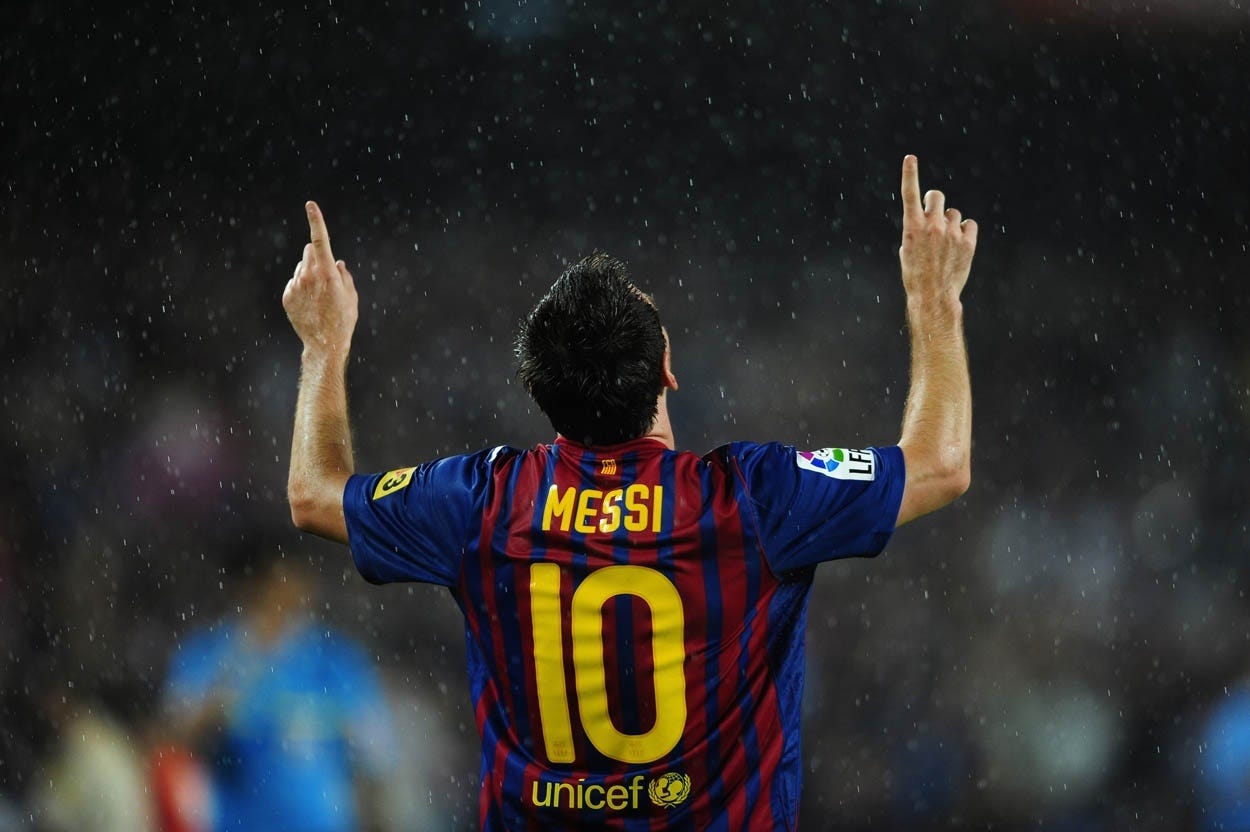
№10 is one of the most coveted jersey #’s in the game
With
an estimated 3.2 billion spectators tuning in to the last FIFA World
Cup, the sport has earned the right to be called a global phenomenon.
Now, with the next world cup just around the corner, I wanted to take a
moment to reflect on the invaluable life lessons I learned through
playing ‘the beautiful game.’
Those
who hate soccer (🇺🇸) see a bunch of grown men chasing down a ball -
but for those who cherish ‘the beautiful game,’ they see a test of
endurance, athleticism, emotions, and strategy in what I call ‘real-time
chess.’
Indeed,
fútbol is a nuanced sport, requiring physical and mental resilience,
spatial intelligence and the ability to think several steps ahead of
your opponent. Therefore, one’s play style is very much a window into
their psychological makeup — beyond how fast someone runs or how
accurately they can shoot, the decision-making and thought processes
behind their actions are largely rooted in their personality. To play
against someone then is equally a mental battle as it is a physical one.
Its
always interesting to see how everyone makes the worldwide game their
own on an individual, team and country-wide level. Typically the
Brazilian culture play with lots of flair, emphasizing dance-like
control over the ball, while Germans play technically and concisely,
with few redundant or unnecessary movements.
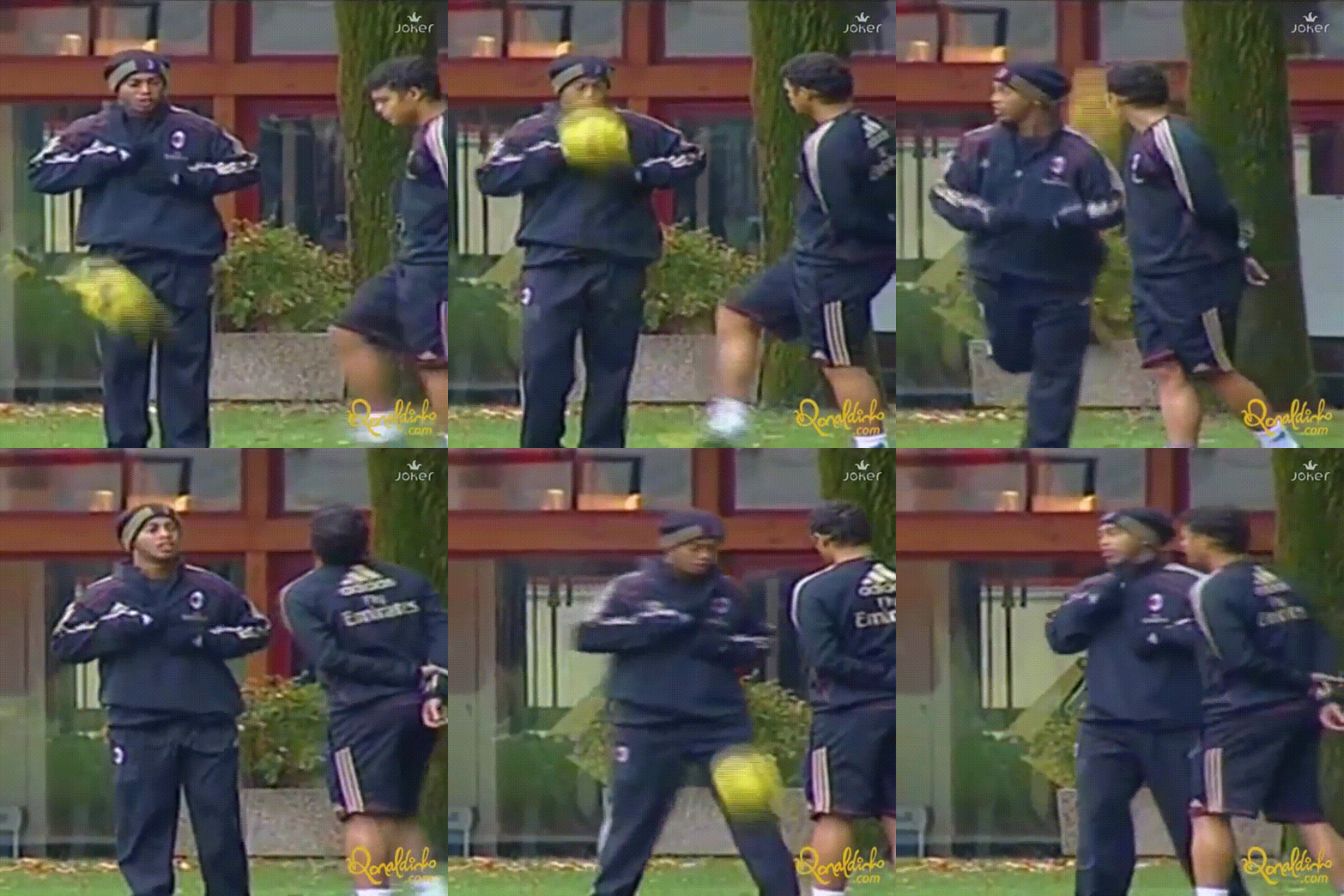
Ronaldinho casually performing his trademarked sorcery
Having
grown up with the sport, a ball at my feet feels like a natural
extension of my body, much like a paintbrush does for a painter, or a
vinyl for a DJ. As a kid, I modeled my play after Ronaldinho, who’s
command of the ball is arguably the best in the history of the sport. I
aspire to mimic just a fraction of the magic he produces.
Throughout
my time experimenting with different positions to find my natural fit,
I’ve learned a thing or two about the sport. These lessons not only
stuck with me as in my athletic development, but have actually poured
over into my career, personal life, and just about everything I do. So
without further ado, here are 10 Lessons Playing Soccer Taught Me About Life.
1. Strike with conviction
We’re
taught to shoot with our toes pointed downwards, running through the
ball with our laces and making sure to follow through with the motion.
The form has to be confident and composed.
To
go for (your) goal, you have to be true to your efforts; if you don’t
believe in yourself to hit the target, you never will. Its all about
timing, positioning, power, precision, finesse and form — things that
can easily take shape in any of your life’s endeavors and, if you’re
truly conscious of and use them effectively, will get you to hit more of
your goals through practice. Think of how and where these tips can
apply to your personal life.
Timing — what
tasks should I be prioritizing? When should I schedule my posts,
emails, meetings, interviews? When is the best time to do X, so that I
can achieve Y?
Positioning — am
I where I want to be right now? If not, how can I get there? If so,
where do I want to be next? Am I playing ‘off the ball?’ (see #2).
Power — how much passion and energy am I bringing to my work? Am I being aggressive or assertive?
Precision — how focused am I? Are all of my endeavors aligned? Am I channeling my power correctly?
Finesse — have
I paid attention to the details? Have I put in the minimum amount of
work needed to obtain the maximum result? (Think: 80/20 rule.)
Form — have I perfected areas in life that demand attention? Are the things I’m supposed to know like muscle-memory?
Zlatan Ibrahimovic always strikes with conviction
2. Play Smart Off the Ball
What
most people don’t realize about soccer is that the game is played
almost entirely off of the ball. With 22 players on the field, and the
ball at the feet of only one person at a time, the chances for any
individual to hold possession is low.
But
just because you don’t have the ball doesn’t mean you don’t have a job
to do. Positioning is critical for off the ball play, since you want to
make it easier for your teammates to progress up the pitch when they’re
met with resistance. It’s about optimizing your movements to put you in a
better position to receive a pass, play the ball out of danger, make an
assist or score a goal.
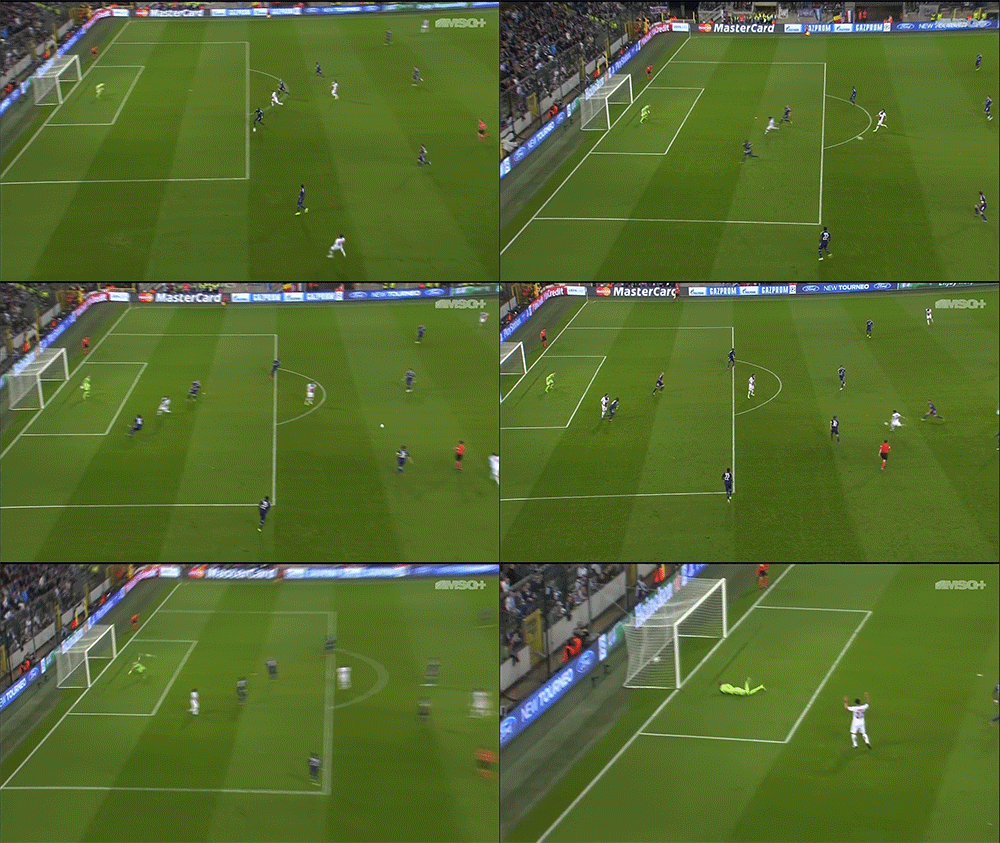
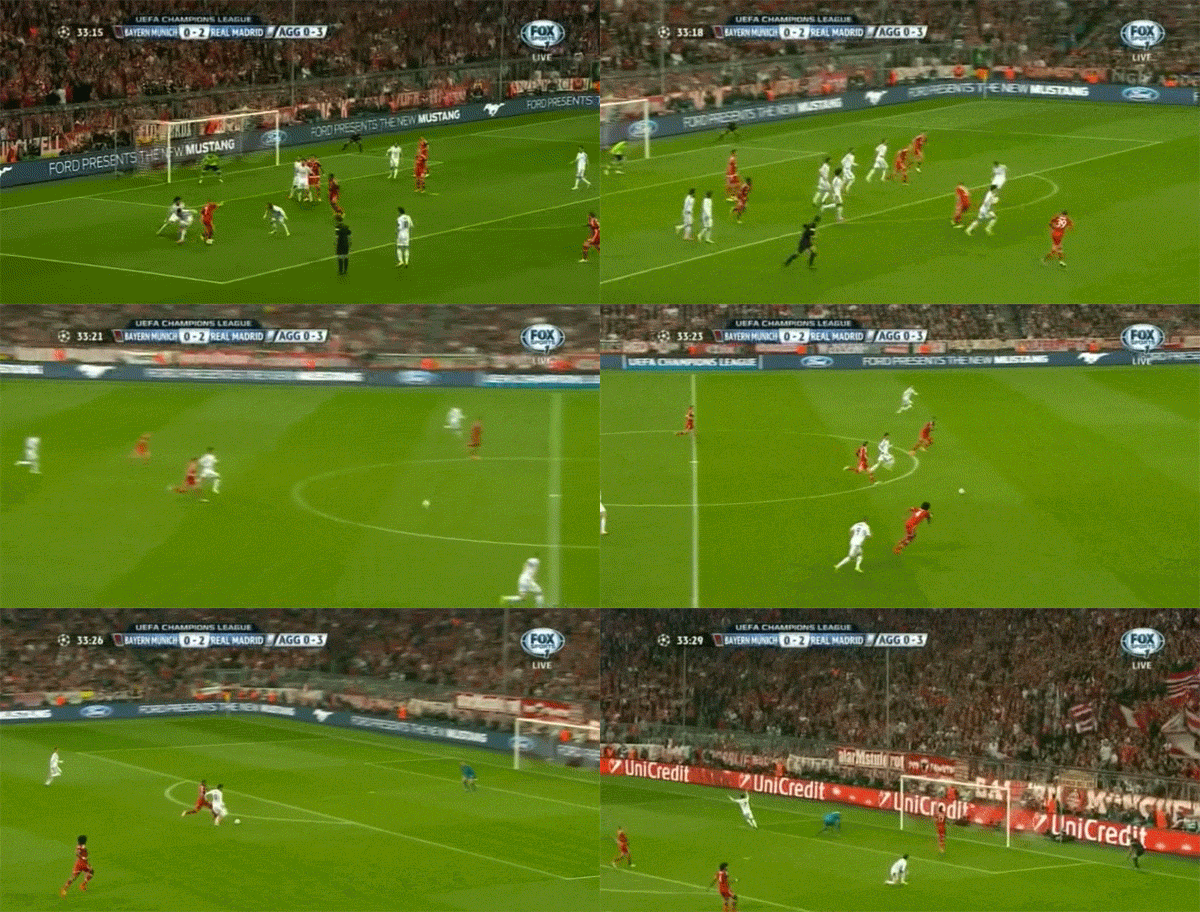
Real
Madrid displays its hallmark counter-attack style of play. Notice how
well the players positioned themselves by finding open space to help
move the ball forwards and find a scoring position
How are you playing off the ball?
If
you’re an athlete in general, you have to train at the gym, get enough
sleep and intake optimal nutrition to maintain a competitive advantage.
If you’re a blogger or musician, its not enough to create content, you
have to learn the ins and outs of social media and promote your work
effectively. If you’re a freelancer and just made your first sale,
‘follow through with the motion’ and reach out personally to make sure
they’re enjoying their purchase. If you’re a business owner, you can’t
just be good at the industry, you have to constantly network, crunch
numbers and do the rest of the *business* aspect of your business.
Learn
the ‘optionals’ and ‘nice to have’s’ of your trade to positively impact
the more immediate aspects of your work. The key is to allocate some of
your attention to the less obvious but equally as important tasks, even
if they seem indirect to your overall progress. Be well-rounded, and
commit to the same work ethic ‘off the field’ as you do on it to ensure
your progress.
3. Sometimes You Have to Move Backwards to go Forwards
Soccer
is predominantly a game about stealing space from opposition. The less
space your opponents have, the closer you are to their goal and the more
likely you’ll have a better shot on target. But in order to progress up
the field to get a chance at scoring, you first have to maintain
possession of the ball.
Sometimes
the best option is to take a step back and recalculate your plan. If
you’ve ever performed an exercise at the gym with the wrong form, you
first had to unlearn the improper form to approach the workout again
with the correct one. Sometimes when switching jobs you have to accept a
lower position to find yourself in better company and with more
opportunities. To turn bad habits into good ones, its easier to slowly
weed yourself off of the negative first instead of going for the
immediate swap and attempting a 0-to-100 overnight transformation.
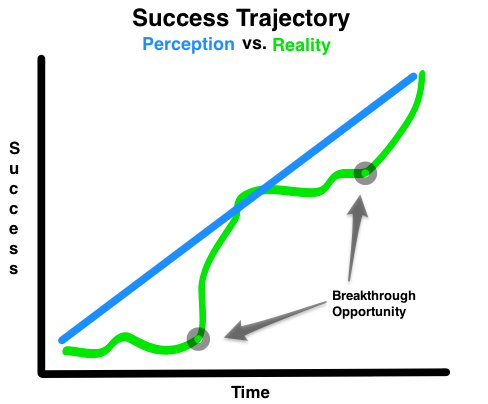
Success
is never a consistently linear path with an upwards trajectory. If
you’ve ever felt like you’ve been moving backwards while conscientiously
trying to make progress, just know that moving backwards is a natural
progression of progress itself.
4. Develop Your Own Style
The
beauty of soccer is that no one body type excels over another. Unlike a
sport like basketball where you have a significant advantage the taller
you are, if you look at the elite soccer players, you won’t notice a
definitive body type that excels at the sport. Sure, it helps to be
stronger, faster, have more stamina, jump higher, but its ultimately how
you play the game and what you can contribute to the team more than it
is any one of the aforementioned traits.
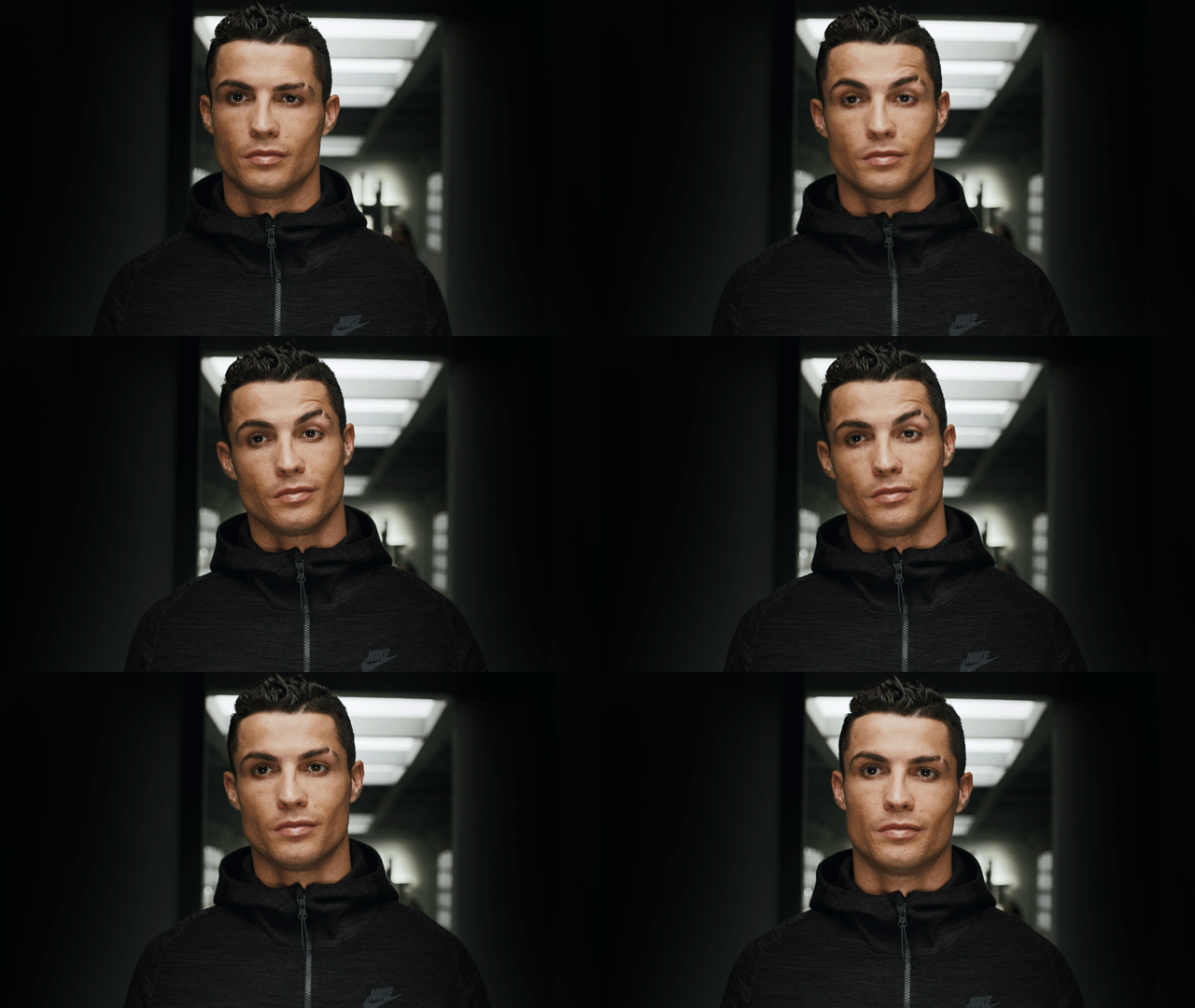
Its
obvious that all players have their own unique makeup when it comes to
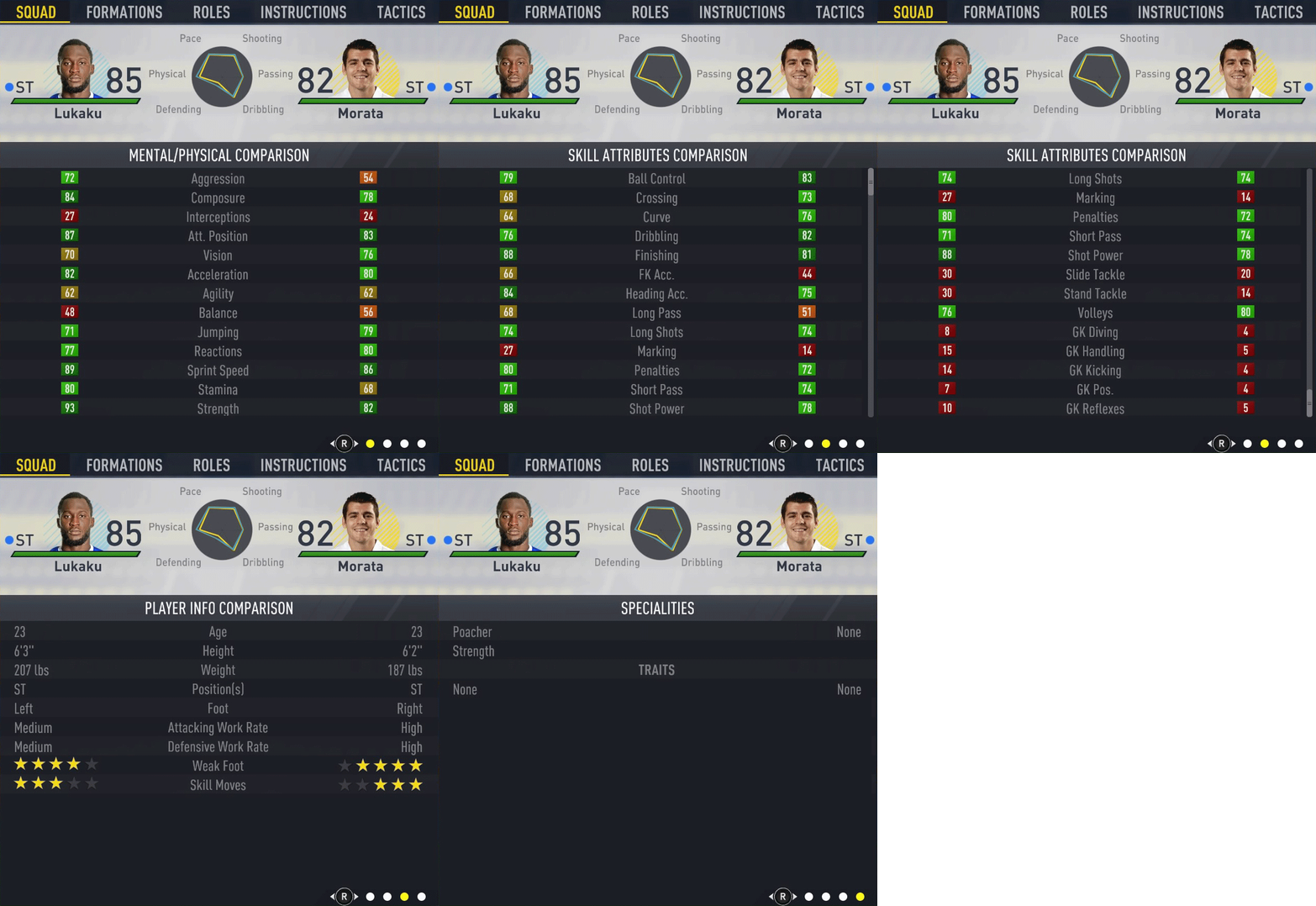
mental and physical attributes, which is why Messi and Ronaldo both
thrive despite their wildly different body types.
To
cultivate your own style, its important to first recognize your
strengths and weaknesses. This is of course easier said than done, since
people tend to severely overestimate abilities they’re confident in and
underestimate the ones they’re not. In the event that your ‘favorite
position’ (however that manifests in life) differs from your natural
fit, you’ll have to do some compromising either on your gifts or the
role you play.
Next,
you’re going to have to figure out how to channel your abilities
effectively. Any one skill doesn’t make a player — you have to
experiment and learn how to combine your unique traits to add your mark
and bring value in a way that’s bigger than the sum of your parts. This
is where the magic happens: in aligning the things you’re good at, you
won’t just be contributing enormous value, you’ll do it in a way that’s
uniquely your own.
Be
true to who you are and constantly work on refining what you’re good at
while counterbalancing what you’re not. Just make sure you’re doing
what you love and prefer rather than what comes easiest.
5. For Teams to Thrive, Chemistry Is Everything
Communication
is critical for any team across any discipline. There have been times
when various egomaniacal managers joined a new club and brought in five
new players for their upcoming season. While they splurged their team’s
funds on the best players money could buy, they somehow still ended up
fourth, fifth, sixth on the league table at the end of the season.
Although
the players themselves were world class talent, they had never played
together, and that reality revealed itself time and again on the pitch.
Lack of communication kept the team fragmented and therefore incapable
of making intelligent decisions in the attack, midfield nor defense.
Their mismatched movements and poor connection in the passing lost the
team possession of the ball — the very currency of the game — which many
times resulted in the ball finding the back of their own net.
It ultimately comes down to this: it’s not the team with sensational players, as much as it is the players with a sense of team.
Chemistry
is one of the most underrated facets of a team’s composition for what
its worth, yet it’s the single most critical factor of whether a team
will succeed. Everyone must be able to work fluidly with one another and
balance each other’s respective strengths and weaknesses to work
effectively as a unit. Trust, community and culture are therefore the
glue that holds a team together; without them, you’re just a collection
of individuals.
U.S.A Women’s team is often touted as the best in the world and its no wonder why, just look at that chemistry.
6. The Leader Isn’t Always the Best Player
There’s
a common misconception that the best player — or even the one that puts
in the most effort — should be the leader. They shouldn’t.
While
Messi is one of (if not) the best player in the world, he’s quite
silent on the field. Because sneakiness is one of his tactics, he relies
on his teammates to scope him out without having to shout or wave his
hands.
While
his contributions to Barcelona have been and continue to be
tremendous — he’s the club’s highest goal scorer and has brought them
countless trophies in the process — he shouldn’t be captain. Despite
having played for the club since childhood, Messi lacks the leadership
that other less-skilled players can offer the team.
Why?
While
leaders should strive to lead by example, mastering the specific skills
that placed them at the top of the totem pole, being good at what you
do is not enough. In fact, it’s not even the most important thing.
As
a leader, you have to be able to facilitate the chemistry of the team,
uniting it through inspiration and communication. Head chefs make sure
the kitchen is organized and running smoothly. CTO’s (chief technology
officer) translate the company’s vision for their engineers, as well as
the engineer’s work for the rest of the company. Film directors
orchestrate the actors to bring out their best for each scene.
While
the soccer player, head chef, CTO and director are all likely the best
in their respective field, it isn’t always the case. More important than
their own capabilities is how they empower others to express theirs. In
the end, the central function of leadership is to produce more leaders.
7. Play with the Goal in Mind
Sometimes
while going through the motions, you lose track of what you’re there to
do. Soccer makes for a particularly nice analogy here because it quite
literally shares the idea of ‘having goals.’
While
in sports the objective is more blatantly apparent, much like in life
you can often forget why you started something in the first place when
faced with more immediate obstacles to overcome. As fatigue sets in and
motivation withers, your ‘why’ has to be be larger than your excuses.
Don’t lose sight of the big picture. Hold yourself accountable.
Passing
and communication are important, just like dieting and business
meetings — but if they’re getting you nowhere then you need to start
changing things up. While we mentioned that progress is never linear in
#3, you’re still at the reigns of your own momentum. Breakthrough
opportunities are just that: breakthroughs. Before you can ‘strike with
conviction,’ you first have to know where the goal is.
Hone your sense of where the goal is. How far are you from hitting your target? What do you need to do to get a better shot?
Zlatan Ibrahimovic always knows where the goal is
8. Know Your Enemy
It pays to do your homework.
Who’s your competition? What are their weaknesses? What are their strengths? How do they go about their business?
Needless
to say, professional teams study their opponents well — long before
they shake hands and await the sound of the whistle.
Sometimes
when studying your opponents, you begin to understand yourself better
as well. Differences in philosophies can lead to new insights and
introspection that reveal why you think the way you do and how these
beliefs influence your own ‘style of play.’
Everyone
is playing the same game, but everyone plays it differently. What’s
really the difference between Uber, Lyft, Gett, Via, Juno and the rest
of the on-demand car rides?
While they all basically do the same thing, the way they do it
is unique. Beyond their branding (notice how they’re all starkly
different on that front), the companies seek to differentiate themselves
through key partnerships, pricing models, experiences and so forth.
At a glance, every soccer team is the same, just like every car-share service is the same. But if you take a closer look, you will spot some key differences that have likely emerged as a result of direct competition.
Knowing
your enemy is vital for survival as a person, company, family unit and
so forth. Its important to note though that your enemies may not always
be other people. Treat roadblocks as your enemies and really try to wrap
your head around what they are, why they’re happening and how you’re
going to fix the situation: in the worst case scenario, you come more
prepare. In the best, you’ll learn a thing or two about yourself in the
process.
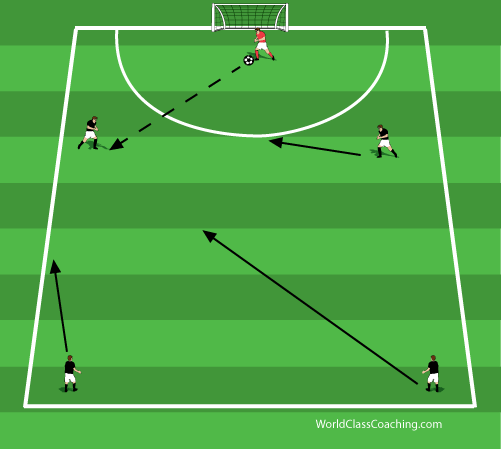
9. Check to the ball
When
receiving a pass, watching the ball come to you simply won’t cut
it — you have to check to it. The art of receiving a pass is as nuanced
as making a pass; if you merely watch the ball roll closer to you,
someone else will inevitably snatch it before it ever gets to your feet.
Checking
to the ball is a lesser known skill in the game (and in life), but one
that will benefit anyone who learns it tremendously.
How do you check to the ball?
Be
the first one to introduce yourself in a new email thread or social
setting. Learn about the new people you’re going to be working with and
offer to help them with something specific. Approach new opportunities
assertively and really embrace them for the chances they present, don’t
be ‘afraid of the ball.’ Even if an impending moment for greatness seems
inevitable, check to it. Make sure you’re giving it the attention it
deserves long before the moments leading up to it, and do your best to
stay on top of it.
Checking
to the ball means you get to keep the ball. It means you now have more
opportunities, and you don’t have to drop to a defensive or reactive
state. Its just one more way to ensure your success in soccer and in
life.
Take a step towards the incoming ‘big thing’ in your life.
10. Be Patient
This
last one is easily observed; its really rather intuitive even to people
who don’t play soccer that the game requires endurance and patience. As
a low-scoring game, the value of each goal has tremendous implications
on the result of a match. Players must expend their energies effectively
to last the full 90 minutes, or else risk burning out in the early
stages of the game.
You’ve
likely already heard the saying that life is a marathon, not a sprint;
indeed truer words could not have been said. Pacing yourself requires
discipline, and discipline requires awareness.
Conscientiousness
is arguably the most important life skill, and it helps lead to better
self-management, introspection and the manifestation of your dreams and
desires. Trust in your abilities rather than your luck, and work
diligently to get to where you want to be. The biggest empires weren’t
built overnight, and neither were their star performers.
How much of yourself did you leave in the trunk of your car today?
A
coworker retired this month. In his life, he started a charity, worked
with under-privileged kids, wrote a novel, and raised a beautiful
family.
That’s what he did outside of work. At work? He processed forms.
He
led a great life. And he was a great man. Yet every day, he drove to
work, and left that great part of himself in the trunk of his car.
So he could process forms.
This isn’t a unique story. People are amazing. They do tremendous things.
Talk
to the people around you. They’re artists and poets. They’re coaches
and leaders. They’re social workers and political advocates and lifelong
learners.
They’re all these things and more. On their free time.
At work? At work, they process forms. They follow procedures. And they do what’s asked of them.
Except what’s asked of them isn’t that impressive. Not compared to what they’re capable of.
How do we change this? How do we encourage people to be their best selves at work?
And I think that maybe the answer lies in a 75 year-old psychology paper.
A Psychological Turning Point
Prior to 1943, the study of psychology focused on the mentally ill. It prioritized avoidance and correction.
In 1943, the practice changed. One psychologist issued a paper called A Theory of Human Motivation
and forever altered psychology’s path. Instead of studying the mentally
ill, he reviewed top performers. Instead of correcting problems, he
offered opportunities for improvements.
He changed psychology from treating people as a “bag of symptoms” to focus on people’s potential for good, famously saying, “The new age which is already upon us is essentially the product of the turning inward to the self.”
The psychologist was Abraham Maslow. And he developed the famed Maslow’s hierarchy of needs.
Often shown as a pyramid, it suggests people have multiple levels of
needs, with higher level needs (self esteem and self-actualization) only
becoming a priority after basic needs (safety and security) are met.
Maslow
considered the lower levels of the pyramid to be “deficiency needs” as
we’re typically motivated by their absence. Once gained to a sufficient
level, their motivational power drops. And as we all know, once you have
$45 million in the bank, going up to $46 million doesn’t bring a lot of
added incentive.
In
contrast, the top level, self-actualization, is a “growth need.” When
we’re pursuing something for the sake of mastery, each gain fuels the
desire for more. Each achievement brings more motivation as we strive to
reach our full potential.
Which also drives people to do the amazing things they do.
The Traditional Bargain
“Our world no longer fairly compensates people who are cogs in a giant machine.” — Seth Godin, Linchpin
Most
companies offer a bargain. They say, come here and follow our
instructions. Do as we tell you. In return, we’ll take care of you.
We’ll give you money. We’ll give you security. We’ll even host company events so you can make friends.
And
it’s safe. If you’re following our process, you’re not really risking
yourself. Come take the safe deal. It comes with your very own cubicle.
It’s
enticing. Well, maybe not the cubicle part. But the safety, the
security, the belonging. Those are seductive. It’s difficult to look
past those.
That’s
why companies focus on them. And that’s also why the majority of people
are disengaged at work. And why they leave so much of themselves in the
trunk of their car.
Aim for the Higher Level
Where does your company focus? What bargains does it offer?
Are you only offering those lower level needs?
Make
no mistake, people need fair, competitive wages. While a lot of people
will tell you that money won’t make you happy, those people always seem
to have enough.
People need stability. No one likes working under constant threat of layoff.
And
people need belonging. As most people who work at conservative news
programs know, it’s difficult to be happy working besides people you
can’t respect.
These needs are important. They cannot be ignored.
But they are not enough. Not if we want people to bring their best selves to work.
As psychologist Barry Schwartz wrote, “If we design workplaces that permit people to find meaning in their work, we will be designing a human nature that values work.”
Lower
level needs are the entrance fee. They’re the starting point. They need
to be covered. But they’re not enough to motivate people to
consistently bring their best selves to work.
Live the Questions
So how do we bring self-actualization into our jobs? How do we bring these amazing things out of people?
I don’t have the answers. And any that I offered would be too generic to apply to your specific situation.
But I do have questions.
Questions that I’ve often asked other companies regarding this same
issue. So ask yourself a couple. Or ask your own. And maybe they’ll help
lead you to those answers.
Does anyone really care about your mission?
Most
employees don’t care about shareholder benefits. Or company returns or
any other fancy financial data. People want to understand that their
work is contributing toward a greater benefit. One that they’re proud to
be a part of.
What
are you doing to make people feel proud of their contribution? If
you’re asking people to give their all, what do you expect them to give
their all for?
Or as Simon Sinek wrote, “If
the leader of the organization can’t clearly articulate WHY the
organization exists in terms beyond its products or services, then how
does he expect the employees to know WHY to come to work?”
Can you connect peoples’ short-term goals to their long-term goals?
Everyone’s
happy to help with the short-term goals. Short-term goals support the
company’s needs. Write this report. Ship this product. Turn this crank.
And
most companies do encourage people to have long-term goals. They’re
happy to ask employees where they want to be in five years. But few
companies actively plan to make sure those short-term actions contribute
towards peoples’ long-term goals. To ensure today’s assignment will
benefit that five year vision.
Employees
know when a company invests in their development. They appreciate the
support. But more importantly, they’re able to let that growth compound.
As Mihaly Csikszentmihalyi, through his work on Flow, described,
“When
we choose a goal and invest ourselves in it to the limits of our
concentration, whatever we do will be enjoyable. And once we have tasted
this joy, we will redouble our efforts to taste it again. This is the
way the self grows.”
How frequently do you give people the opportunity to truly contribute?
Meaning
comes from constant pursuit. It’s the focus of consistently building on
yesterday’s progress that drives fulfillment and brings out our best
efforts.
The great Lou Holtz once said “If what you did yesterday seems big, you haven’t done anything today.” Are you giving people the opportunity to do something big today?
“The
maintenance of self-esteem is a continuous task that taxes all of the
individual’s power and inner resources. We have to prove our worth and
justify our existence anew each day.”
What problems do you trust people to solve?
Go
to a grocery store. Bring an expired coupon. If a cashier refuses to
accept it, complain to a manager. The manager then accepts it.
Most
grocery stores instruct their cashiers not to accept expired coupons.
But managers are instructed to honor them if people complain. Can you
imagine a better way to show people that you they’re not trusted?
You hire people to be responsible. Let them be responsible. In the words of John J. Bernet, “Men are more important than tools. If you don’t believe so, put a good tool in the hands of a poor workman.”
How do you encourage employees to bring out their best ideas?
Standardization
often gets a bad rap. We think of mindless factory workers soon to be
replaced by machines. But standardization is also a benefit. It gives
people guidance so they can reliably start from the best position.
The
difference in mindless standardization and meaningful work is whether
we’re empowering people to contribute their own ideas. Empowerment helps
people contribute in their own unique way. When people are able to
contribute their own unique value, they feel uniquely valued. Are we
giving people that opportunity?
In the encouraging words of David Mamet, “Do
not internalize the industrial model. You are not one of the myriad of
interchangeable pieces, but a unique human being, and if you’ve got
something to say, say it, and think well of yourself while you’re
learning to say it better.”
How do you encourage people to practice excellence daily?
One
of my favorite parts of Disney World — other than the fact that
everyone has to be nice to me — is that every detail is always covered.
You’re left with little doubt that excellence is a daily practice.
In
our love of simplicity, too often we sacrifice the depth that’s
necessary to encourage excellence. In the words of Oliver Wendell
Holmes, “I would not give a fig for
simplicity this side of complexity, but I would give my life for the
simplicity on the other side of complexity.”
Until
we give people the opportunity to embrace excellence, simplicity is
just a short-cut. And few people find meaning in short-cuts.
How do you encourage people to grow?
Are you asking enough of your people?
There’s
a limit to the shear quantity of workload that people can support. I’m
not suggesting you load people up until they have a mental breakdown.
But
are you limiting your expectations to mere productivity? Are you only
asking people to come in and punch the clock? Or are you challenging
their ability to make that unique contribution?
As Michelangelo famously warned, “The
greater danger for most of us lies not in setting our aim too high and
falling short; but in setting our aim too low, and achieving our mark.”
The
same logic applies to our expectations of others. We do them no favors
by asking too little of them. We don’t build meaning by setting a low
bar.
In the words of Kara Swisher, “Smart people like to be challenged and they like smart people challenging them.”
You’re smart. Challenge people. I doubt you’ll be disappointed.
Build Meaning. Start Now. Don’t Look Back.
“Of
all the virtues we can learn, no trait is more useful, more essential
for survival, and more likely to improve the quality of life than the
ability to transform adversity into an enjoyable challenge.” — Mihaly
Csikszentmihalyi
I
could tell you that the world is changing. That there will be a time in
the near future when companies that can’t bring out the best from every
employee will lose their competitive edge and no longer be tenable. But
you’ve likely already heard that. And I don’t really know if it’s true.
So
instead I’ll just ask, what type of company do you want to be a part
of? One where people bring their best selves through the door? Or one
where they leave that part in the trunk of their car?
There’s plenty of opportunity for the latter. We just need to get started.
Buddha
needs no introduction. He’s the main figure of one of the most
practiced religion in the world. Everyone has at least heard of him.
But I’m going to say that right away: this is NOT a post about religion. I do not pretend to understand buddhism, or any other religion for that matter.
I
simply believe that inspiration can be found anywhere, wether it’s your
environment, your friends, your family, your experiences, your beliefs,
etc. It doesn’t matter. There are good lessons to learn from
everywhere.
“What you think, you become. What you feel, you attract. What you imagine, you create.” — Buddha
What you think, you become
What do you think of yourself?
Do you act according to this belief?
How did you get there?
Work backwards in your thinking. Start from where you are now, and rewind a year. Did you become what you thought?
I’m quite different from what I was 6 months ago. I had good ideas of what I wanted to become. At least on a broad scale.
I have become it, and a little more.
BUT!
Thinking without action doesn’t make you become. Neither does acting without thinking.
Most of us want to be more than what we currently are. Yet we do nothing to make it happen.
Plan your days, at least one day in advance (Think). Be precise with time. Execute consistently (Do).
Before you know it, you’ll have become the things you have been thinking and doing.
What you feel, you attract
We are SO emotionally influenced by our surroundings.
Everyone is happy at a party.
Everyone is sad at a funeral.
If you’re negative, you’ll attract negativity. If you’re positive, you’ll attract positivity.
I’m a positive guy. Especially outwardly. The truth is, I fake it sometimes. And it’s a hack I propose to you.
When something negative happens to you, force yourself to think positively, however hard that may be. Your brain will need convincing. Act it out long enough and you’ll convince it.
Here’s a quote I really like from Conor McGregor:
“At the end of the day, you’ve gotta feel some way. So why not feel unbeatable? Why not feel untouchable?” — Conor McGregor
When I feel unstoppable, people around me catch my vibe.
I
un-intentionally started a fitness group at the co-working space I
worked from. I just wanted to be more fit, so I thought, and acted. I
started doing push-ups.
People laughed. People judged. People got curious. People joined.
I started a movement, simply because I felt I was unstoppable at fitness.
What you imagine, you create
Reflexion is an incredibly powerful tool to motivate you to act and create whatever it is you want to create.
In
our busy day-to-day routine, we rarely take the time to reflect.
Reflect on ourselves, reflect on our day, reflect on our environment,
reflect on our future.
We don’t take the time to let our imagination run wild through reflexion, or deep thinking.
For 50 years, cancer was considered to be caused primarily by genetic mutations. This line of thinking got us almost exactly nowhere. As the research began to repudiate the main tenets of the Somatic Mutation Theory (SMT) of Cancer,
competing hypotheses gained attention. The SMT’s main premise was that
cancer is derived from a single somatic cells that has accumulated a
bunch of genetic mutations that allow it to become immortal. The main
cancer causing genes are termed onco-genes and tumor suppressor genes.
This is a classic case of not seeing the forest for the trees.
What
does this mean? Well, imagine yourself stuck in the middle of a forest.
All you see are trees. It doesn’t seem so great. It’s just a bunch of
trees like you find in your backyard. Here’s a tree. Here’s another
tree. Here’s a third tree. What’s the big deal? But, if you could see
the Amazon rainforest from a helicopter, you could then appreciate the
beauty of the entire forest.
The
same problem happens if you read too close. Imagine that you are
reading this blog post but have mistakenly zoomed in by 700%. You can’t
see more than a few letters. Can’t see much. Gibberish. By looking too
closely, you have missed the entire point of the passage. You need to
‘zoom out’. Imagine there are 3 blind men examining an elephant. The
first, examining the trunk, says the elephant is long and limber. The
second, examining the tail, says it is small and swishes around. The
third, examining the body says it’s huge and flat. All three are
simultaneously correct and incorrect, because they have ‘zoomed in’ too
closely.
The
same problem exists in the SMT. We’ve zoomed into cancer too
closely — right down to the genetic makeup of the cancer and it is
gibberish. We can make no head or tail of cancer’s origin and therefore
make no progress towards treatment. Over 100 oncogenes and over 15 tumor
suppressor genes have been identified, but we don’t know what it all
means as a whole. Instead of three blind men and an elephant, we have
thousands of blind researchers and cancer. Each sees a tiny, tiny piece
of the puzzle and can’t see the whole. The rate of mutation necessary to
develop a cancer is far, far more than the known rate of mutation in
human cells (Loeb et al 2001).
Normal cells just don’t mutate anywhere close to what is needed to
produce cancer. Further, while every cancer has mutations, it was not
known what the ‘denominator’ was. That is, how many cells had mutations
but no cancer. This turned out to be pretty high. You could alter 4% of
the genome and still have a cell that looked and acted completely
normally. This is a remarkable high degree of tolerance (Humpherys 2002)
We
need to zoom out and look at cancer from a different perspective. The
SMT looked at cancer at a microscopic genetic level. The Tissue
Organization Field Theory (TOFT) begins to correct the problem by
looking at the tissues surrounding the cancer. In multicellular
organisms, single cells do not have an existence outside of the whole
organism. The liver, for example, could not exist outside of the body.
We don’t walk down the street and say hi to the next door neighbor’s
liver out walking the dog. You don’t see your spouse’s lung jumping out
of the body at night to rummage around the refrigerator. You don’t yell
at your spouse’s kidney to put the toilet seat down.
All
cells originate from a single fertilized egg, so all cells in the body,
including all the different organs share the same genes and DNA. The
original undifferentiated stem cells have the ability to become any part
of the body — lung, liver, heart etc. It is therefore, not the genes
that determine if a cell becomes a liver or a lung, it is the signals
received from the surrounding tissues that tell an undifferentiated cell
to become a liver cell. There is detailed hormonal signalling involved
in this process.
For
every problem, including cancer problems may develop in one of two
places. There may be a problem with the cell itself — it mutated and
became a cancer. Or, it may the environment it grows in that may be
telling that cell to become cancerous. Is it the seed or is it the soil
or both? If you drop a grass seed in the desert — it does not grow. But
drop that same grass seed into your lawn — it may grow extremely well.
But it is the exact same seed with exactly the same genes. Focusing
exclusively on the seeds means we missed the forest for the trees.
Myopically researching the genetic difference of seeds to see why one
grows and the other does not is futile.
By
the same token, a cancer cell may grow very well in the normal
environment of growth pathways. But that same cancer cell may not grow
at all in the ‘desert’ where growth pathways have been entirely shut
off. The key is to shut off these pathways. How to do that (previously discussed here)?
Well growth pathways are closely linked to the body’s nutrient sensors.
If the body sees that there are no nutrients, then it will shut down
all cells to go into a quiescent state, just as baker’s yeast will
become dormant without water. The reason is self preservation. In this
dormant state, it can live essentially forever.
This
understanding of the importance of the ‘seed and the soil’ concept
helps to answer one of cancer’s most interesting questions. Why can
virtually every cell in the body become cancerous? Think about
this — there is cancers of the lung, breast, stomach, colon, testicles,
uterus, cervix, blood cells, heart, liver, even fetuses. The ability to become cancerous is an INNATE ability of every cell of the body, almost without exception.
Sure some cells become cancer more frequently than others. The
oncogenes and tumor suppressor genes discovered so laboriously over the
last quarter century are mutations of NORMAL
genes. The seed of cancer lies in every single one of our cells. So we
must pay more attention to the ‘soil’ because that is what likely makes
the difference between having cancer and being healthy.
The question is why? Why should any cell turn into cancer? Why shouldn’t all
cells turn into cancer? The origins of cancer lie in our own cells. The
capacity to turn into cancer lies in the normal pathways of growth that
become somehow perverted — by the environment it lives — the ‘soil’. If
you bathe lung cells in cigarette smoke, it will more likely turn into
cancer. If you infect cervical cells with Human Papilloma Virus, it will
more likely turn into cancer. If you give asbestos to the lung lining
(pleura), it will more likely turn into cancer. If you are obese, breast
cells will more likely turn into cancer. The question of what is the
common linkage of all these stimuli?
The
SMT assumes that the default state of cell proliferation in humans is
quiescence. The liver cell, for example, won’t grow unless it receives
growth signals to tell it to grow. Therefore the assumed problem in
liver cancer is that the ‘seed’ is bad. But it could just as easily be
the ‘soil’ or the environment surrounding the liver that the will tell
it to grow or not.
On
the other hand, single celled organisms are assumed to have a default
state of growth. That is, cells grow all the time unless they are
constrained by not having enough nutrients. Put a bacteria in a Petri
dish and it will keep growing until it runs out of food. From an
evolutionary perspective, since we evolved from single celled organism,
it would only make sense that all our cells retain this INNATE ability
to grow. For example, the replication machinery of yeast and human cells
is almost completely homologous. So, if you simply find the right
‘soil’ any cell may return to its original state of growth. Unregulated,
this is almost the very definition of cancer.
The
same issue exists for motility. Liver cells, for example, don’t move
around our body at will. But for unicellular organisms, this is the
natural state of things. Yeast will move around constantly. Bacteria are
constantly moving. This has enormous implications for why cancers
spread (metastasize), which is 90% of the reason people die of cancer.
Metstasis, or movement of cells, is an INNATE feature of life on earth.
Cancer
exists at many levels. If we dig too deeply into the genetic level, we
miss entirely that the way that cells are organized plays a huge role in
cancer’s development. If we look too closely at the trees, we miss the
forest. If we look too closely at the genetic level, we miss the tissue
organization level problems — the growth signals, the nutrient sensors,
the hormonal signalling. Cancer cells do not grow faster than normal
cells. It’s just that normal cells don’t normally grow. Also the growth
of cancers are not autonomous. Breast cancer cells, for example will
still respond to hormone changes like estrogen.
Gleevec,
the very poster child of recent cancer breakthroughs illustrates that
we have been digging too deeply. Recall that Gleevec, imatinib, is a
drug that blocks tyrosine kinase, a growth signal for cells. It can cure
many patients from chronic myelogenous leukemia, a disease that is
caused by a genetic distortion, the Philadelphia chromosome. But here’s
the crucial part. Gleevec does not affect the genetics of the cells. It
affects the growth signalling pathways — the SOIL, not the SEED. In
doing so, it sometimes so completely cures the cancer that the genetic
aberrations disappear.
Gleevec,
the most successful cancer treatment of the last 50 years, is proof
that we had been diving too deeply into the minutiae of the genetic
problems and failed to consider the cancer’s hormonal environment. This
is an example of so called ‘preposterous reductionism’ (Dennett, Darwin’s dangerous idea).
“If you want to know why traffic jams tend to happen at a certain hour
every day, you will still be baffled after you have painstakenly
reconstructed the steering, braking and accelerating processes of the
thousands of drivers whose various trajectories have summed to create
those traffic jams.”
If
you want to know why cancer happens, you will still be baffled after
you have painstakenly reconstructed the oncogenes and tumor suppressor
genes and other processes of the thousands of cells whose various
trajectories have summed to create cancer. This is exactly the track we
have taken with almost all of modern cancer research, and we wonder why
we’ve made no progress. After billions of research dollars and decades
of time, The Cancer Genome Atlas is the cancer equivalent of
reconstruction steering patterns of thousands of cars to see figure out
rush hour traffic.
Zoom
out. Look at the proper level (tissue level, not genetic level).
Consider cancer’s soil, not only its seed. This does not invalidate any
of the advances of genetics. The changes merely occur at different
levels. The SMT looks at cancer at a cell based level, and tissue
organization theory looks at the ‘society of cells’ level. But
understand that one does not preclude the other.
If you are a true entrepreneur, then you can certainly relate to this.
As
a kid, you were probably diagnosed with ADD. Your teachers were
constantly frustrated by your “acting out” or your “inability to follow
the rules of the assignment.” You probably didn’t have the best grades.
Your creativity was mistaken for disobedience and rebellion.
And above all, you probably didn’t have the smoothest relationship with your parents.
Don’t
get me wrong, there are plenty of entrepreneurial spirits that pledge
their parents were the first to support them in all their endeavors.
Gary Vaynerchuk comes to mind here.
But
for a lot of us, it has been a constant struggle since day one to
convince those around us that our wildly imaginative ideas are not
daydreams — they are very real, very tangible pursuits that, for
whatever reason, attract us.
And we believe we can bring them to life.
If you are the parent of an entrepreneurial kid, it can be very easy to see their risk-taking behavior as a negative.
I would know — I was one of them.
I
was diagnosed with ADD. I was a straight C student all the way through
high school. I was constantly thrown out of class for being
“disruptive.” I didn’t have many friends — because I was far too
committed to the things I was interested in (like becoming one of the
highest ranked World of Warcraft players and gaming bloggers in North
America). And I was sent to therapist after therapist with the hopes of
understanding why I wasn’t “normal.” Why my head always seemed to be in
the clouds and I couldn’t get myself to enjoy studying Geometry.
Obviously, it wasn’t until long after the fact that my own parents realized what it was they were dealing with: an entrepreneurial spirit.
If you are the parent of an entrepreneurial kid, here are 15 things I hope you remember:
1. We can’t change who we are.
We
love what we love. We’re fascinated by things. We follow our intuition
and we trust ourselves enough to figure things out as we go. It’s not a
choice — it’s simply in our DNA.
2. We don’t need your fear, we need your support.
We have enough fears to deal with.
We fear how it’s all going to come together. We fear what the world will think of us. We do not need your fear in us as well.
All we need is you to believe in us.
3. We love the journey.
That’s the whole point of being an entrepreneur.
It’s
not about securing the paycheck or ending up with the house and the
white picket fence. It’s about the game of it. Building something of
value.
That’s why we do it — for the love of the game.
4. We are ok with learning through experience.
As a parent, it’s tough to watch your kid fall.
But we welcome the fall.
We
want to fall off our bikes so we learn how to ride them. We want to
jump off the cliff so we can learn how to dive. We aren’t book-learners.
We learn better through experience.
5. We hate, more than anything, being told we can’t do something.
The whole point of the game of entrepreneurship is to do what hasn’t been done before.
The
more you tell us we can’t do something, the more frustrated we will get
(and that isn’t always a healthy thing). Please, don’t tell us it can’t
be done. If that’s what we want to explore, then just support our
journey.
6. We don’t want to be like Johnny, Martha’s boy, who has a really nice office job selling insurance.
If we wanted that, we would have done that.
But we don’t.
7. We value our freedom over everything.
Creative freedom. Freedom to travel. To explore. To build.
Freedom is what we’re after. Not money, not a title. Not safety.
Freedom.
8. We want to help other people.
This is not a selfish endeavor.
We
want to build something that will give back to others, provide
opportunity, and in some way leave our mark on the world. That has to
count for something, right?
9. We know we can do it.
Something inside of us says, every day, “I know I can do this.”
It
might just be curiosity on our part, but so what? We want to know if
that voice is real — if we really can “do it.” And we’d rather find out
the hard way than wonder “what if” for the rest of our lives.
10. We don’t expect you to understand it, we just hope you’ll respect it.
Entrepreneurship is such a vague of a pursuit in life.
To
be honest, we’re not even sure what it means either. All it means is
we’re going to figure something out on our own. Maybe we know what that
is now, maybe we don’t.
We don’t expect you to understand. We just hope you’ll respect us for staying true to who we are.