Personal Development

Showing posts with label Personal Development. Show all posts

Monday, February 26, 2018

Unemployed At 25: How To Recover


At 25, life got real for me. I got served the sort of challenge that knocks you flat on your ass. It was yet another failed startup with my childhood buddy: my brother. I’d had enough, and I wanted to take back control. No longer could I live a life that wasn’t in line with my purpose.
I left all the money, significance, nightclubs, nice cars, and beautiful women behind. I was in search of greener pastures. Unfortunately for me, greener pastures meant temporary unemployment and a sinking feeling that I wasn’t enough — when are we ever enough, right?
Things quickly started to get real. I’m not the sort of person that can just stand there and do nothing. I got in my BMW that I could no longer afford, drove to the local park, and started making phone calls.
It’s the only thing I can do in times of crisis that helps me figure stuff out. The more calls I made, the more I felt that I wasn’t enough. If it was a friend, they had no answers for me other than “Only you can work this out.”
“Geez thanks for nothing,” I would say to myself quietly. Then I would make calls that I was hoping would lead to a new industry or a career I hadn’t thought of. I’d continually get hit with “how much experience you got mate?” When I told them I had none, the call ended quickly.
Out of desperation, I did what any entrepreneur who has failed does, and I started another business with a friend. He’d met this guy who was supposedly married into the Chinese Government, and we thought our little importing business was set. “We’re gonna be rich,” we’d say to ourselves.
Within three months the entire thing collapsed, and our friend turned out to be a total liar and had about as much business skill as a child who’d been at kindergarten for one year. He was a joke, and we felt like an even bigger joke.

The Inner World

By this point, I felt like I had nowhere to go. I was able to see what homeless people saw, and I began to understand how easy it was for your life to spiral out of control. I saw firsthand how things could just suck and you could feel so powerless to fight back against it.
No one would hire me, and I’d lost all my entrepreneurial swagger. It sucked big time, and my options were quickly running out. Somehow, I can’t quite remember, I discovered personal development. It was sold to me through some YouTube video as a miracle cure.
I had nothing else, so I decided to run with it. Quickly this giant man called Tony Robbins spoke to me like a voice from up above and said quite clearly “Tim, fix your inner world, and your outer world will prosper.”
Easier said than done Tony! Still, I committed to giving it a go even though it still seemed a bit “woo woo.” I’d walk around the block late at night rebuilding my life with his audiotapes.
“I became the observer of myself, and I watched my thoughts like clouds passing through the sky”
Suddenly, I could see things that were previously invisible. Things such as: my health sucked; girls mostly dated me because of the car I drove, and left me before three months had passed; I had zero goals; I was obsessed with money; I never gave anything to anyone; I was a smart ass; and the list goes on. I was essentially flawed in a major way across all areas of my life.

The light bulb moment — small steps

The moment that changed it all was when I started taking action. What I did differently this time, though, was to take small steps. I didn’t try and do stuff that was massively out of my reach. I did:
– Ten minutes of exercise a day
– Read a chapter of an inspiring book
– Bought some indoor plants to improve my mood and air quality
– Stopped watching the news
– Went to some networking events
– Made it a habit to give more
– Travelled the world despite my fear of flying

I dealt with fear

The last point is probably the most important. For many years I adopted my mom’s unhealthy fear of flying. I thought it was dangerous and should be avoided at all costs. As a result, I’d never really gone anywhere, and this depressed the hell out of me.
I felt like a prisoner in my own city. As the personal development journey continued, I became convinced to suck it up. I jumped on a sixty-minute flight and flew to an Unleash The Power Within seminar. At first I thought it was a cult, then I quickly drank the Kool Aid. I was high on energy, inspired, and it felt awesome!
Had I have never dealt with the fear and took this first step, I suspect I would be still living in fear. It was this one flight where I conquered my fear that paved the way for everything else that followed. The podcasts, viral blog posts, overseas trips, and the opportunities to hang with mega influencers would never have been possible if I didn’t make the decision that enough was enough.

Believe in yourself

As I started conquering other fears, I began to re-develop my confidence. I felt like that eighteen-year-old entrepreneur again that could try anything to make a buck. The difference was that this time it had to have meaning and purpose.
I was wiser. I felt like I was becoming my own version of Yoda. It was bloody exciting, and the journey continues. So the fear was the trigger, and that led me to start believing in myself.
While realigning your beliefs and values is crucial to the transformation process, the first person I began to believe in again was myself.
I thought, “If I was successful as an entrepreneur once, who says I can’t do it again? Who’s going to stop me?” From this point on I had a sparkle in my big blue eyes. I applied to work at my dream organisation.
The plan was to rebuild my sales skills, network my face off, save some money, and then find out what’s next. Over the next few years, I improved myself in every single way.

The birth of a new calling

I found a website called Addicted2Success, and I began writing about what I’d learned. Several blog posts went viral, and I had found my calling. My calling was to inspire the world through entrepreneurship and personal development. The way I do this and the platforms I use to do so change every year.
“Through rock bottom, we discover our faults and get the opportunity to improve them, one small step at a time”
Through this process, we find out who we truly are. Our perspective changesand our life becomes about giving. Through giving, we get more fulfillmentand discover what our true gift is. Once we know our gift, it’s our job to exploit it with every breath we have left in our body until the day we die.
It’s not only our job, but our life purpose to live with passion and seize the moment. Don’t wait until you become unemployed like I did. Don’t wait until you narrowly miss cancer like I did, and realize that our time on this planet is limited.
Go out there, get amongst it, get excited, find your tribe, and become who you already know you can be!

Originally posted on Addicted2Success.com
Monday, February 5, 2018

3 Difficult Habits That Get Easier Over Time


How many “positive habits” articles do you need to read before you start taking action?

Here’s the thing about forming positive habits: It is difficult.

The things we know we should do, we don’t — and the reason we don’t is because they are challenging.
They are not easy. They make us tired, or insist that we (gasp!) “think.”

We don’t do them because, in some sense, we fear that they will be as difficult as they feel now, forever.

But the thing is (and anyone who has ever pushed themselves knows this), difficult things get easier the more you do them.
Even the really hard habits, the ones that constantly feel strenuous, in some sense get easier with time. And the reason is because you not only become more skilled in that area, but you also become more patient with yourself throughout the process.

Here are 3 essential habits everyone knows they should do, but tend not to.

And here’s exactly how you can get through the “difficult” phase and make them part of your daily routine.

1. Reading

If you’re reading this right now, you are (in some sense) on the right track.
One of my favorite things to ask people is, “What was the last good book you read?” Most people are shocked, and I know the answer before they even say it: “Wow, I can’t remember the last book I read.”
Sure, we read blogs, and tweets, and long-winded Facebook posts — but reading a book is different. Reading a book takes time, and patience, and especially when dealing with fiction versus nonfiction, both categories work different parts of your brain.
Reading is essential.
I strive to read a book every other week. Two weeks is more than enough time to get through a roughly 300-page book.
The best way I have found to create a habit of reading is to have it take the place of your smart phone and “filler time” social media usage.
Whether that means reading on your iPhone or keeping a book in your backpack or purse, every time you have a few free minutes, open your book. When you’re waiting in line at the grocery store, open your book. When you are on the train, open your book. Anywhere and everywhere you would otherwise compulsively check your e-mail and Facebook notifications (the majority of which are not important), open your book.
You’ll be amazed how quickly you move through material, and how much more stimulated your mind feels throughout the day. And, most important, reading will no longer feel like a chore. It will simply become a way to pass the time.
A smarter escape, if you will.

2. Waking up early

This is the king of “habits I really should do, it’s just that my bed is so comfortable.”
If you’re not a morning person, waking up early is horrible. It is not easy. It feels grueling, and you’re fighting yourself all the way to the shower — and then once the hot water hits your head, you practically fall right back asleep then and there.
When most people try to instill this habit into their lives, they think it’s all about “waking up early.”
It’s actually about something else.

It’s about going to bed earlier.

Sleep is the constant.
There are only two variables you can change: You either go to bed earlier, or you wake up later.

If you want to create a successful early morning routine for yourself, it’s much more about mastering the evening routine that comes before it.

Slow yourself down an hour before bed.
Read a book (see above) instead of browsing Instagram, so your eyes can relax. Meditate, or take a warm shower. Do activities that are intended to move you into sleep, so that you can wake up ready to go the next morning.
Where people tend to go wrong is they set their alarm for 5:30 a.m., but still go to bed at midnight. That’s a disaster waiting to happen. And then of course, 5:30 rolls around, you’re exhausted, you call yourself a failure, etc.
Focus on the night before — and stick with it. Nobody forms a habit after three days. It takes a bit. But once you do it for two or three weeks, it becomes your “normal,” and suddenly waking up early isn’t so difficult anymore.
It’s just “what you do.”

3. Forgiveness

Had to throw a curve ball in here.
Forgiveness. Compassion. Understanding. Patience. The act of listening and taking time to see life through someone else’s eyes: For many, this is not easy.
What few seem to realize is that forgiveness and humble traits of the sort are not inherent. They don’t just “happen.” You have to practice them — no different than how you have to practice firing pucks at a hockey net to improve your wrist shot.

To be forgiving or compassionate, in a way, is a habit.

As soon as you start to think of it as something that you can consciously practice, your approach to it inherently changes.
Suddenly, moments when you are frustrated or upset become opportunities to react differently.
I have witnessed many people in my life make the proclamation that they are going to “turn things around” or “be better listeners” and then fail to keep their word for longer than a day, or an afternoon, or even an hour.
And the reason is simple: Habits don’t change overnight.
Your personality, the way you react to situations, and the energy you bring to the moment is the way it is because that’s what you practice. Every day, in everything you do, that’s what you practice — so if you want to change that, you have to practice something different.
But should you stick with it, and continue challenging yourself to step back, reflect, and react differently the next time, the easier it ultimately becomes — until eventually, it is simply “who you are.”

Tuesday, January 30, 2018

How To Know What You Want


When it’s really hard to figure that out

What do you want?

“I don’t know.”
We do, of course. Somewhere, deep down inside. Somewhere, we have preferences, thoughts, wants and needs. Somewhere, we have an opinion on literally anything.
Because we are human beings, with agency and authority on our self.
The problem, however, is that sometimes we misplace this as easily as we misplace our keys.
And here’s how we backtrack and retrace our steps.

We must stop shouting at ourselves (please)

Stop demanding an answer to “what you want” — right now!
And definitely don’t let anyone else do the shouting for you.
I think about that scene from The Notebook, where Noah is berating Allie by shouting “what do you want?!” Many people thought this was hilarious and adorable and true love, but, guys, that’s not love — not for each other, and definitely not ourselves. That’s now how this works.
So when Allie cried back, “it’s not that simple!” she was speaking her truth.
Which is kind of ironic.

It’s NOT that simple

I feel very irritated and impatient when articles on “how to figure out what you want” effectively include, as step one: “figure out what you want.” (Like “list all the things you enjoy!” or “what makes you happy?!”, as though recognizing “want” is somehow easier if reframed in other ways...)
It’s not. Our issue isn’t the grammar or the specific thing in question. If we knew how to identify “wants,” we wouldn’t struggle with small things like where to eat. So of course we’re going to struggle with whether we want to marry shouting-match Noah or old-money James Marsden, let alone anything else in our lives.

This is why advice like “brainstorm ideas!” doesn’t work

It’s like dragging an anorexic to a buffet thinking that’ll solve the problem. Allie, for example, didn’t need to make a list of everyone she could marry.

It’s also why “just do it!” doesn’t work

This just makes us feel panicked and forced. We’re liable to jump blindly at the next thing or anything, and Allie might’ve run off with the milkman.
The problem isn’t context, but rather skill set. We aren’t always equipped with the answer because we aren’t always equipped with the instinct.

The reason we don’t know

We make decisions in one of two ways and, to Noah’s credit, he got them right: either what we want, or what others wants. (Sometimes we resist both and make no decision.)
If we don’t know what we want, it’s because we silenced ourselves.
Empathy and learning to “play well with others” is fine — to an extent. The issue is when it comes time to live self-actualized lives, and we can’t choose between external influences and ourselves.
That, or more commonly: we realize we’re unhappy.

We’re ignoring the signs

Anxiety is a sign we’re ignoring our own needs. So is insecurity, loneliness, helplessness, feeling inferior.
So is withdrawal. And apathy, boredom, sarcasm.
Attachment, preoccupation, codependence. The chase of “simple pleasures,” good or bad.
Any of these are subconscious sirens that we’re silencing ourselves and shutting needs down.
But absorb the language here: we are ignoring our needs. (They are not being ignored by others. And others are not making us feel our reactions.) We are failing to serve ourselves.
It’s here that the gig is up. We can no longer turn to “others” for guidance — or blame. Not on these feelings, and not the originating want or need.
All of it — the anxiety or avoidance, and the underlying problem — is first ours to resolve. And if we have any hope of ever being able to answer “what do you want,” we have to do this for ourselves first.

We’re cashing checks we can’t cover

We’re rushing to the bank demanding answers and our account is just staring back at us, like “uh, who are you?”
We ignore the signs for years and then expect our subconscious to deliver magical solutions when we want them.
We have to do the grunt work first. We have to make $2 deposits. And it’s us — not anyone else — who has to do it.
How? We must first give ourselves everything we need from others. Attention, understanding, validation, support, acceptance… love.
We think we’re doing this, but we’re not. As evidenced by the above.
We’re so out of touch we don’t even realize we’re out of touch. And if we aren’t in touch with our emotions, we have to get in touch with ourselves other ways.

I wrestled with meditation for years, trying apps, in-person guided practice, even monk-led retreats but was, at best, only reasonably good at “making an attempt,” distracting myself with directives or only finding a few fragile seconds of focus. I sat with meditation in the way we visit relatives we don’t like: out of obligation, smiling to hide our discomfort — as much from ourselves as them — each moment dragging on (and us along with it.)
But, like a switch was flipped, meditation suddenly “worked” for me the instant I did it because I wanted to do, not because I felt like I should.
But I didn’t force or demand myself to want it.
What happened was I wanted to fix the “what I want” problem. I wanted to be able to answer it, and I wanted to know why I “couldn’t.”
I asked myself “what makes you happy,” and when I had no confident answer (instead distracting myself with side questions like, “what is happiness, even?”), I then asked “how do you feel?” My only answer, always, was “fine.” So then I thought, “just for fun, pick the closest feeling — or one you sometimes feel! You can’t always be fine!” Still unsure, on a whim I Googled “feelings chart” — and not only do they exist, but they totally blew my mind.
Looking at them, I thought “these are feelings?!” I didn’t realize half these even existed, and didn’t realize things I was feeling were the feelings they said on this chart (like I was surprised at how little “fear” I felt, that what registered as “happiness” for me was actually “peace” or “power,” that most everything under “happy” I only experienced in fleeting blibs, and that sarcasm and distance are “anger.”) That’s how out of tune I was.
After that, I read that negative feelings (anything besides happy, joy, power, peace, love) means we’re “neglecting our needs.” I read that and was like “wait, what ‘needs?’ where?” and went hunting for a “needs chart.” And that’s where things got dicey, because I stared at the list and felt dumbfounded, like: “but… I have all this.”
Except clearly I didn’t.
And that is how we get lost.
I searched on and found some compassionate souls who offered:“if you can’t get in touch with your feelings, get in touch with your breath.”
Great, I thought. Meditation.
But as a last resort, I gave it a try. I wanted to resolve this.
And in this mindset — of self-interest and self-love and intrinsic want — I sat down by myself — no apps or monks — closed my eyes, and ended up meditating for over 30 minutes. In absolute comfort, awareness; both light and heavy-sweet, like a hug.
I was overcome with a feeling of care. Other things caught my attention, but I also realized that every time I gave my attention to anything besides myself, I was actually telling myself “this random thought is more important than you are.” And with this state of mind, I’d gently come back. Because every time I brought my attention back to myself, I was also saying, “you are most important right now.” Like, this is everything. I felt like I could have sat there all afternoon.
As I withdrew from the meditation, there was a quick surge of emotion. I didn’t understand what it was, and actually had to reference the “feelings wheel” to identify it. Sadness.
Now I meditate most mornings. For how long? “As long as it takes.” As long as I need to feel: I am here. Some mornings, 10 minutes. Others, I indulge and stay 45.
And after this experience, I am left wondering if meditation shouldn’t always be self-guided. Because I’m not sure we’ll ever fully sit with and see ourselves if we keep part of our attention on some omnipotent authority figure barking in our ear, no matter how “reassuring” their voice.

Go as far back as you need to go to “know”

Sometimes I didn’t know what I wanted to eat for dinner. But not only that, sometimes I didn’t even know if I was hungry — which seems insane.
Because it means that I not only didn’t know how to meet my own physiological need — but I didn’t even know whether or not I had it.
It’s hard for me to discern wants and needs sometimes. It’s hard for me to discern feelings — physical sensations? Hm, couldn’t say. Emotions and feelings? Psh, clearly beyond me.
Which is why I had to keep going all the way back until I did know something about myself with absolute certainty: breath.
“I am breathing.”
I am breathing out. And I am breathing in. I am aware of my own breath. And, the unspoken implied: yes I want to breathe.
And, beyond this, the overarching want: “I want you;” “I want to know what you want;” “I want to be here.”
This is how I finally came to meditation, and got back in touch. And it is with blind faith that I sit there, patient and faithful but mostly patient, believing: everything else will build from there.
We have to stop fighting ourselves and shutting ourselves down. When we feel we don’t “want” to do something we know we “should” do, it’s a siren in our ear. The solution isn’t to force ourselves, crying or kicking and screaming or terrified, but to pause, give attention, resolve.
If we don’t know what we want, it’s because we lost touch on much simpler questions. And the solution isn’t to force, or brainstorm, or “just take action,” or look to others. It’s also not avoiding our feelings— anxiety or sadness, withdrawal or attachment — or dumping them on other people, but rather to address our needs. And if we don’t “know” what our needs are, our job is to sit quietly with ourselves, be present and aware, and rebuild from bottom, with whatever is handed to us. Only in this way will we eventually (I trust) understand “what we want” in all things.

Saturday, January 27, 2018

8 Definitive, Scientific, and Time-Tested Methods to Live Longer and Healthier


Over the past few years, there has been an ever-increasing obsession with biohacking and life extension: FDA-approved studies to see if metformin, a drug historically used to treat Type 2 diabetes, can slow aging. A supplement called Basis, which purports to extend life and is backed by multiple Nobel Prize–winning scientists. Transfusing the blood of younger individuals into older ones. Plus a whole manner of other hacks, such as dumping loads of butter into your coffee and wearing headbands that allegedly improve brain function.
Although these approaches are intriguing and arguably worth studying further (at least some of them), too many people seem to have forgotten that there already exists a scientifically proven method — one supported by decades of peer-reviewed research — to extend both the quantity and quality of your life: adopting a few healthy, quotidian habits.
“We’ve known since the mid-1960s that lifestyle behaviors have an outsize influence on health and longevity,” says Michael Joyner, a researcher and expert on health and human performance at the Mayo Clinic. Since then, evidence to support the positive impact of healthy living has mounted, he says, even as more people try to find the elixir of youth. Consider research published in 2011 in the American Journal of Public Health demonstrating that adopting healthy lifestyle behaviors — regular exercise, a wholesome diet, no smoking — can increase lifespan by 11 years. Or a 2016 study published in the British Medical Journalthat found a healthy lifestyle reduces one’s chance of all-cause mortality by a whopping 61 percent.
The great irony is that “the idea behind a lot of these moon-shot fountain of youth drugs, supplements, and gadgets is to replicate the already proven biological and physiological effects of a few key behaviors,” says Joyner.
Aubrey de Grey, a pioneer in the anti-aging movement and chief science officer at the SENS Research Foundation, a Silicon Valley–based longevity institute, recently told the New Yorker that by doing things like optimizing his mitochondrial mutation, “I can drink as much as I like, and it has no effect. I don’t even need to exercise, I’m so well optimized.” Perhaps. But in the meantime, there’s an easier, proven method to life extension.

#1. Move

If exercise could be bottled up and sold as a drug, it would be a billion-dollar business. Decades of studies show that just 30 minutes of moderate to intense daily physical activity lowers your risk for physiological diseases (like heart disease and cancer), as well as psychological ones (like anxiety and Alzheimer’s). According to Joyner, many of the newfangled longevity elixirs aim to prevent mitochondrial dysfunction, or the breakdown of a cell’s ability to properly use energy, which is a normal part of aging. “But people who exercise can double the number of mitochondria in their skeletal muscle and improve its function throughout the body,” he says. “This is why exercise has such a potent anti-aging effect.”

#2. Eat Real Foods

Avoid stuff that comes wrapped in plastic. “Foods that undergo ultra-processing tend to see much of their nutritional bounty stripped from them,” says Yoni Freedhoff, an Ottawa-based obesity doctor and author of The Diet Fix. Another reason to avoid processed foods is related to energy density, or calories per gram of food. “Generally speaking, ultra-processed foods are much higher in energy density than foods made from fresh, whole ingredients,” says Freedhoff, “which isn’t great for maintaining a healthy weight.”
Freedhoff’s ideal diet for health and longevity? “One that is rich in whole foods that in turn are especially filling. You can keep calories at bay while maximizing nutrition,” he says. “This means a diet rich in vegetables, whole grains, fish, and leaner meats with regular but not excessive consumption of fruits, nuts, and healthy oils.”

#3. Call Your Friends

A mounting body of evidence is revealing that hanging out with friends and family doesn’t just make you feel good in the moment — it’s also good for long-term health. Social connections are associated with reduced levels of the stress hormone cortisol, improved sleep quality, reduced risk of heart disease and stroke, slowed cognitive decline, lessened systemic inflammation, and improved immune function.
In a 2010 study published in PLOS Medicine, researchers from Brigham Young University followed more than 300,000 people for an average of 7.5 years. They found that the mortality risks associated with loneliness exceeded those associated with obesity and physical inactivity and were similar to those associated with smoking.

#4. Avoid (Nearly) All Supplements

Americans spend more than $30 billion every year on dietary supplements, yet the vast majority don’t work and may even cause harm. A 2016 article published in the Journal of the American Medical Association cited more than 20 years of research and concluded that “studies evaluating dietary supplements have yielded predominantly disappointing results about the potential health benefits, whereas evidence of harm has continued to accumulate.”
Though supplements are often pristinely packaged in alluring promises, Freedhoff says that “it’s smart to have a policy of ‘just say no.’ There simply aren’t any supplements with sufficient evidence behind them to support their use in a person who doesn’t have a particular proven deficiency or need.”

#5. Sleep 8 Hours (at Night)

Regardless of what the biohackers may tell you, you simply cannot nap or intermittently sleep your way to optimal health and functioning. It’s only after you’ve been sleeping for at least an hour that anabolic hormones like testosterone and human growth hormone — both of which are critical to health and physical function — are released. What’s more, a 2007 study published in the journal Sleep showed that with each additional 90-minute cycle of deep sleep, you receive even more of these hormones. In other words, there are increasing marginal benefits to sleep, and hours seven through nine — the hours most people don’t get — are actually the most powerful.
Deep sleep is also beneficial to mental health. Researchers from Harvard found that it’s only during deep sleep when your brain combs through, consolidates, and stores all the information you came across during the day. “There’s a reason all the bodybuilders and super-intellectual people I know are obsessed with sleep,” says Joyner. “Sleep works wonders.”

#6. Enjoy Nature

In Cheryl Strayed’s bestselling memoir, Wild, her mom tells her that the cure for much of what ails her is to “put [herself] in the way of beauty.” Turns out she was right, at least according to the latest science. Time in nature is an antidote to the ill effects of stress, prevents and in some cases even helps cure anxiety and depression, and enhances creativity. Though the exact causal mechanisms are not yet known, researchers speculate there is something unique about nature — perhaps related to the fact that we evolved to be in it — that puts both our bodies and minds at ease, promoting physical and psychological restoration and subsequent functioning.

#7. Don’t Smoke

Smoking is associated with dozens of types of cancer, as well as heart disease, dementia, and chronic obstructive pulmonary disease. According to the American Cancer Association, smoking causes one out of every five deaths in the United States, killing more people than alcohol, car accidents, HIV, guns, and illegal drugs combined. According to the Centers for Disease Control and Prevention, your body literally starts repairing the damage caused by smoking within days of stopping.

#8. Don’t Drink Too Much

Like smoking, excessive alcohol use is associated with a number of chronic diseases, such as liver cirrhosis, throat cancer, and cardiovascular disease. Drinking too much also impairs sleep and daily function. The good news is that if you enjoy alcohol, drinking reasonably — one drink per day for women and up to two for men — carries minimal risk. “Moderation is key,” says Joyner.

Wednesday, January 24, 2018

8 Things You Need to Give Up to Go Up Before the End of 2017


Photo by Jason Briscoe on Unsplash

Life is simple. There are three steps:
  1. What do you want?
  2. What does it cost to get what you want?
  3. Pay the price.
I can’t help you with step one.
Step three is up to you.
However, step two will trip you up.
Achieving anything has a cost.
The “cost” of something is this: what do I need to give up in order to get it?
When it comes to a short-term goal, you will have to give up significant things in order to hit your goal.
Here is what you need to give up now to be achieve something awesome before 2017 runs out.

1. Stop Rooting for Colors

“We’re often so busy cutting through the undergrowth we don’t even realize we’re in the wrong jungle.”
— Stephen Covey
If your actions cannot affect the end results of something, then you must stop paying attention to it.
What am I talking about?
Sports.
Why do we cheer so hard
As a teenager, I remember crying when my favorite team lost a game. I was crushed.
Later on I found out that half of the team was out partying the night before a game. As a fan, I was more ready and prepared for the game than the team was! I used to sit in a fan section and stand, cheer, and yell for hours during a game.
Let’s focus on the real problem: I was deluded into thinking that cheering for a winning team made me a winner.
Someone recently asked Gary Vaynerchuk about his favorite football team, the New York Jets. The guy ribbed Gary a little bit about the Jets. The comment did not phase Gary. In fact, Gary said one of the most insightful comments about sports I have ever heard.
“You root for winners. I am a winner. There is a difference.”
Stop cheering harder for people that you have never met than you cheer for people you love.
Stop committing more time to colored jerseys than you do to your own goals.
Colored jerseys. That is the difference. Maybe you are cheering for your school or your city. Sure, that makes sense. But I bet there are good people on both teams. Why are you rooting against good people? It is not rational.
Plus, what happens if your favorite player gets traded to a different team — a team that you hate? Does the player immediately became your enemy, or a bad person, now that he wears a different jersey color? Does that team itself actually change? Not at all.
You can still watch sports for fun. I have bonded with my dad and brothers through sports. I know my son loves sports as well.
But you need to stop cheering for jerseys. Or colors. Give it up if you want to move forward.
What else am I talking about?
Politics. Television. Movies. Gossip.
Some of you who do not like sports probably thought that rooting for colors only applied to sports. Sorry, no. It applies to many different areas.
Ask yourself: are the people that I am cheering for going to cheer for me when I am performing? If the answer is no, then it is time to pause and reflect. And change.
Stop rooting for colors. Root for good people to succeed based on doing good work. But don’t compromise your goals in order to root for other people who have no vested interest in your success.
Give up rooting for jerseys if you want to hit your short-term goals.

2. Stop Rationalizing

“We are not rational animals. We are rationalizing animals.”
— Christopher Sommer
Everyone wants to claim perfect rationality. We all want to believe that our decisions are all logical and coherent. We all believe that we are smart.
A study once revealed that over two-thirds of people surveyed believed that they were above average. Some people are lying to themselves.
In a given moment, we believe that we are thinking about our problems in a logical manner.
But that is simply not true. In fact, our biggest mistakes come from believing that we are being “logical.”
The truth is that most people make a decision with emotion, and then justify the the emotional decision with logic.
But why do you need to give up rationalizing? Because rationalizing means you are making excuses.
Stop.
Someone else has had worse problems than you and has overcome them. Probably multiple people.
One of my favorite quotes about excuses is from Tim Ferriss, who was quoting Olympic coach Jim Conroy:
Just remember: somewhere a little Chinese girl is warming up with your max.
Ouch. But the truth hurts.
If you are going to hit your short-term goal, you cannot make excuses. You cannot rationalize. You must think and act based on reality. If you fail, there is no excuse that you need to tell yourself or anyone else. Failure is the amazing opportunity to learn and begin again.
Adversity makes weak men break, and strong men break records.
Stop rationalizing. Start moving.

3. Stop giving your ideas to other people.

When you’re a champion, you have a powerful tool available to you. You can lower your voice, pause, look everyone right in the eye and say, “I take responsibility for making this happen.”
— Seth Godin
Stop giving your ideas to other people and then thinking that is equivalent to execution.
There is a release that you get when you tell someone about an idea. This is not good. There should be tension until the idea is executed. Then the release — maybe. Do not let the tension drop until execution is complete.
I have worked in the entertainment and artistic fields for some time. One thing that happens near-daily is that people will contact me and ask me to read their script, review their book, or look at their artwork. Implied in this request is that the person wants to know what I think about his art.
Here is what I think: it doesn’t matter what I think.
Successful people do not walk around asking what other people think of their ideas. Successful people execute and get real feedback in the marketplace — actual data. And then they learn, and either iterate or try again.
The truth is this: some of the best ideas do not make a single penny. Some of the worst ideas make millions of dollars. The only way to know the difference is to execute and figure out what will happen.
Without execution, there is no value in an idea.
Stop giving your ideas to other people and expecting magic to happen.

4. Stop being good.

“We are kept from our goals not by obstacles, but by a clear path to a lesser goal.”
— Robert Brault
Stop being good: not in a moral sense, but in the sense that good is somewhere on the scale that stretches from bad to great.
There is a fundamental problem with “good.” It does not last. It is like a piece of fruit that reaches perfect ripeness. The fruit tastes great at that moment. But if you wait too long, it does not stay ripe. It becomes rotten.
Our own skills and achievements are exactly like the ripening fruit. We need to be able to recognize the process of ripening and also the process of rotting. Often, it feels great to be good at something. It is exciting. But it takes that little something extra to push past the inertia that starts to set in once we can taste a little bit of the ripeness.
Here is the problem: when we are good at something, other people start to give us recognition. We can settle for receiving recognition instead of hitting our goals. Don’t settle! The solution is to keep pushing, regardless of whether we are “good” or others recognize our progress.
Stop when your goal is hit. Not when you are ripe or “good.”

5. Stop thinking that tomorrow exists.

“There are no ordinary moments.”
— Dan Millman
Tomorrow is a lie. It never comes.
Try waiting for it. You will wait forever. Tomorrow is a figment of your imagination. It is a thought. It is a dream. It is not going to come and it will never will.
The only day that actually exists is today.
If you need to act, it must be done today. No excuses. No mercy. Today is all there is.
Just because you fall asleep that does not mean that the rest of the world stops.
When you need to get something done, never think that you can do it tomorrow. As soon as you hear yourself think “tomorrow” — stop. Do whatever you need to do. The cost today is always less than the cost tomorrow. Always. Never mortgage today to get to tomorrow. Always pay the lower price now.
You start life at Point A. And you end life at Point B. Every day in between you have to crush it.
Stop thinking that tomorrow exists. It doesn’t.

6. Stop focusing on long-term goals.

Even the longest journey must begin where you stand.
If you want to hit a short-term goal, then you need to temporarily forget your long-term goals.
You need to sacrifice your long-term goals in order to hit a short-term goal. It does not mean that you should not have long-term goals. And this does not mean that you should only think of today. But this does mean that you need to so intensely focus on what is exactly in front of you that you do not think about your long-term goals.
When you are climbing a mountain, your long-term goal is to get to the summit. But your short-term goal is to take one more step. As you climb higher, each step becomes harder. You cannot focus both on that next step and also on the summit. You will end up tripping, slipping, or getting injured. You must intensely focus on the single, next step so much that you momentarily forget, or block out, the long-term goal of the summit.
Achieving any short-term goal requires the same attitude. Focus on your next step — today’s step — and be so intensely focused that you do not even think about the long-term goal — until your short-term goal is done.
Use the gaps — the interstitial spaces after short-term goals are achieved — to return back to the long-term perspective.
I love the story of the man sitting on the side of a mountain as he reads an engrossing book. To enjoy the book, he needs to focus on the 12 inches in front of him. He needs to focus on the words on the page. But to enjoy the mountain, he needs to look up and focus on the magnificence of the expanse before and above him. Your short-term goal is the book. But your long-term goal is the mountain. To enjoy the mountain, look up every once in a while to take in the beauty.
But when you are traversing the difficult path right in front of you, focus on the next step only.

7. Stop letting other people’s problems become your urgencies.

“Most of us spend too much time on what is urgent instead of what is important.”
— Stephen Covey
You can’t solve everyone else’s problems. You can solve some. Maybe a lot. But not all. So what can you do?
Pick the problems that you are going to solve. And then focus intensely on those. You will have to ignore the other problems, at least temporarily.
If you are going to sprint for (let’s say) 30 days to achieve a goal, then you need to focus on your own goals and chosen problems.
Tom Izzo has said, “Every successful person has a little jerk in them.” I think this accurately describes what you need to give up.
Successful people do not seem like jerks because they are mean, but because they are focusing on their own chosen problems, goals, activities, and not even giving any time or energy to other people’s problems.
Here’s another way to think about this: don’t let other people’s problems become your problems. Or don’t let other people’s urgencies become your urgencies.
Stop accepting other people’s problems. If you truly want to help, then set this as a goal and specifically act in a way that will help who you want to help.
Do not deny to the world a person who can focus and solve the problems right in front of them.
I used to do accept every problem that I heard about as my own. The reason why can be boiled down to one concept: I did not elevate the importance of my own goals.
If I were training for the Olympics, then I imagine I could tell everyone around me: “Sorry, I can’t help right now. I need to train for the Olympics.” I hope my sacrifice would be self-explanatory at that point. But for many goals, you treat them differently.
Previously, I would have thought that my goal is considerably less important than the Olympics, in my own mind. And so when someone would ask me what I’m doing, I would not even think about my goal, or that my goal requires me to sacrifice.
I love the people around me. I always want to help if I can. But here is what I tell myself: If I never achieve, or hit my own goals, then over time, I will never be able to help others — especially the people that I love.
And this doesn’t mean don’t spend time with your family, close friends, or other important relationships. If any issue arises in those groups, those issues become my short-term goals that I need to focus on and solve.
Do not let other people’s urgencies take up real estate in your mind without your permission.

8. Sacrifice perfection.

“Perfection is the enemy of done.”
— Jeff Goins
Perfection is a god, and she is mean, cruel, and unforgiving. We cast our work before her, so she can destroy it. For 30 days, we need to ignore perfection and focus on another deity: execution.
Quality is imperative, but quantity creates quality.
The filmmaker Robert Rodriguez has referenced the book Fear and Art as one of the most influential books in his life. My favorite story from that book is about a pottery class.
In the pottery class, the teacher divided the students into two groups. The first group would be graded strictly on quality. Those students would submit one piece of pottery at the end of the term and the teacher would grade the single piece on its quality.
The second group would be graded only on quantity. If 100 pieces of pottery are submitted, then the student would receive an A, 80 for a B, and 60 for a C.
At the end of the term, the results shocked the teacher. The students graded on quantity only had incredibly better pottery. It was not even close. The students graded on quality initially spent a lot of time on each piece. But the students graded on quantity rapidly made pieces. The intense focus on producing lots of pieces in a short time caused the quantity students to get better faster.
Stop trying to be perfect.

Saturday, January 20, 2018

How to be a leader in the Fourth Industrial Revolution


Currently, many jobs involve long commutes and little opportunity for professional development. Image: REUTERS/Simon Dawson
Jennifer Artley, President, Americas, BT Group Plc

We often underestimate the scale and speed of change that occurred in the 20th century. Wave upon wave of scientific discovery and technological advance has transformed many aspects of our daily and working lives. As we strike out into the digital age it is our responsibility as business leaders to navigate these changes with integrity and to provide positive, impactful leadership as the business landscape takes a new shape.
Currently, many jobs involve long commutes, hard physical labor, or low pay, and little opportunity for professional development or personal fulfilment. But what if that all could change? The digital age will create an opportunity to reinvent work and to reinvent the workplace.
Connectivity is a by-product of technology. It leads to a more inclusive workspace, a chance for co-workers to collaborate despite miles and oceans between them. The digital era now allows us to work anywhere at any time, playing a vital role in the work/life balance for families. It is now fully possible to swap long commutes to the office for the precious moments of being available to run our kids to school and still be online for a full day of work.
While we are improving our lifestyles in some ways, there are many of us who feel uneasy in the face of such momentous and rapid change. We have seen examples in the news of companies that have automated labor-intensive tasks and reduced their workforce as a result. It’s only natural to wonder if our jobs are vulnerable.
It’s impossible to predict the future, but we can look to the past to find similarities that might provide indicators of where we are heading. The Industrial Revolution of the 1900s brought forth new technologies and different ways of working. Many skilled workers found themselves replaced by machines.
While there were certainly displacements during this shift, the situation created an opportunity for education, previously not available for agricultural workers living in rural areas, and prompted the adoption of a whole new skill set needed to handle the then-modern machinery.
We certainly will face our own set of labour-force consequences as this Digital Revolution progresses. But, if history is to be our guide, business leaders must consider what skill sets will be most favourable, and then help their employees develop those proficiencies.
Supercharged human beings and a more human leadership
Technology democratises human capabilities — physical and intellectual. We might be able to hand over labor-intensive or highly analytical tasks to machines and robots. We’ll likely use digital technologies such as artificial intelligence and machine learning to boost the skills, talent and outputs of our people.
In some sectors and some markets, a lack of IT skills is already holding back digital transformation. Many governments and employers, including BT, are actively encouraging young people to study science, math, and engineering in order to increase the pool of future candidates.
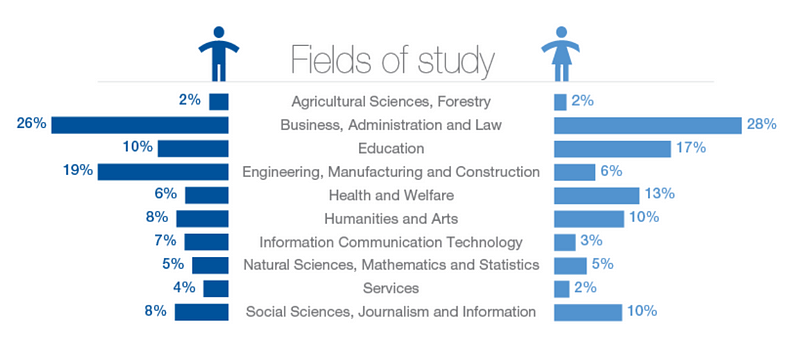
Image: Global Gender Gap Index, 2017, World Economic Forum
We can also fill the pipeline by attracting more women into the technology industry. As of now, women are drastically under-represented in the global technology sphere — just 24% of the information and communication technology (ICT) workforce is female, according to the World Economic Forum report, The Industry Gender Gap.
Jobs should always go to the best and most-qualified candidate, but it is important that we not overlooks the rich differences between men and women, and the space where diversity of thought and approach encourage creativity and innovation.While we don’t need everyone to be a software engineer, we do need employees who can learn, who can share, who can connect the dots and build good relationships with colleagues inside and outside of the organisation. Just as important, we need employees who understand how technology and society interact to drive progress for all stakeholders.
If we need employees who can do all of that, then we need leaders to match. We will need to learn new ways of leading: how to successfully manage people who are not sitting in the office where you can see them; how to measure and reward in a virtual work place and how to virtually connect diverse skill sets that will lead to optimum results.
As Professor Klaus Schwab notes, “We need leaders who are emotionally intelligent, and able to model and champion co-operative working. They’ll coach, rather than command; they’ll be driven by empathy, not ego. The digital revolution needs a different, more human kind of leadership”.