Recognize you have control of this, if nothing else — Michael Marcus Jan 10 By JESHOOTScom on Pixabay I rem...
Business
5/Cars/feat-tab
Search This Blog
Author Details
Templatesyard is a blogger resources site is a provider of high quality blogger template with premium looking layout and robust design. The main mission of templatesyard is to provide the best quality blogger templates.
The
quality of mobile design can be measured simply. When the process of
usage is so smooth and effortless that people don’t even think about it,
it is the sign of the professional design work. On the other hand, if
there are some problems in the interaction system, users will definitely
notice them and won’t be pleased about it.
Mobile
apps are expected to be clear and easy to operate so that they could be
effectively used anytime and anyplace. Designers’ task is to create an
intuitive interface which will guide users within the app helping them
operate its functionality without problems. In this article, we describe
the essential aspects of the effective mobile interaction system along
with the tips helping designers to create intuitive design.

Every
designer strives at creating a unique product with original
interactions and navigation systems. Such an approach allows standing
out a crowd and being noticeable on the market. However, creating
absolutely new environment designers have to think how users will adjust
to it.
If
the interaction system of a mobile application has no logic and
sequence or it doesn’t respond to needs of the target audience, it may
be frustrating and annoying. That condition is critical for UX, so
people will simply give up on trying to decipher an app and quit it.
To avoid this kind of outcome, designers need to care about learnability of the interactive elements. Learnability
stands for how easy tasks can be attained during the first usage and
how quickly users learn from the previous experience. To increase
learnability, designers need to keep it simple and clear helping
quickly adjust to it. Also, the system should be consistent and logical
so that users could identify the repeating patterns and use a mobile app
intuitively.
Consider multiple holds
We
all are different in many ways, even how we hold smartphones. The way
of holding smartphones depends on various factors including the
situation and conditions in which the app is used as well as the task we
need to accomplish.
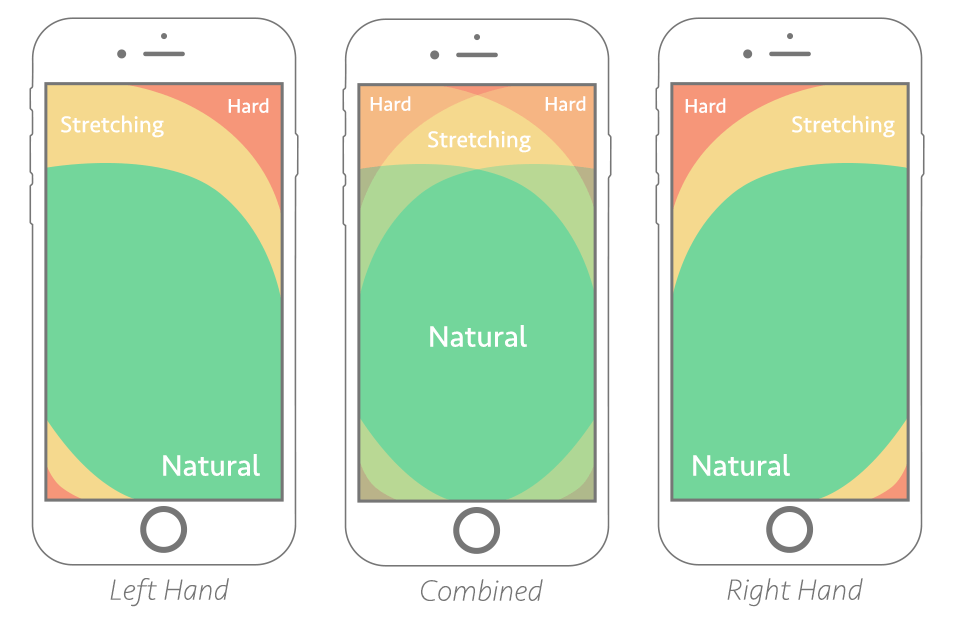
There
are three common types of holding a mobile. The first is when we take
it with one hand and navigate it with a thumb. Another way is to hold a
smartphone in one hand and interact with it with the forefinger of the
other hand. Also, the type which is common for chatting people is
holding a phone in two hands using both thumbs for actions. Of course,
there are other types of holds but these three are thought to be the
most common.

Considering
this fact, designers have to figure out if the layout elements placed
effectively for different holds. One-handed hold requires special
attention since it has the most limited space of reach. To make the
interaction process within a mobile app effortless it may be a good idea
to put the key components at the bottom of the screen so that users
would be able to reach tap areas easily. In addition, the interactive
elements should be big enough so there would be no chance for a mistap.

When
a new app can be used intuitively it means that the designer did a good
job. To provide intuitive interactions, UI design has to contain
recognition patterns. They are the elements which users are already
familiar with and those which give slight hints on how an app works. The
thing is that using an application we are expecting to see certain
things associated with the definite kind of product. For example,
working with e-commerce apps we are used to seeing cart icons along with
CTA buttons “Buy”. Familiar elements in a new app make people feel more
confident in their actions.
Users
become accustomed to things quickly and their absence makes them feel
uncomfortable. That’s why, if you plan to use custom interactive
elements, don’t forget to add some standard components. This way a new
application won’t overwhelm with an absolutely unfamiliar environment
and will help to learn quickly.

A
big pitfall of mobile UI design is small screens of the devices.
Designers have to figure out how to include all content in a short space
without turning user interface into clutter. Clean UI design helps
effectively interact with a product since all the core elements can be
easily reached.
To
create neat mobile UI it is recommended to use icons as interactive
components. Copy elements often can be too big for the small screen, so
icons are a sufficient alternative. They can explain a function
visualizing it with simple shapes and it helps to save the space on the
screen. However, during usability testing, it should be thoroughly
checked if the icons are perceived appropriately and transfer the right
message.
Decrease the number of actions
Probably,
many of us have the experience of using an annoying mobile app which
made us take a long way before we could finally accomplish the task. It
may often be caused by ineffective interaction system which employs too
many actions and the unnecessary functionality.
Mobile
apps usually serve as problem-solving assistants, so it’s vital for
them to be designed ergonomically. It means that designers have to apply
only core functional elements which will get the users right to the
point they needed. Minimum of actions won’t make your product look
primitive. It will help a mobile app be effective and pleasing in usage.
Remember that people mostly rate the quality of an application not by
extraordinary features but how helpful it is.
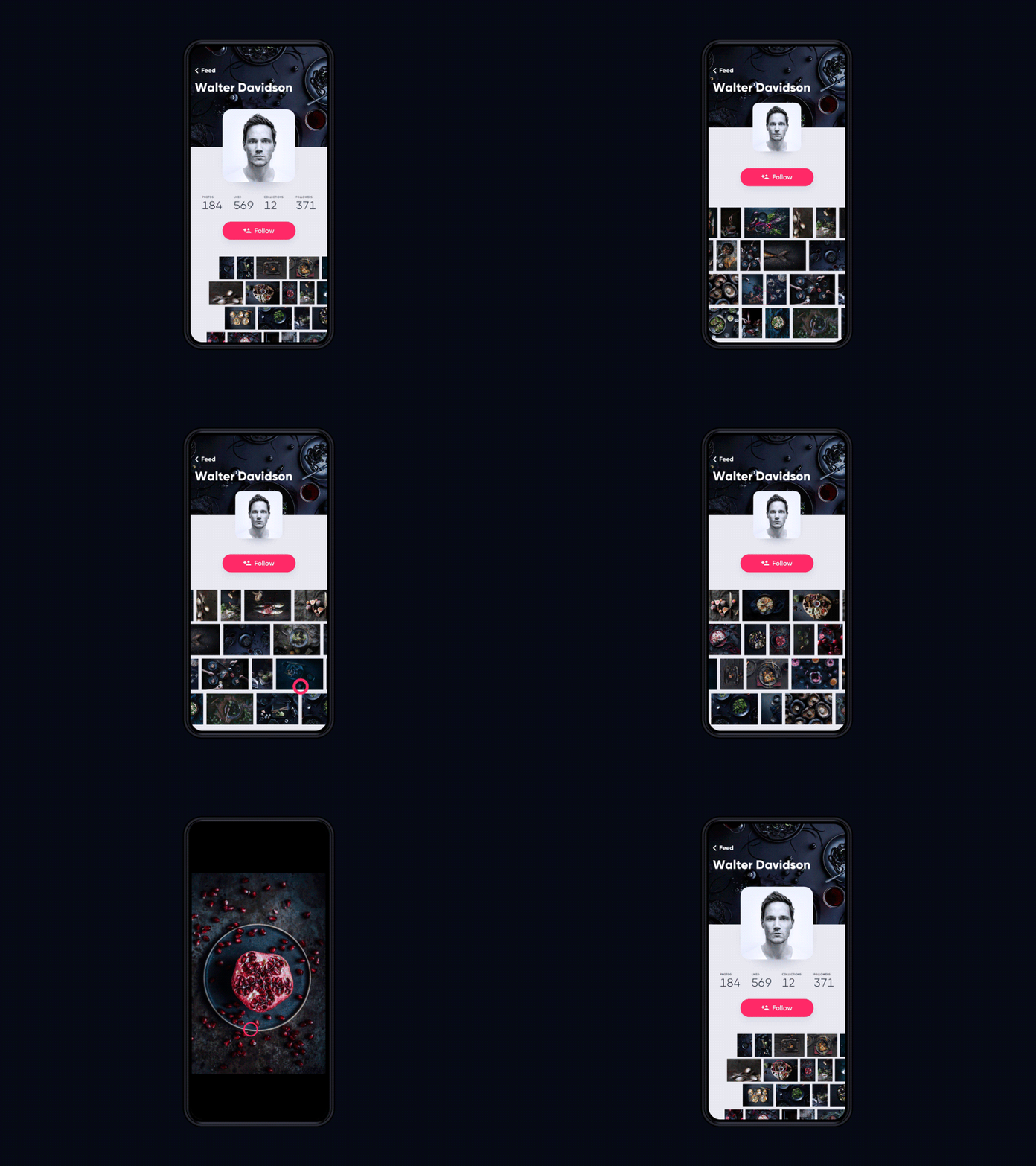
Based
on the facts described above, we can say that an effective mobile
interaction system should be simple and clear to use so that it could be
operated without problems.
However,
simplifying the interface it’s vital not make it boring. Apps which
seem ordinary have fewer chances to gain users’ attention. That’s why
it’s important to bring some emotional aspects into applications that
look standard at the first glance.
To
make the process interesting and catchy, it may be a good idea to use
gamification. It is the technique of exerting game mechanics into the
non-game environment like mobile applications. Various challenges and
leaderboards along with the awards and stickers motivate users to
interact with a product more and come back to it constantly.
What’s
more, implementing a game mechanic called a user journey is an
effective way to create clear layout and transitions. A journey is
user’s progression stages at the time of usage. Designers create UX that
way so that people could go step-by-step through the various features
which gradually change depending on needs of the target audience. An
approach helps to avoid problems with incomprehensible interactions and
functions.
Last
but not least, gamification adds the element of fun. Users enjoy
entertainment, challenges, and competitive spirit similar to video
games, so they are encouraged to go back. People always need some kind
of recreational activity so that they could escape from everyday routine
for a bit. By adding the fun element into a casual application, you
help to reduce some stress and relax for a moment.

Mobile
interaction design aims at creating a user-friendly product which will
be pleasant to use under different circumstances. But how can a designer
define if an app is usable enough and distinguish possible problems in
UX? This is when usability testing comes into play.
Usability
testing is an essential stage in creating mobile apps helping to
evaluate it by testing on the potential audience. It is usually
conducted at the UX building stage before a project goes to the
development team so that inefficient solutions could be changed easier
and faster.
Various
usability testing methods allow identifying problems and bugs and
quickly eliminate them. This way designers can improve all the aspects
of UX ensuring user satisfaction.
So,
before you deliver a project to the development team remember to handle
testing. Test it by yourself, on your colleagues, on the potential
users and then you’ll get the desired outcome.

A
simple mobile interaction system is not that easy to create. It
requires hard work, concentration and lots of practice before you
receive sufficient results. Stay tuned!

A timeless rule of living, the Golden Rule, goes as follows: “Do unto others as you would have them do unto you.”
While
largely associated with Christian ethics, this rule finds itself
embedded into numerous other schools of thought, such as in Judaism and
Confucianism. The Golden Rule is also relatively salient through modern
society and sits prominently in commonplace societal ethics.
The principle goes by many names but boils down to treating others as we’d like to be treated ourselves.
Taken a step further, with the intent of being a good citizen of
society, it begins to involve doing good for others without expectation,
which is generosity at its core.
However, there are many forms of generosity, and varying levels of impact born from generous acts. Perhaps the most tangible component of generosity is the “value” born directly from an individual performing a generous action.
However, in terms of defining value, something is missing.
The
creation of value is what betters the lives of others, whether said
value is born from acts of generosity or not. Value refers (in my mind)
to acts worth doing and things worth building, and as such, can be used
as a compass-of-sorts for those aiming to better society as a whole.
Let us define value.
Here are the first 4 definitions of value provided by Merriam-Webster:
1] the monetary worth of something (market price) 2] a fair return or equivalent in goods, services, or money for something exchanged 3] Relative worth, utility, or importance 4] something (such as a principle or quality) intrinsically valuable or desirable
As such, acts/things/projects of value are those which can be categorized as:
1] worth some amount of money to possess/receive 2] provide utility and a degree of importance to the owner 3] are typically desired by human beings
If
your “thing” (your project, generous act, idea, etc) does not fulfill
one or more of these criteria, it likely sucks; that is to say, it isn’t
valuable.
For
example, if a startup’s MVP doesn’t cover 2 of these 3 criteria, the
team should probably pivot. Products are valuable they provide a benefit
that is worth parting with our hard-earned money to enjoy.
In
order to personify the Golden Rule and the subsequent desire to improve
the lives of others (as we would only want to do “good” things unto
others as to ourselves), we must internalize the idea of what is
“valuable” and then do good things that are worth doing.
How do I bring value to the world?
A
close friend of mine often states how she “doesn’t have any valuable
skills” yet remains adamant about “wanting to change the world”
(presumably for the better).
In
some cases, the previous description of valuable acts isn’t enough. We
can have deep-seated desires to make a positive impact, or build a
better future for ourselves and loved ones, but we often need to know
where to search for further information in order to have these dreams
materialize.
In
order to understand the question we’re posing, let’s review my friend’s
source of upset — she doesn’t understand where her existing skillset
can be applied to create one of the sources of value (remember, we all have skills).
Humans
strongly desire purpose and often take great joy out of making things
happen and doing/creating things that are bigger than themselves. Living
purposeful lives makes us happier, which is contagious and makes other
people happier, and so the happiness feedback loop continues.
Soon the question becomes which sources of information tell us where our effort is best directed and create the most value for ourselves and others?
There are two approaches you can take in solving this question:
Approach #1: Figure it out on your own
This
approach sucks largely due to the fact that if you’re anything like me,
after spending an hour trying to figure out what the world needs most
(because invariably we are not satisfied with “good”, but also beat
ourselves up over “optimal”), you’ll have somehow gone from Givewell.org, to a Reddit AMA, to cat GIFs on 9gag.#productivity.
There
are too many inputs, opinions and data sources to figure out what will
be the most impactful course of action if we go it alone.
“I can get there if I just read this last article on changetheworld.org!”
Approach #2: Let the market do the research for you
“If I have seen further it is by standing on the shoulders of giants” — Isaac Newton
In
this case it is advantageous to let hundreds of other people do the
work for you. Approach #2 utilizes quantifiable metrics and data as well
as the opinions of groups and experts.
We are now on our quest to uncover the world’s most coveted valuable skills.
Our primary sources of information will break down as such:
1] Research
2] Job Market Validation
3] Social Validation
Source #1: Research
There
are organizations of people quite literally dedicated to figuring out
the most optimum ways in which we can impact the world. The two that
come to mind are GiveWell.org and 80,000 Hours.
If you have money to give:
Use GiveWell. Go look at their list of Top Charities. Recognize that the “Against Malaria Foundation” has been ranked #1 for the past 4 years in a row. Give them your money. Remember that the first definition of value was that of “the monetary worth of something”. Last time I checked, money was rather valuable.
Boom.
For less than $6 you can provide a malaria net that can save a life.
Give up Starbucks coffee for a month ($3/day over 30 days) and you can
provide 15 nets.
15 lives tangibly improved for the better.
Value created.
That was easy.
If you don’t currently have money to give:
Use 80,000 hours
as your starting point. Their mission is to help us “make the right
career choices” because then “you can help solve the world’s most
pressing problems, as well as have a more rewarding, interesting life”.
The premise is that while you may not presently have money to direct
towards valuable initiatives, you have 80,000 hours of a working career
to spend creating it.
That’s right up our alley.
Solving the world’s most pressing problems is important and also intrinsically valued. Value = created & acquired.
80,000 hours has written tremendous guides across a number of topics. I’d start with familiarizing yourself with this list to get a sense for what 80,000 hours perceives the world to need.
Then take this quiz to help determine which path to walk down.
Explore this document to get a better understanding of how 80,000hours defines the opportunities that await you.
And then go kick ass.
When
I read articles from 80,000hours and similar groups, it feels like
there is a swarm of researchers doing all of the heavy lifting to
condense all of the world’s issues down into specific paths I can walk
and ways I can help. It’s the closest we’ve gotten to a “genie in a
bottle” when it comes to knowing the first step to take in providing
value to others.
Source #2: Job Market Validation
“The
great virtue of a free market system is that it does not care what
color people are; it does not care what their religion is; it only cares
whether they can produce something you want to buy.” — Milton Friedman
The
idea of a free market economy contains the belief that markets know
what they want from us individuals and will compensate us according.
Many individuals willing to do the same types of work desired by the
market will receive lesser wages than when another type of work has a
comparatively smaller group of individuals capable and willing to do it;
this is one application of supply & demand.
In
our case, we can think about this as massive corporations doing
research for us. These corporations sit down quarterly and annually to
make forecasts regarding what they intend to do over the next period of
time. One aspect of these forecasts includes which resources are
required to achieve their goals.
That’s where we come in.
The
job market is the literal manifestation of “putting your money where
your mouth is” and as such, explicitly tells us where to direct our
efforts in order to receive certain levels of compensation.
If
you are focused on the acquisition of wealth, the market has the
ability to tell you exactly which firms to apply to work for, and the
jobs they are most willing to pay to have done.
In
some cases this is easy to understand. Large banks have needs for
individuals who can pragmatically lend out capital to requesting
organizations, and profitably trade assets in the stock market. From a
skills perspective, the banks require those who understand most asset
classes, how a commercial bank is structured, risk premiums,
diversification, etc.
In
other cases, the resource need is still explicitly stated (on the basis
of job posting itself) but the required skills grow increasingly vague.
This is based on the idea of employers needing people with certain
dispositions and past experiences, so that they will assimilate well
into the organization and its norms, rather than specific skill sets
previously taught. A majority of new graduate hires fall under this
umbrella — higher education continues to serve as a signal for the ability to push through drudging tasks and tolerate a high volume of work.
A
point of note is that in a corporate setting, we often lose the
altruistic touch that comes from working with some of the companies
listed by 80,000hours. We are trading our time for money, which means
that some available opportunities are far from glamorous — tis’ why
we’re being “compensated”. (And don’t forget there’s always the “earn to give” option!)
All
things considered, if you’re looking to earn a wage, especially if you
have a larger value-creating goal in mind (such as buying a first home
for your family or making charitable donations), then you can’t beat the
job market for telling you where your efforts are best directed. It is
more of a self-directed search, rather than 80,000hours spoon-fed the
answer, but can prove just as fruitful from an economic perspective.
Source #3: Social Validation
“When given the choice, people will always spend their time around people they like.” — Gary Vaynerchuk
This is the most intuitive source of validation.
When you perform an act for others…
Do they smile?
Do they say thank you?
Do they tell their friends?
With
all of the social media platforms available today, we can now spread
ideas rapidly across the internet. We can connect to anyone else with a
smartphone.
Most importantly, anyone we can DM or text, we can provide value to.
We
gravitate towards people we like. We take this further and spend time
with people whose values we share. We buy from businesses whose “why”
resonates with us. And if we are successful, we spend our life learning
skills and taking action to make the lives of others even better.
This is the crux of social validation.
We no longer have to say thank you in person.
Every
Instagram favorite is a thank you. Every Facebook like is a thank you.
Every Pinterest pin is a thank you. Every retweet is a thank you.
When
we are thinking of how to provide value to the world, it is best to
listen to the people whom we are working to provide value for.
There are millions of confirming/disconfirming data points.
The reason certain Instagram models receive thousands of likes is simple — their followers really like what they see!
The
reason certain companies stand out over others is simple — their
mission/values/approach resonates with their customers more than those
of their competitors.
The reason cat gifs explode onto the top page of Reddit is simple — we love cats doing ridiculously stupid things.
Social media tools practically scream at us either “YES, THIS IDEA MEANS SOMETHING” or “nah, not so much. we don’t really care.”
In effect, we must:
The new anthem for value creation
This approach comes with a caveat. In most cases, the people only want high quality content and high quality individuals.
So
yes, the world does need more personal trainers and jacked fitness
models. But only if you are in better shape yourself and more
knowledgeable than those already out there getting it done.
Yes, the world does need more instagram models. But only if you are sexier, have better lighting, and are racier than others.
Yes, the world does need another mens grooming products business. But only if your “why” is more resonant and if your products make the market happier than the majority of your competitors.
Use social media to learn about what the people want. Then give it to them in an even better way.
The
desire to create value in the world is a basic human need. We desire
purpose in our lives, and light up when we have a mission worth laboring
for.
Sometimes
we are unsure of how we can create this value in the world. Do we
pursue altruistic sources of value? Work hard and earn wages that
provide great luxuries for us and our loved ones? Build businesses
intended to resonate with our customers? The possibilities are numerous.
The
key is in using the tools already at our disposal, by letting the
collective efforts of research groups, labor markets and social networks
do the heavy lifting for us. The answers are out there, waiting for us
to act on them.
Always note the fine print. Because good writing always counts.
In
a perfect startup, employees mean everything. Hiring the best employees
is crucial to startup success. Yet, everyone HATES writing letters. The
best example? Your employee’s Job Appointment Letter. Screw this up,
and you’ll lose your best task force.
Many of us have big dreams. But how many of us actually follow through and achieved them?
Startups
starting from scratch have a hard time hiring employees. A major reason
that turns away potential hardworking, cream-of-the-crop employees is
simple — when a brand new company appears shady in its hiring process.
One
of the biggest differences between a true winner and a loser, is how
they approach their potential employees, with a direct, simplified,
semi-transparent and target-oriented selection process.
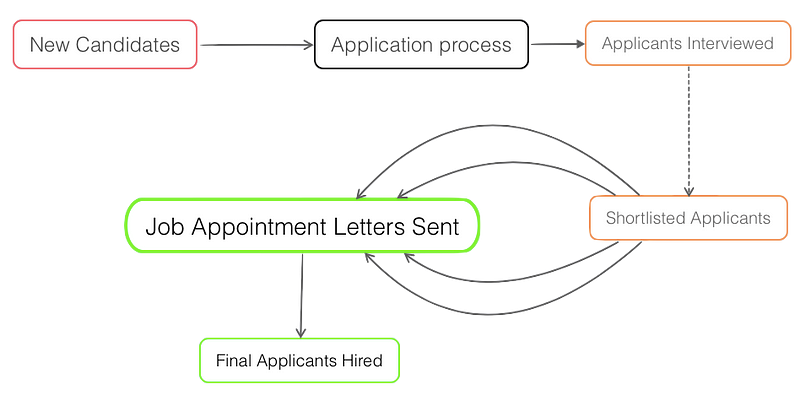
Each
time a company needs a person to fill a vacant position, it calls for
qualified applicants to send in their applications. After receiving
applications, a group of shortlisted applicants are called for
interviews. Depending on the kind of company/position, it can be one or
more interviews.
After the completion of this process, the qualified candidate[s] will be issued a job appointment letter.
This
is an overlooked step in this entire process, where potential employees
can be disinterested in a new startup, especially if the company is
either too descriptive or is not descriptive enough for the employee’s
liking.
So make sure your Job Appointment Letters are upto Scratch.
Dribble
A
Job appointment letter can be defined as a formal written document,
which is directed to an applicant who has shown interest to a particular
position in a company and has qualified in all levels of assessments.
Writing
a job appointment letter can be an overwhelming and tiresome work to
do, particularly for a CEO too busy to prepare such cumbersome
documents.
This is why it is crucial to use templates as examples which will guide you to prepare a professional job appointment letter.
A
professionally written appointment letter usually includes all the
information one needs to know about that particular position, this
includes important elements like :
1. Job Title
The official employee’s title for that particular position.
2. Commencement Date
It
is very important for the letter to clearly inform the candidate of the
starting date and time in order to avoid all possible misunderstanding.
3. Salary:
The
salary for the appointed candidate is usually stated clearly in the job
appointment letter and the mode of payments as well as the frequency of
payments. This will be important for the candidate to analyze and
accept or open a room for negotiation if there will be any.
4. Conditions:
Included
here are all the rules to abide within a particular position of a
company. This includes details about dress codes, punctuality and all
other kinds of conditions required for that position.
5. Bonuses + Compensations:
These
are rewards that will be awarded by the employer when certain targets
are met. These included health care services, days off for vacations,
store discounts and many other benefits.
★ TIP : State. Do not Invite.
A
job appointment letter is not an invitation for your employee to come
work in your organization. Instead, it is a formal statement of rules
and regulations, to which the employee must adhere to whilst spending
time under your company’s roof.
This is what a typical Job Appointment Letter looks like :
Final Conclusions :
1. This is not a replacement for a legally-binding contract. There
is still a contract which will be signed afterwards, therefore all
legal formalities will not be included in this letter. Instead they will
be found in the actual job contract.
2. Keep a Free-Flowing Communication with your Employee. You
should speak or call the candidate before issuing this letter because
this will make it seem more enthusiastic and personal on your part.
Hence, avoid sending this letter without direct communication with the
candidate.
The
most common and cliche’ advice about seeking a happy life and
prosperous career is to “follow your passion.” Millennials are notorious
for seeking fulfilling and passion-filled jobs, only to be left
disappointed and disappointing.
The primary problem, according to Newport, with the passion hypothesis is that all the attention is focused on the self. People
who want a job they are passionate about are less concerned about what
they can give to the world and are more concerned about what the world
can give to them.
There Is No “Right” Job
“Everything popular is wrong.” — Oscar Wilde
Most people are unsuccessful for a reason. They operate with faulty assumptions about how the world works.
One
of those assumptions is that we as people have preexisting passions we
need to “discover” and then follow. Famed psychologist and author of Mindset, Carol Dweck, would call this a “fixed mindset.”
Rather than selfishly seeking a life you’re passionate about, Newport recommends becoming a “craftsman,” wherein you develop rare and valuable skills. Newport calls these rare and valuable skills, “career capital.”
Here’s how this work:
You determine skills and abilities that would be useful to the world.
You set clear goals for mastering those rare and valuable skills.
You engage in deliberate practice, pushing your skills and abilities to mastery.
As
you develop confidence, you begin to deeply enjoy what you’re
doing — and become very passionate about it. As Newport explains, “Passion
comes after you put in the hard work to become excellent at something
valuable, not before. In other words, what you do for a living is much
less important than how you do it.”
As
your expertise, confidence, and passion grows, you begin to see your
work as a “calling” or “mission” (like passion and confidence, your
identity and personality are byproducts, not innate).
Because
you have developed such mastery of rare and useful skills, you have the
perspective and context to discern the “cutting edge” of your field.
You can then begin making distinct connections and projections into what has been dubbed, “The adjacent possible” which Steven Johnson described as, “a
kind of shadow future, hovering on the edges of the present state of
things, a map of all the ways in which the present can reinvent itself.”
In other words, this is how you become an innovator and a shaper of societal and global change.
Quick Re-Cap of Takeaways and Then A Road-Map of the “How”
Here is a quick recap of the core ideas in developing mastery:
You don’t have an innate passion that you should “follow,” instead, your passion follows you
Confidence isn’t what leads to success, instead, successful behavior is what leads to confidence
As
you develop “career capital” through mastering rare and valuable
skills, you’ll begin to develop confidence, passion, and personality
Thus, your personality doesn’t shape your behavior, but instead, your behavior shapes your personality
You are the shaper of your identity, happiness, and the impact of your life’s work
If you believe the reverse of any of these things, you have a “fixed mindset,” which assumption will keep you stuck and rigid.
How To Develop Mastery, Make Millions, and Be Happy
“If
you want to love what you do, abandon the passion mindset (“what can
the world offer me?”) and instead adopt the craftsman mindset (“what can
I offer the world?”).” — Cal Newport
This
final section briefly sketches the “how-to” in developing mastery,
making millions, and being happy. All three of these things are
byproducts of making congruent, aligned, and consistent choices.
Develop Mastery
If you want to become successful, it’s better to follow what successful people did to get there than to follow what they do after achieving “success.”
What people do after becoming successful is often very different than what they did to get there. This is true for a few key reasons:
“What got you here won’t get you there.”
In other words, what got people successful isn’t what keeps them
successful. There are levels, and your strategy must change the higher
up you go. If you don’t evolve and adapt, you’ll plateau.
Which
is what most people do. They reach a certain level of success, become
comfortable, and stop growing. To quote Greg McKeown, “Success becomes a
catalyst for failure.”
In order to get out of a plateau, you must embrace a learner’s mind, leverage your position, and laterally jump into new projects that force new growth and development.
If you look at any person who is honestly seeking a higher level of success, they are usually waking up early, studying and learning lots, seeking advice and feedback, and creating, testing, and failing.
This
is harder to do once you’ve gained a certain level of expertise and
success. Once you become comfortable, it’s hard to go back to the
discomfort of learning and humility. Some of the world’s most famous
chef’s continually remake their menu from scratch, even after they’ve
become world-class and received global recognition, because for them,
it’s about the process of growth and creativity.
According
to Tucker Max, many people who become good at something immediately
believe they are good at everything. They aren’t. And this is a key
reason many successful people plateau. They get “fat and lazy,” and stop
doing high quality work and pushing themselves to greater mastery. They
stop thinking about what they can do for the world and instead focus on
what the world can do for them. According to Cal Newport, if you stop
developing more “career capital,” it begins to fade away. You can only
use up so much of what you got until you have to get more. Career
capital is a resource that you use. And if you don’t use it, you’ll lose it.
Make Millions
“Life gives to the giver and takes from the taker.” — Joe Polish
Developing mastery to the point of making actual impact will not develop until you begin:
Investing in yourself, and
Investing in key relationships
If
you invest in the stock market, you may be able to get a 10–15% return.
However, when you invest in yourself and in relationships, you can
often get a 1,000% or 10X return.
According to Strategic Coach founder, Dan Sullivan, growing by 10X is actually easier than growing by 2X.
When
you make investments in yourself, you shatter unhealthy and limiting
subconscious patterns. You upgrade your sense of what you can be, do and
have.
When
you invest in key relationships, you put yourself into proximity to the
best and most generous mentors available. You gain immediate access to
people and ideas that could never have been possible without such
relationships.
Investing
actual dollars in both yourself and others dramatically changes the
psychology of things. When you invest in yourself, you become highly
committed to what you’re doing. Investing in yourself is an act that
facilitates what Charles Darwin would call, “Selective Pressure,”
which is a phenomenon that alters the behavior and fitness of living
organisms within a given environment. It is the driving force of
evolution and natural selection.
Investing in yourself creates internal supply
to match the external demand of the investment. The bigger you invest,
the bigger the psychological leap — which then facilitates a radical
upgrade in behavior, confidence, harmonious passion, and outcomes.
Investing
in relationships creates the optimal level of synergy — where both
parties can go higher and deeper than ever before — because both are
invested in each other. Crazy stuff happens when you invest dollars into
the causes and cares of other people. It changes the dynamics of the
relationship incredibly. Those you invest in will go above and beyond to
help you in all you’re doing. It becomes more than a relationship — it
becomes a mission to help you and what you’re doing.
Joe
Polish, founder of Genius Network, has what calls the “Magic Rapport
Formula,” which leads to 10X relationships and growth, and includes the
following concepts:
Focus on how you will help them reduce their suffering
Invest time, money, and energy on relationships
Be the type of person they would always answer the phone for
Be useful, grateful, and valuable
Treat others how you would love to be treated
Avoid formalities, be fun and memorable, not boring
Appreciate people
Give value on the spot
Get as close to in-person as you can
When
you engage with givers who operate by these principles, incredibly
synergistic possibilities arise. I’ve engaged in such possibilities, and
can honestly attest to the 10X principle. My income has gone up at
least 10X the last three years in a row — from making basically nothing
to making seven figures — and I anticipate 10X continuing to happen as I
humbly engage these principles.
The
only way this is possible is by continually honing your “career
capital,” investing in the right relationships, and then generously
GIVING your rare and valuable skills to the success of other people’s
goals.
It is by giving that your rare skills and abilities continue to develop and grow.
It is by giving and investing in other people that your network becomes
world-class and your ability to make lots of money becomes easy. Your
network is your net worth.
Be Happy
“Don’t
aim at success. The more you aim at it and make it a target, the more
you are going to miss it. For success, like happiness, cannot be
pursued; it must ensue, and it only does so as the unintended side
effect of one’s personal dedication to a cause greater than oneself or
as the by-product of one’s surrender to a person other than oneself.” — Viktor E. Frankl
Happiness is a byproduct. You cannot pursue it directly. It comes from dedicating yourself to a cause you firmly believe.
In
order to dedicate yourself to a cause you believe in, you must invest
yourself in the development of rare skills and abilities, which then
lead to confidence, passion, and purpose. That purpose is your “cause,”
which you now have skills and passion to contribute to.
You love what you invest yourself in.
Happiness comes from investing yourself deeply into something and someone other than yourself.
Happiness can’t come from following a self-centered and obsessive passion
aimed only at making yourself feel good. Happiness comes from
self-growth and using that growth to make the world a better place.
Either you’re focused on:
Growth or greed (“what can I give to the world” vs. “what can the world give to me”)
Giving or taking
Nurture or nature
Possibility or rigidness
You’re
happiest when you’re growing and giving. When you’ve become dedicated
to something bigger than yourself. When you’re engaged in work you have
control and autonomy over and which work is making a tangible impact in
the lives of other people. You can only have this type of work by
developing mastery, investing in others, and being a giver.
Aging has always been considered an inevitable process. But the discovery that the aging process itself could be ‘hacked’
has led to the concept of ‘health span’ as opposed to merely
‘lifespan’. A long life is not necessarily marred by disability and
death and specific dietary interventions in particular may promote
healthy long life.
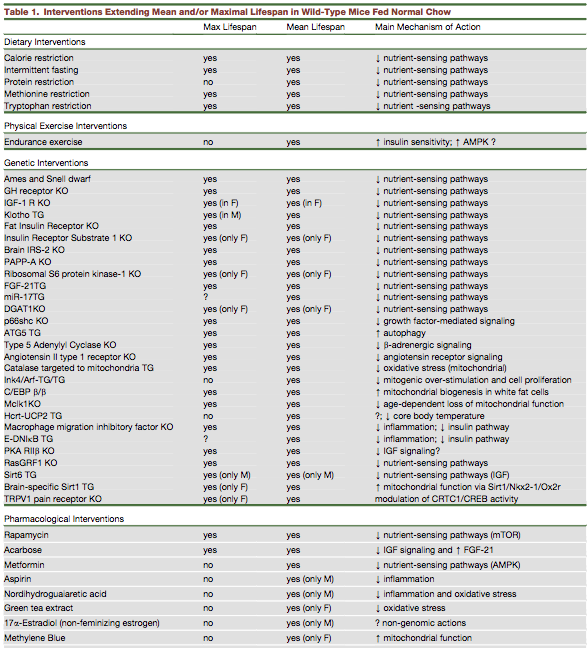
However,
much of this data results from animal data as it is difficult to
experiment on live humans. The table below illustrates the results from
dietary, exercise, genetic and drug interventions and their main
mechanism of action. Pay particular attention to the column ‘Main
Mechanism of Action’. This is the best guess as to how all these
different interventions may increase lifespan.
Did you notice something rather striking? Almost all of the interventions work through the same pathway — decreased nutrient sensing — which also includes decreased growth factor signalling and increased autophagy. As you may recall from our previous post on mTOR, the main 3 nutrient sensors of the human body, which is similar to most animals are
mTOR
AMPK
Insulin
Most of these interventions affect one or more of these pathways. With TOR, less is more.
Blocking mTOR improves protein handling, increases autophagy and
enhances stem cell function. That is, from all the animal research,
increased health span depends not on having more nutrients, it is having less. Increased longevity depends on decreasing
the nutrient sensors (lower mTOR and insulin, higher AMPK) at least
periodically. This is fascinating, because the most ancient dietary
intervention is fasting — a clear form of decreasing nutrient sensing
pathways. Humans have used fasting (or cleansing, detoxification,
purification or whatever you call it) as a method of increasing wellness
since antiquity. Benjamin Franklin, kind of a smart guy, said “The best
of all medicines is resting and fasting”
In
addition, there is a clear correlation between better mitochondrion
functioning and decreased nutrient sensors. Mitochondrion are the
powerplants of the cells, and it is obvious that cells need to have
power to work properly. Activation of SIRT1 and AMPK activates PGC-1a, a
key regulator of mitochondrial function, antioxidant defenses, and
fatty acid oxidation.
AMPK
is a highly conserved regulator of energy homeostasis and links
energetics to aging. AMPK is a sort of reverse fuel gauge of the cell.
ATP is the molecule that carries energy in a cell. When this level gets
low, AMPK goes up. AMPK induces mitochondrial biogenesis (creation of
new mitochondrion) as well as regulates mitochondrial metabolism and
dynamics. In the 2017 study, Weir et al show that AMPK can maintain
youthful mitochondrial network morphology even with aging. When they
exposed animals to Intermittent Fasting, there was a striking change in
mitochondrial networks. Both fission and fusion are required to maintain
health and lifespan.
Recent (2017 Weir et al)
work highlights the key role that dietary restriction may increase
lifespan by affecting mitochondrial networks. Mitochondrion are part of
networks that can fuse together (fusion) or break apart (fission) in
constant remodeling. A dysregulation of these mitochondrial dynamics and
abnormal morphology (shape) of these mitochondrion are hallmarks of
aging and thought to contribute to many degenerative diseases such as
Alzheimers and Parkinsons. With age, many studies report increased
swollem fragmented mitochondria. Mitophagy, a process of degrading
damaged mitochondrion and recycling, plays an important role in keeping
the dynamics normal.
If this holds true for humans, then dietary interventions are the key to longevity.
This has refocused attention to meal frequency, timing and intermittent
fasting. During our evolutionary history, most large animals and humans
ate only intermittently. Long periods of starvation were normal,
whether due to seasonal changes or due to episodic weather events. Many
animals developed forms of quiescence in response to the onset of food
shortages. If food was not available, then most of the cells in our body
stop growing. Importantly, the same genes that control quiescence also
control lifespan. In rodents, fasting for 24 hours every other day or
twice weekly extends lifespan up to 30%. Chronic caloric restriction may
also have similar benefits. Fasting may promote mitochondrial function,
trigger autophagy and DNA repair pathways.
But
what is more controversial is whether the benefits relate to caloric
restriction in general, or whether it relates to specific nutrients. Original studies from 1985
suggested that it was calories, rather than protein. However, a point
overlooked originally was that these animals were not food restricted.
Subsequent studies, (eg. Grandison et al, 2009,)Solon-Biet 2014, Nakagawa 2012
and others pointed specifically to protein restriction as the key to
longevity in these animal studies. Most believe this is due to dietary
protein’s key regulatory effect on mTOR and IGF1. In humans, unlike
rodents, severe calorie restriction does not reduce serum iGF-1
concentration unless protein intake is also reduced.
Is
it all protein or certain amino acids? The answer is not known. In
animal studies the specific amino acid that is critical differs between
species. In humans, branched chain amino acids seem to be a particularly
strong activatory of mTOR.
Decreased Nutrients Sensors
Compared
to other dietary interventions, intermittent fasting appears to be far
more powerful because alone has the ability to affect all 3 nutrient sensors simultaneously,
as well as stimulate autophagy and mitophagy. mTOR is sensitive to
dietary protein. Insulin is sensitive to proteins and carbohydrates. So
eating a pure fat diet (not realistic) may lower mTOR and insulin, but
will not be able to raise AMPK, since that senses the energy status of
the cells. If you are eat a very high fat diet (ketogenic) your body
will still be able to metabolize this to energy — generating ATP and
lowering AMPK. Only 2 of the 3 nutrient sensing pathways have been
alerted. Only complete restriction of nutrients will have this effect
(ie. fasting).
Theoretically,
eating less frequently may significantly improve health. Most
omnivorous mammals eat only intermittently, since we tend not to live on
a Petri dish where nutrients are constantly available. Carnivores like
lions and tigers often eat once a week or less. Ancestral humans tend to
eat intermittently depending on food availability. Being able to
function at a high level, both physically and intellectually, for
extended fasting periods was fundamentally important to survival. This
explains our well developed systems for food storage (glycogen in the
liver, and body fat), and also our highly conserved nutrient sensors to
slow cellular growth during a period of low nutrient availability.
Things
changed somewhat with the agricultural revolution approximately 10,000
years ago. From a hunter-gatherer society, agriculture allowed
populations of humans to stay in one area and resulted in more stable
food availability. However, there would still be seasonal variation and
possibly long weeks or months where food is less available. There would
also be shorter periods of time, days — weeks, where food was
restricted.
Most
humans ate between 2–3 times per day. Without light, it would be
difficult to eat a ‘midnight’ snack in the pitch blackness. So early
humans still followed a tradition of a long overnight fasting
period — hence the term ‘break-fast’.
Different
nutrient sensors are sensitive to different time durations. That is, it
would be useful for our body to know whether nutrients were restricted
in the short term (overnight) in the medium durations (days) or long
durations (weeks — months, seasons). You can see that our human body has
evolved exactly those same capabilities in our nutrient sensors.
Insulin (short term)
mTOR (days)
AMPK (weeks)
Insulin
spikes quickly after a meal, but falls just as quickly during an
overnight fast. It responds primarily to carbohydrates and proteins.
While protein does not raise blood glucose, it raises insulin quite a
bit. It also raises glucagon, so that blood glucose stays stable. mTOR
is mostly sensitive to protein and particularly branched chain amino
acids. It does not fall as quickly and takes somewhere from 18–30 hours
to activate. AMPK is the reverse fuel gauge of the cell (AMPK goes up as
cellular energy stores of ATP deplete) and only increases with
prolonged energy deprivation. All macronutrients can contribute to ATP
production, so AMPK is sensitive to all macronutrients.
These
nutrient sensors overlap somewhat in their sensitivities and functions
but each is also unique. In this manner, our cells are able to gain
exquisite information about the particular macronutrient availability of
the outside world. Crafted by millions of years of evolution, the
biochemical wizardry of our nutrient sensors makes a mockery of our
comparatively dull brain that can only say ‘Look like food to Grok. Grok
eat.’ But we don’t need to understand all the complicated biology to
gain the benefits. We can begin to regain some of our lost ancient
wisdom by following the ancient food tradition of taking a break from
eating once in a while. Give yourself a chance to digest the food you’ve
eaten. Intermittent fasting. Boom.