Recognize you have control of this, if nothing else — Michael Marcus Jan 10 By JESHOOTScom on Pixabay I rem...
Business
5/Cars/feat-tab
Search This Blog
Author Details
Templatesyard is a blogger resources site is a provider of high quality blogger template with premium looking layout and robust design. The main mission of templatesyard is to provide the best quality blogger templates.
The
quality of mobile design can be measured simply. When the process of
usage is so smooth and effortless that people don’t even think about it,
it is the sign of the professional design work. On the other hand, if
there are some problems in the interaction system, users will definitely
notice them and won’t be pleased about it.
Mobile
apps are expected to be clear and easy to operate so that they could be
effectively used anytime and anyplace. Designers’ task is to create an
intuitive interface which will guide users within the app helping them
operate its functionality without problems. In this article, we describe
the essential aspects of the effective mobile interaction system along
with the tips helping designers to create intuitive design.

Every
designer strives at creating a unique product with original
interactions and navigation systems. Such an approach allows standing
out a crowd and being noticeable on the market. However, creating
absolutely new environment designers have to think how users will adjust
to it.
If
the interaction system of a mobile application has no logic and
sequence or it doesn’t respond to needs of the target audience, it may
be frustrating and annoying. That condition is critical for UX, so
people will simply give up on trying to decipher an app and quit it.
To avoid this kind of outcome, designers need to care about learnability of the interactive elements. Learnability
stands for how easy tasks can be attained during the first usage and
how quickly users learn from the previous experience. To increase
learnability, designers need to keep it simple and clear helping
quickly adjust to it. Also, the system should be consistent and logical
so that users could identify the repeating patterns and use a mobile app
intuitively.
Consider multiple holds
We
all are different in many ways, even how we hold smartphones. The way
of holding smartphones depends on various factors including the
situation and conditions in which the app is used as well as the task we
need to accomplish.
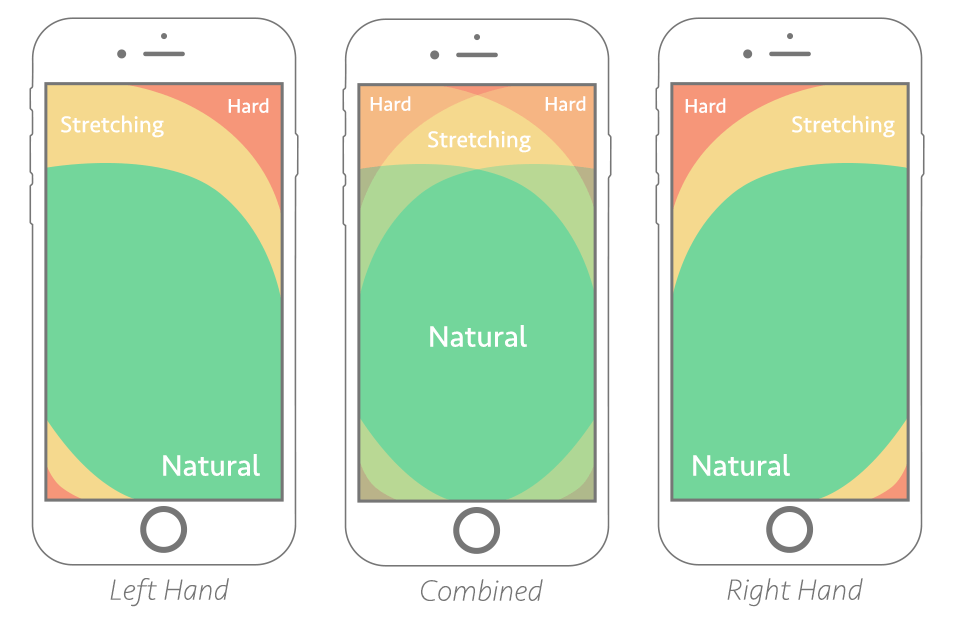
There
are three common types of holding a mobile. The first is when we take
it with one hand and navigate it with a thumb. Another way is to hold a
smartphone in one hand and interact with it with the forefinger of the
other hand. Also, the type which is common for chatting people is
holding a phone in two hands using both thumbs for actions. Of course,
there are other types of holds but these three are thought to be the
most common.

Considering
this fact, designers have to figure out if the layout elements placed
effectively for different holds. One-handed hold requires special
attention since it has the most limited space of reach. To make the
interaction process within a mobile app effortless it may be a good idea
to put the key components at the bottom of the screen so that users
would be able to reach tap areas easily. In addition, the interactive
elements should be big enough so there would be no chance for a mistap.

When
a new app can be used intuitively it means that the designer did a good
job. To provide intuitive interactions, UI design has to contain
recognition patterns. They are the elements which users are already
familiar with and those which give slight hints on how an app works. The
thing is that using an application we are expecting to see certain
things associated with the definite kind of product. For example,
working with e-commerce apps we are used to seeing cart icons along with
CTA buttons “Buy”. Familiar elements in a new app make people feel more
confident in their actions.
Users
become accustomed to things quickly and their absence makes them feel
uncomfortable. That’s why, if you plan to use custom interactive
elements, don’t forget to add some standard components. This way a new
application won’t overwhelm with an absolutely unfamiliar environment
and will help to learn quickly.

A
big pitfall of mobile UI design is small screens of the devices.
Designers have to figure out how to include all content in a short space
without turning user interface into clutter. Clean UI design helps
effectively interact with a product since all the core elements can be
easily reached.
To
create neat mobile UI it is recommended to use icons as interactive
components. Copy elements often can be too big for the small screen, so
icons are a sufficient alternative. They can explain a function
visualizing it with simple shapes and it helps to save the space on the
screen. However, during usability testing, it should be thoroughly
checked if the icons are perceived appropriately and transfer the right
message.
Decrease the number of actions
Probably,
many of us have the experience of using an annoying mobile app which
made us take a long way before we could finally accomplish the task. It
may often be caused by ineffective interaction system which employs too
many actions and the unnecessary functionality.
Mobile
apps usually serve as problem-solving assistants, so it’s vital for
them to be designed ergonomically. It means that designers have to apply
only core functional elements which will get the users right to the
point they needed. Minimum of actions won’t make your product look
primitive. It will help a mobile app be effective and pleasing in usage.
Remember that people mostly rate the quality of an application not by
extraordinary features but how helpful it is.
Based
on the facts described above, we can say that an effective mobile
interaction system should be simple and clear to use so that it could be
operated without problems.
However,
simplifying the interface it’s vital not make it boring. Apps which
seem ordinary have fewer chances to gain users’ attention. That’s why
it’s important to bring some emotional aspects into applications that
look standard at the first glance.
To
make the process interesting and catchy, it may be a good idea to use
gamification. It is the technique of exerting game mechanics into the
non-game environment like mobile applications. Various challenges and
leaderboards along with the awards and stickers motivate users to
interact with a product more and come back to it constantly.
What’s
more, implementing a game mechanic called a user journey is an
effective way to create clear layout and transitions. A journey is
user’s progression stages at the time of usage. Designers create UX that
way so that people could go step-by-step through the various features
which gradually change depending on needs of the target audience. An
approach helps to avoid problems with incomprehensible interactions and
functions.
Last
but not least, gamification adds the element of fun. Users enjoy
entertainment, challenges, and competitive spirit similar to video
games, so they are encouraged to go back. People always need some kind
of recreational activity so that they could escape from everyday routine
for a bit. By adding the fun element into a casual application, you
help to reduce some stress and relax for a moment.

Mobile
interaction design aims at creating a user-friendly product which will
be pleasant to use under different circumstances. But how can a designer
define if an app is usable enough and distinguish possible problems in
UX? This is when usability testing comes into play.
Usability
testing is an essential stage in creating mobile apps helping to
evaluate it by testing on the potential audience. It is usually
conducted at the UX building stage before a project goes to the
development team so that inefficient solutions could be changed easier
and faster.
Various
usability testing methods allow identifying problems and bugs and
quickly eliminate them. This way designers can improve all the aspects
of UX ensuring user satisfaction.
So,
before you deliver a project to the development team remember to handle
testing. Test it by yourself, on your colleagues, on the potential
users and then you’ll get the desired outcome.

A
simple mobile interaction system is not that easy to create. It
requires hard work, concentration and lots of practice before you
receive sufficient results. Stay tuned!
Humans have a tendency to overweight surface-level benefits.
Everybody
wants to be more productive. Everybody wants to learn the hard skills
that will make them more successful. Everybody wants to know how they
can build smarter habits and cultivate better routines.
These
skills have a visible reward that’s very apparent once they’re
mastered, and as a result, they get a lot of attention and resources
dedicated to them.
If
you learn how to manage your time better, you’ll be more equipped to do
something useful with it. If you learn to code or to write, you may
have a career ahead of you that you can pursue beyond an office. If you
build better habits, you can make a lot of difficult tasks easier.
These
rewards are clearly valuable. That said, they’re ultimately not the
highest leverage skills that you can nurture in yourself. In fact, the
skill that is perhaps the most potent of all is also the most neglected.
It’s
one that we all already engage with, but it’s also one that very few us
of have truly mastered. It’s both easy and difficult at the same time.
The most important skill in your life is knowing how to think.
The Fundamental Meta-Skill
Much of western philosophy can be traced back to the mind of Socrates.
The
only problem is that Socrates never wrote anything. The only record we
have of the man comes from other writers and philosophers who knew him
and engaged with him, most notably Plato.
In
Plato’s work, much of the writing is presented in the form of dialogue,
and a good portion of the dialogues are of Socrates engaged in
conversation with others, which generally end with him out-reasoning
them.
He is known to modern society for his Socratic method, which is essentially just a process of asking “Why?” over
and over again until you have broken the argument down to its core. In a
way, this simple method helps us get to the core promise made by
philosophy.
The
promise being that it will teach you more than just how to live well.
It will teach you how to think, a skill perhaps even more important.
Unfortunately,
however, this skill while responsible for everything from how you make
decisions to how you face challenges is becoming increasingly
disconnected from the institutions that are supposed to teach it to you.
Although
the internet has helped by democratizing knowledge, there are few
places that provide you with processes for making sense of it.
More
than ever, it’s on us to hone this ability. Fortunately, there are ways
you can do that. Here are three methods to improve your mental
processing.
1. De-Habituate Yourself From Instinct
Most of the responses that we give to our surroundings are habitual.
We
sense a cue in our environment, this cue is associated with something
in our memory, and whatever is in our memory produces an automatic
response.
Although
this is efficient when it comes to tasks that don’t require a thought
out response, it can be detrimental when applied to other situations.
Psychologists
often differentiate between fast thinking and slow thinking, and fast
thinking, while convenient, isn’t always completely optimal.
Whether
it’s trying to control your anger or it’s making a deliberate effort to
better evaluate an important decision at work, it’s worth reminding
yourself to look at things like you’re seeing them for the first time.
A
beginners mind, coupled with detached experience, produces a far better
result than just an instinctual reaction to an event. It forces you to
slow down and ask questions before proceeding to a final solution.
This
not only works as a way to second-guess an otherwise rushed reaction,
but looking at things like a beginner also helps you see and think about
different outcomes from a unique and, sometimes, better angle.
2. Take Time to Think About Thinking
What
is the core mental representation that you have of the world? How do
your thinking patterns connect and interact with each other? What’s the
process you go through when you make a decision?
These
are important questions, and very few people take time to actually
think about them. It’s worth creating some space to do that.
The
relationship between the different mental models you have in your mind
and how they interact with the world shapes everything else that occurs
in your life. It’s the lens through which you make sense of reality.
It’s not something that should be happening in the background of your mind.
It’s
something you should actively take time to understand and connect. It’s
something you should deliberately manipulate by reading things of value
and learning from people who are smarter than you.
As Warren Buffett says, “I
insist on a lot of time being spent, almost every day, to just sit and
think. That is very uncommon in American business. I read and think, and
make less impulse decisions than most people in business.”
You should know how your brain works so you can better influence it.
3. Routinely Reflect on Your Decisions
Your day to day decisions are ultimately the core product of your thinking.
You
can judge the quality of someone’s mind by the track record of their
decisions over an extended period of time. If the record is consistent,
then their mind is likely sharp. If it’s inconsistent, they have work to
do.
Naturally,
context matters, and so does their perception of the world, but
generally speaking, your decisions tell you a lot of about yourself.
This
doesn’t necessarily mean that you have to record every single choice
you make, but you should routinely take moments to reflect on how the
big things in your life turned out relative to your intention.
If
things went well, you should trace back to see why they did so and how
you can replicate that in the future. If they went poorly, the
dissection of that decision will teach you about a blind-spot that you
can avoid in the future.
It creates a feedback loop which, if approached well, self-corrects over time.
The
best thing about the past is the wisdom it gives you to improve
yourself for the future. That said, for it to do so, you have to
actually seek it out.
Why Is It So Important?
While
things like productivity and habit building can take you pretty far in
life, alone by themselves, there is a limit to what they can do for you.
No matter how you spin it, everything in your life begins in your mind.
The personal outlook you have is shaped by how you think about the situations that you’re engaged with on a daily basis.
The choices you make are influenced by the thinking patterns that guide your attention when you’re deeply lost in thought.
The skills you learn are influenced at their core by what you currently understand about the world and how you reason with it.
In the words of Einstein,
“The world as we have created it is a process of our thinking. It cannot be changed without changing our thinking.”
Every
idea, ambition, and possibility in your life is directly connected to
your ability to adequately make sense of your interactions with reality.
There
is no set place that’s going to teach you how to think, and it’s not
just something that’s restricted to a particular time period in your
life. It’s a skill that demands ongoing effort and commitment.
Winter has been good to my poems, with one little baby out in the world in Stirring, and another out in SWWIM, and two out in Street Light Press. But aside from the fact that all these journals begin with the letter “S,” is some other similarity playing a quiet tune here?
When
I get a piece published somewhere, I read the entire issue of the
journal. Inevitably, I’ll come across a poet whose work sings to my
existing tastes or whose work surprises me. (Check out Carolee’s poem in Stirring, for example!)
This, in turn, will often push me to read more work by those poets, in
other journals, which, in turn, gives me ideas for new places to send my
work.
Submitting
work to journals and contests and publishers (lions and tigers and
bears) is one big pain in the ass. First, you have to locate journals
that are a good match for your work. My go-to spot for that is Trish
Hopkinson’s blog, A Selfish Poet.
Then
come the tasks like record-keeping and filling out online forms, not to
mention opening yourself up to rejections. If you’re like me, and you
get lots of rejections, you need to know about lots of journals.
What makes submitting easier? Two things come to mind: a system and some sisters.
If Tim Ferriss is the “Oprah of Audio,” that means that Ryan Holiday has to be on the short-list for being named the “Pharrell of Marketing and Book Writing.”
Rarely
on the cover, but if you dig a little deeper you will find his
fingerprints everywhere. From some of the worlds most influential and
innovative people and companies, to the locker rooms of some of the most
successful sports teams, to even the clothes on your back, his name is
in the conversation.
Recently, Ryan sat down and wrote “Thank You Letters” to his friend, Tim Ferriss, and his mentor, Robert Greene, addressing 23 things he has learned by being fortunate enough to work and play with them.
While
reading these articles it dawned on me that people do not do this
enough, sit down and write out what their friends and mentors mean to
them.
After
reading his articles I sat down and wrote out “thank you letters” to my
wife and parents and realized that I should give credit, to where
credit is due, by taking the time to thank Ryan for not only positively
impacting my work, but more importantly, my life.
1. EMBRACE THE COUNTER-ARGUMENT:
A
few years back I told my dad about a book I really liked, thinking it
would start a conversation. Instead he replied “Good, now go read the
counter-argument.” End of conversation.
Ryan
and my dad would get along just fine. His work shows that after reading
a biography on Grant, he picks up Lee next. By hearing both sides of
the story, he has found a way to write his own, and in the process by
sharing his thoughts and book recommendations, he has helped thousands
of others to write theirs.
2. TREAT READING AS ANY OTHER “MUST-DO” EVERY DAY:
I
used to treat reading as a hobby, reserved for rainy days and the
occasional bathroom break. It was not until I came across Ryan´s article
on “How To Read More — A lot More” did I make the switch from reading for fun to reading for necessity.
Ryan
has said numerous times that the reasons he reads so much (hundreds of
books a year) is because, “Someone, somewhere, at some point in time,
experienced the exact same problem you are facing now and they took the
time to write about it, what took them years to figure out on their own,
we get to learn in a matter of hours.”
Is there a better reason to read?
3. WRITE EVERY DAY:
Even if you have absolutely zero aspirations to be a writer, there is no better way to clear your head and organize your ideas than putting pencil to paper.
4. LOOK WHERE EVERYONE ELSE IS GOING AND THEN DO THE OPPOSITE:
Much
of Ryan´s marketing success has come down to the idea, and execution
of, “Picking one of the our sacred cows and then slaughtering it.”
Although, he may do this to get clicks, from what I have gathered, he also lives his life this way.
Instead of being seduced by the lifestyles of LA and NYC he
decided that a small farm in Austin, Texas was the best place to be
able to do the work that mattered most to him and anything that could
potential lure him back he thoroughly analyses to make sure it is not
throwing him off track of what “he” really wants to do.
If
you create an environment, instead of allowing the environment to
create you, you might just find that the very people you once chased,
come knocking.
5. DON´T JUST ASK QUESTIONS BEFORE DOING SOMETHING, ANSWER THEM:
Ryan’s post, “3 Questions You Need To Answer Before You Have The Life You Want,”
shaped my thinking and my business more than any other. It could have
just come down to good timing. However, prior to reading this article I
had a tendency to jump into things without answering the personal side
of business questions, which ultimately led to my demise.
Define your “why” and get clear on “how you want to live.”
Answer the question, “What do you need money for?”
Take the time to audit what you really want to accomplish, not only in your career, but in your life.
For a long time I skipped this part and I paid for it.
Like Yogi Berra said, “If you do not know where you are going, you will end up somewhere else.”
6. LEARN THE RIGHT WAY TO CONTACT PEOPLE:
Successful people are successful for a reason, they have meticulously determined how, and with who, to best spend their time.
However,
a “no” does not always mean a “no.” It just means that you did not do
your homework well enough and did not identify what tools in your own
skill set can provide them real value.
Ryan taught me to take my time with this, and to make sure when I do make contact, it serves “them” more than it does “me.”
7. THE VALUE OF “ME FIRST”:
Take
the morning and knock out the things that matter to you first. If a few
hours into the day you have already done your most important work, and
filled the “you” void, playing a more reactive role going forward
becomes a lot more tolerable.
8. DO AWAY WITH DISTRACTIONS ENTIRELY WHEN WORKING:
Give
your work the respect it deserves and block out all potential
distractions for a certain amount of time each day. No phones, no
emails, just what Cal Newport calls “Deep Work.”
Block
out three hours today to get your work done. You might be surprised at
how productive you can be. Most of the time, emergencies are not
emergencies an hour later. Things can wait.
9. HOW TO MANAGE PROBLEMS:
A great deal of Ryan´s work involves the ancient Greek philosophy of Stoicism.
In the works of Marcus Aurelius, Seneca, Cato, Epictetus, Ryan has
found his own way to navigate through the things that he cannot control.
Problems are a lot less scary if they are identified before they happen.
10. THINK LIKE A PHILOSOPHER, BUT SPEAK/WRITE LIKE A TRUCK DRIVER:
No
matter how intelligent you are, if you cannot communicate your ideas in
a way that is simple to digest and easy to understand you, will never
make the mark you set out to make.
Ryan
has taken the works of some of histories greatest teachers and packaged
them in a way that is relevant to modern times. In doing so his work
has impacted thousands of people who would have otherwise written off
anything with the word “philosophy” in it. See his presentation tips here.
11. SAY “YES” EARLY and THEN “NO” OFTEN:
Learn
new skills, network like crazy, have new experiences as much as you
can, right up until you know exactly what you want to do, then protect
that privilege of finding work that matters like crazy by saying “no” often.
And for those of you that lead emails to strangers with “can we grab a coffee” and “steal just a little bit of your time” click here.
Ryan is an avid note-taker. If he reads something that hits home, he writes it down by hand on a note-card and then categories it to use at a later date or to spur ideas when he is in a rut (a habit he learned from Robert Greene).
How
often do you get stuck frantically searching for a thought or quote
that could properly fill a hole? Often? Me too. When you come across
something of value, take the time to catorgize it in a way that allows
your dots to connect more efficiently.
14. A GOOD PARTNER IS THE BEST LIFE HACK YOU WILL NEVER READ ABOUT:
Jim Rohn famously coined the expression, “You are the average of the five people you spend the most time with.”
A
big part of me agrees with this statement. However, what Mr. Rohn
failed to mention was to be very careful about who takes the top spot,
as that person may actually equate to more than 50% of your time.
The
perfect spouse will give you the confidence to do the things you dream
of doing and also some of the things you never dreamed you were capable
of in the first place.
15. IT IS OK TO STEAL FROM OTHER PEOPLE:
Ryan
is a master of taking the ideas of others and putting his own twist on
them. If you think about it, that is all innovation is today. Simply a
different take on an existing idea or product.
I
used to think that in order for me to publish something I needed to
come up with something truly original. I regret that, and Ryan helped me
to move away from that thinking, and recognizing that adding to the
conversation can be just as powerful as trying to create a new one.
16. SURROUND YOURSELF WITH PEOPLE BETTER THAN YOU:
At
an early age Ryan was fortunate enough to apprentice under some
extremely successful people. And from the looks of it, he has not slowed
down in the least from doing this.
Seek out people you admire.
Figure out a way to help them. Then rinse and repeat. As Ryan said,
“The best way to clear your own path, is to help others to clear
theirs.”
17. TAKE PRIDE IN WHAT YOU HAVE ACCOMPLISHED, THEN GET BACK TO WORK:
Shortly
after Ryan send out a Facebook message with the words, “Define Irony,”
above an image of his book, “Ego Is The Enemy,” shown on the big screen
in Time Square, he released another book, “The Daily Stoic.”
What got you where you are, very rarely is going to keep you there.
As soon as you hit send on the work you are doing, or hang up the phone after making a sale, get back to work.
18. THE BEST COMES FROM PUSHING THROUGH THE BAD:
I
grew up with a speech impediment. The one constant in my career has
been trying to overcome my embarrassment by becoming a good communicator
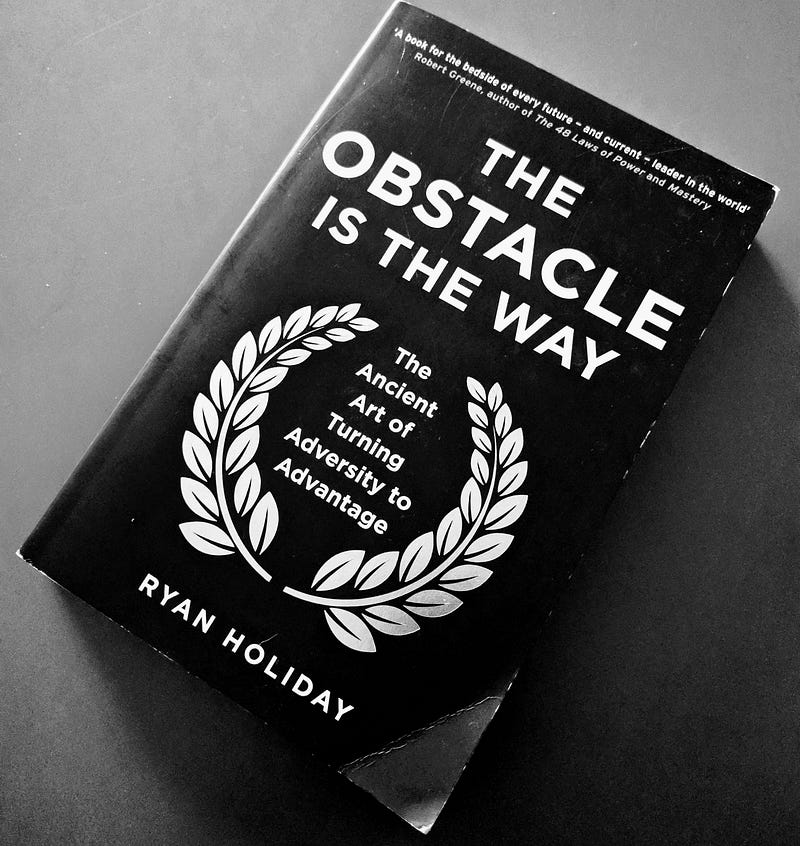
and strong salesmen. I love that Ryan went against the grain of “stick
with your strengths” for us underdogs when writing “The Obstacle Is The Way.”
19. OTHER PEOPLE SAYING HOW GREAT YOU ARE IS MUCH MORE POWERFUL THAN YOU SAYING IT ABOUT YOURSELF:
I
cannot count the number of interviews with authors, entrepreneurs, or
successful people in general, where Ryan´s name was brought up as a
quick side note. By doing good work, day in and day out, Ryan does not
have to rely on his marketing skills to sell books. His reputation takes
care of that.
20. RECOGNIZE THAT THE BRUTAL FACTS, ARE THE ONLY FACTS:
After having a light-bulb moment it is difficult to not get ahead of ourselves and build castles in the sky.
However, Ryan has trained himself to do the opposite
and also plan out worst-case scenarios. This is not a gloomy way to
look at things. It is a very pragmatic one. Planning for when things go
south, because they always will in some form or another, alleviates some
of the inevitable stress because you already have thought through the
worst case scenarios and have a plan in place to keep moving forward.
21. IT IS BETTER TO MAKE A HARD LEFT THAN AN EASY RIGHT:
Every
successful person can vividly recall the moments in their lives that
shaped their stars, and more often than not it involved making a hard
left instead of an easy right, despite the pushback.
What
I admire most about Ryan is the fact that instead of taking low-risk,
high-profile jobs, he consistently follows his intuition by choosing
personal projects that “may work out.”
22. OVER THANK PEOPLE, OVER THANK PEOPLE, OVER THANK PEOPLE:
Kind
of a gimme since the inspiration for me writing this was Ryan thanking
both Tim Ferriss and Robert Greene for all that they have done for him.
But I would imagine a young guy like Ryan did not get to where he is
today by not thanking people every chance he gets.
23. KNOW WHEN TO STOP:
The more I think about Ryan´s influence the more I could easily keep going. But I am going to stop at 22 (See Law #1).
I
am not sure how my wife is going to feel about me writing out 23
lessons I have learned from a guy who I have never met, especially one
who lives on a farm in Texas surrounded by goats, when I only wrote out
five for her.
But
like Tim Ferriss taught Ryan, “You have to keep somethings for
yourself,” and heeding their advice, I am going to keep the other 197
lessons my wife has taught me just for us.
Until you love something, you’ll never give everything you have for it.
Passion fades. Love only becomes more powerful, regardless of the outcome.
Love is the highest of all human motivations.
The lower motivations — avoiding punishment/pain, seeking
reward/pleasure, and duty — aren’t even comparable to the power of love.
Love takes the attention off of you and
places it on someone or something else. When you love something, you
put it before yourself. Very few display this level of devotion, where
you’re willing to be and do whatever is required.
Where is your love directed?
Give-Up Your Notion of “Authenticity”
If you want to make improvements in your life, you need to fundamentally change as a person.
The
idea of “changing yourself” is off-putting to some. The desire to be
“authentic” keeps people stuck in unhealthy patterns. Said, David
Heinemeier Hansson, author of Rework, “Just be yourself” is a terrible platitude for accepting the random attributes of character you’ve acquired thus far.”
According to psychologist Carol Dweck,
having the belief in a “fixed” identity can interfere with growth. Your
identity isn’t fixed. Without the belief that you can growth and
change, all of your choices would be meaningless and irrelevant.
If
you truly love someone, you’ll be who you need to be for that person.
Your thoughts will be directed toward their happiness, not how they can
make you happy. Your creativity will be towards creating meaningful
experiences for them.
If
you love a particular cause, you’ll be who you need to be to bring that
cause forward. You won’t let your current deficiencies stop you. You’ll
get educated. You’ll acquire skills. You’ll develop relationships.
You’ll fail. You work. You’ll look foolish.
It’s not about you. Kierkegaard, Socrates, and Levinas all believed love is fundamentally directed toward something outside oneself. An
over-focus on yourself keeps you stuck in your head and worried about
your own feelings, rather than out in the world doing good.
Forget
yourself and get to work. Become who you must be for the people and
causes you love. It is only in devoting yourself wholly to something
outside of yourself that you become self-actualized. It cannot happen is
a self-absorbed and self-concerned manner.
Being about something far greater than yourself is the most beautiful way to live.
Completely Own Where You Currently Are
If you want a life more than you currently have, you must be more than you currently are. Said Benjamin Disraeli, “Man is not the creature of circumstances, circumstances are the creatures of men.”
Your circumstances are a reflection of you.
If your relationships are toxic, who’s to blame?
If your finances are a mess, who’s to blame?
If you hate your job, who’s to blame?
Of course there are external factors at play, but life organically shapes itself around your standards. Until you change, your circumstances won’t. To quote Darren Hardy, “To achieve what you have not, you must become what you are not. You have to grow into your goals.”
Whatever it is you want in life, you must be that person before
you can have it.Until you become that person, you are delusional. You
won’t “live your dreams” until you become the person who creates those dreams. Said Jim Rohn, “Success is not to be pursued; it is to be attracted by the person you become.”
This
reality has recently become very apparent to me. To be blunt, I’ve been
living far beneath the results I’m seeking in my life. The reason is
simple. I haven’t loved deeply enough.
I haven’t loved my family enough.
I haven’t loved my clients enough.
I haven’t loved my work enough.
I haven’t loved my life enough.
Because I haven’t loved enough, I haven’t been the person needed to make these things as great as they could be.
I’m not crying over this fact. I’m not depressed. I’m just stating the facts. I’ve been selfish.
“Love is the only thing powerful enough to overcome everything holding you back.” — Chris Chann, professional skateboarder
Love is powerful enough to make hard and sometimes irrational decisions.
Love is powerful enough to commit to something for the long-haul.
Love is powerful enough to get you out of bed at 5AM and get to work.
Love is powerful enough to learn things and acquire skills to benefit the lives of others.
Love is powerful enough to change you into someone more and better than you currently are.
Love is always directed outward.
You Love What You Invest Yourself In
People often ask: How can I know what I WANT TO DO? How can I know what I’m passionate about?
These
questions are misdirected. They’re overtly focused on themselves and
their own happiness. Happiness cannot be pursued, it must ensue as the
unintended consequence of devotion to something or someone else. Viktor Frankl believed this too, explaining it as the very reason for both survival in Nazi concentration camps and for success in life.
Rather than worrying about what you’re passionate about, invest yourself in something you believe in.
You grow to love what you put your energy into. You love what you do well.You love what you’ve sacrificed for. You love what you’ve changed for.
If you work hard in a particular class, you’ll love that class.
If you work hard on a project, you’ll love that project.
If you work hard writing a paper, you’ll love that paper.
If you invest yourself in a relationship, you’ll love that person.
Love comes from work. It’s not a feeling. It’s committed action. And commitment is a byproduct of investment.
There
is an appalling amount of real misery and suffering in the world. It is
not far away from us. It lies at our very doors. All of us need a
feeling of deep sympathy or sorrow for another who is stricken with
misfortune, accompanied by the strong desire to alleviate the suffering.
Let
your feelings be at hand, and feel and commiserate as soon as touched.
Let your tenderest feelings come in contact with the miseries of the
distressed as soon as ever they present themselves.
A
feeling of their sorrows and weaknesses. A benevolence, which excludes
no person, not even strangers or enemies, from its tender regards, which
disdains no condescension, grudges no cost, in its labors of love!
Inward pity and compassion to distressed objects, the most tender regard
to persons in misery, and such compassion as is free from all hypocrisy
and deceit is the need of the hour.
The heart, even more than the brain, determines you.
Real
strength or weakness is closely linked with moral nature. One may have
the beauty of Venus and the charms of Cleopatra, and another the figure
of Adonis and still be void of “good” manners. Stand by the weak and
defenseless. There is no nobler feature in anyone’s character than a
determination to do this.
There
is no good in a sour, misanthropic temper. None in rudeness, stiffness,
and repulsiveness. None in violating the rules of good breeding.
Compassion
prompts us to do good to all, to forget all national or sectional
distinctions, and to aid all those who are in circumstances of poverty
and want. It would be the most lovely and desirable principle on earth,
and all, especially in their early years, should seek it. Nothing that a
young person can gain will be so valuable as the feeling that regards
all the world as one great family, and to learn early to do good to all.
Be even to thy enemy in distress as kind, humane, and merciful. Let a
young person have a large mental capacity, it will not weigh for much if
that be all.
Compassion Heals.
All
who are afflicted know how much it diminishes their sorrow to see
others sympathizing with them. How sad would be a suffering world if
there were none who regarded our griefs with interest or with tears! It
would be miserable if every sufferer were left to bear their sorrows
unpitied and alone and if all the ties of human sympathy were rudely cut
at once, and people were left to suffer in solitude and unbefriended.
We
owe sympathy to others because it is an effective means of contributing
to their moral perfection, and because by withholding it we inflict on
them a grave moral inquiry. We are tenderhearted or compassionate when
we feel affection for someone else, when we look beyond our pain to see
the pain of others. It not only lessens the misery of humanity but also
unites humans to each other as to make them responsible for the good and
comfort of one another.
While
we differ in “opinions”, we should still treat each other kindly, that
we should aid each other in necessity. A good thing done 3,000 years ago
works now, and will work through all endless times and years. No good
effort has ever been lost, or ever can be.
There are so many great lessons we all learn from life. I personally made a list with
some of the most important ones so far, lessons that had a great impact
in my life. These lessons have helped me become the person I am today. I
know there are more to come and I am ready, opened and receptive to
them all.
Enjoy.. 😃
1. We get treated in life the way we teach others to treat us.
People will treat you the way you allow them to treat you. Respect and love yourself and others will do the same.
2. There are no mistakes, only lessons we need to master.
If
you learn from everything that happens to you, you will discover that
there is no such thing as mistakes, only lessons to be learned. And if
you don’t, chances are that your life will look at 40 the same way it did when you were 20. And at 60 the way it looked when you were 40…
3. Forgiveness is a gift you give to yourself.
“Forgiveness
is a gift you give to yourself, to be at peace, to be happy and to be
able to sleep at night. You don’t forgive because you are weak but
because you are strong enough to realize that only by giving up on
resentment you will be happy. If you hold on to poisonous thoughts like
hate, anger, and resentment toward someone, you will end up poisoning
yourself more than you poison the other person, and you will be very
unhappy.”
4. What you resist, persists.
What
you focus on expands and what you resist, not only does it persist, but
it also grows in size. And if you want to shrink something and make it
disappear from your life, you need to stop feeding it by fighting
against it.
5. Life is all about the journey and less about the destination.
A
lot of times we get so focused on our big dreams and goals, that we
forget to enjoy this beautiful journey called life. Always remember that
life is all about this moment. Life is all about the journey and less
about the destination.
So
take a deep cleansing breath and allow yourself to be present in
everything you do. Allow yourself to enjoy each second of your life — to
observe the world around you, the people present in your life and the
beauty that is present within and all around you…
6. People always deserve a second chance.
The
moment you forgive somebody, chances are that you will also give them a
second chance, a chance to be near you, without trying to remind them
of what they did to you, treating them not as they are, or as they once
were, but rather as you want them to be. By doing this, you are also
allowing them to grow and to become better and better every day. Your
ego might tell you to “let these people go”
but what does your heart tell you? We are all humans, we all make
mistakes, and we all deserve a second chance, and why not, maybe a
third, fourth, a sixth and a seventh…
7. If you don’t believe in yourself, nobody will.
Don’t
expect others to see gold where you can only see dust. If you don’t
believe in yourself, if you don’t believe that you are capable, a worthy
human being, chances are that nobody will. You will act on that belief
and people will treat you based on what you think about yourself, based
on how you treat yourself and based on how you act and behave in the
world.
8. Our attitude towards life will determine life’s attitude toward us…
If
you think life is unfair, and that bad thing always happen to you,
chances are that life will treat you unfairly, and you will always have
many reasons to complain about. Because just like there is a law of
gravity, there is also a law of attraction, and based on this law, you
attract in your life, that, which you think about all day long, you
attract that, which you are, because you see, like attracts like.
When life puts you in tough situations, Don’t say Why me ? Just say Try me..
9. If you love yourself, chances are that others will also love you.
It’s
all about self-love, it all starts with self-love. If you don’t have
the love for yourself, how can you expect to get it from somebody else?
Love yourself and others will love you also.
10. The world has plenty of information but not “enough inspirations”.
If
you think about it, now with the technological revolution, we get
access to so much information. Let’s take for example a tiny chip. How
much information can you store on it? Isn’t it incredible? We have more
information than ever… but when it comes to inspiration (in- spirit) I
would say that we have a deficit. We focus too much on the outside and
not enough on the inside. We can’t seem to understand that it all starts
from within. If the inside is a mess, the outside will also be a mess.
Listen to your heart, listen to your intuition and know that:
“The only real valuable thing is intuition.” — Albert Einstein
11. The world won’t change if you don’t change.
You
hear people all the time complaining about how crazy the world is and
how they want it to change, but if you tell them to make the first step…
“What? Me? Do you think there is
something wrong with me? I am perfect, there is nothing I need to
change. These people are crazy and they need to change, not me! They are
the ones who are destroying us all, not me… Those ***** !”
You
see, the outside world is a reflection of who we all are on the inside,
and all this madness that is taking place around us, is a result of our
collective consciousness, and unfortunately it’s a very polluted
consciousness. It’s not just them, it’s us, we all. If we want the world
to change, we have to start with ourselves and trust me, there is
something wrong with many of us. With you, with me, with he and she…
12. Loneliness is different from solitude.
There
is a difference between being lonely and being in solitude. When you
are in solitude, you take advantage of it to get in touch with your inner self,
to meditate and to quiet your mind, and that constant need to be around
others in order for you to no longer feel lonely, will disappear.
Wayne Dyer talks about this in such a wonderful way, saying that “we can never be lonely if we like the person we’re alone with”.
If you like yourself, if you have no problem with your own person, if
you have accepted yourself completely, you will be content with having
some quiet time, away from all the noise. You will feel happy when alone
and also when surrounded by other people.
13. The more we express our gratitude, the more things we will have to be grateful for.
The
law of attraction works in all that is good and also in all that is
bad, and it’s only up to us whether we choose to focus our attention on
the negative or on the positive. Focus your attention on the many great
things you have and you are grateful for, and you will see that the more
you do that, the more reasons you will have to express your gratitude
for.
14. Patience is a virtue.
In order for things to happen, in order for anything to happen, we need to be patient. We first plant the seed of Greatness,Goodness and then we wait for it to grow, we allow it to grow; we take care & nurture it and we protect it. Great things take time and we need to learn how to give time.
15. Courage is not the absence of fear.
Fear, that crazy fear who won’t allow us to move forward,
who won’t allow us to grow and transform our lives and of those around
us will always be present in our lives. Even though many of us know that
fear does not exist and that fear is only in our mind, we choose to be
paralyzed by it and we choose to allow it to control our lives, our
dreams, our goals and the level of our happiness. Fear will be present
whenever you want to stretch, whenever you want to get out of your comfort zone
and whenever you want to do more, be more, have more. What we need to
do is look beyond it, and always be aware of the fact that most of the
things we fear never happen, because FEAR is nothing more than False Expectation Appearing Real.
One Last thing..
What is one lesson you have learned from life that completely changed and transformed you?
If
you found this helpful, please help in spreading this message by
recommending this post. Also, feel free to share your own ideas about
this in the responses below. Thanks for reading 😀…