Recognize you have control of this, if nothing else — Michael Marcus Jan 10 By JESHOOTScom on Pixabay I rem...
Business
5/Cars/feat-tab
Search This Blog
Author Details
Templatesyard is a blogger resources site is a provider of high quality blogger template with premium looking layout and robust design. The main mission of templatesyard is to provide the best quality blogger templates.
The
quality of mobile design can be measured simply. When the process of
usage is so smooth and effortless that people don’t even think about it,
it is the sign of the professional design work. On the other hand, if
there are some problems in the interaction system, users will definitely
notice them and won’t be pleased about it.
Mobile
apps are expected to be clear and easy to operate so that they could be
effectively used anytime and anyplace. Designers’ task is to create an
intuitive interface which will guide users within the app helping them
operate its functionality without problems. In this article, we describe
the essential aspects of the effective mobile interaction system along
with the tips helping designers to create intuitive design.

Every
designer strives at creating a unique product with original
interactions and navigation systems. Such an approach allows standing
out a crowd and being noticeable on the market. However, creating
absolutely new environment designers have to think how users will adjust
to it.
If
the interaction system of a mobile application has no logic and
sequence or it doesn’t respond to needs of the target audience, it may
be frustrating and annoying. That condition is critical for UX, so
people will simply give up on trying to decipher an app and quit it.
To avoid this kind of outcome, designers need to care about learnability of the interactive elements. Learnability
stands for how easy tasks can be attained during the first usage and
how quickly users learn from the previous experience. To increase
learnability, designers need to keep it simple and clear helping
quickly adjust to it. Also, the system should be consistent and logical
so that users could identify the repeating patterns and use a mobile app
intuitively.
Consider multiple holds
We
all are different in many ways, even how we hold smartphones. The way
of holding smartphones depends on various factors including the
situation and conditions in which the app is used as well as the task we
need to accomplish.
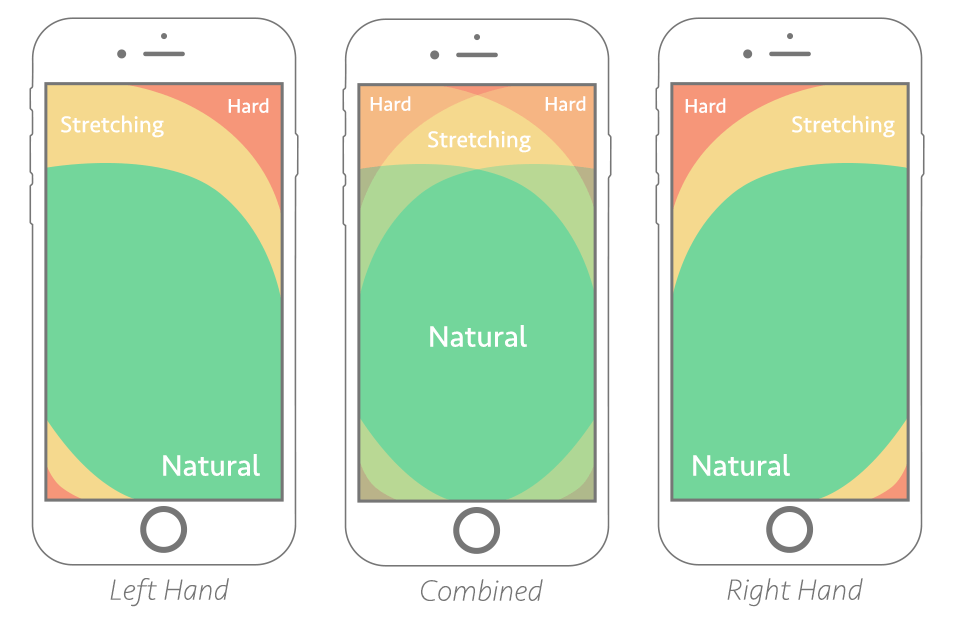
There
are three common types of holding a mobile. The first is when we take
it with one hand and navigate it with a thumb. Another way is to hold a
smartphone in one hand and interact with it with the forefinger of the
other hand. Also, the type which is common for chatting people is
holding a phone in two hands using both thumbs for actions. Of course,
there are other types of holds but these three are thought to be the
most common.

Considering
this fact, designers have to figure out if the layout elements placed
effectively for different holds. One-handed hold requires special
attention since it has the most limited space of reach. To make the
interaction process within a mobile app effortless it may be a good idea
to put the key components at the bottom of the screen so that users
would be able to reach tap areas easily. In addition, the interactive
elements should be big enough so there would be no chance for a mistap.

When
a new app can be used intuitively it means that the designer did a good
job. To provide intuitive interactions, UI design has to contain
recognition patterns. They are the elements which users are already
familiar with and those which give slight hints on how an app works. The
thing is that using an application we are expecting to see certain
things associated with the definite kind of product. For example,
working with e-commerce apps we are used to seeing cart icons along with
CTA buttons “Buy”. Familiar elements in a new app make people feel more
confident in their actions.
Users
become accustomed to things quickly and their absence makes them feel
uncomfortable. That’s why, if you plan to use custom interactive
elements, don’t forget to add some standard components. This way a new
application won’t overwhelm with an absolutely unfamiliar environment
and will help to learn quickly.

A
big pitfall of mobile UI design is small screens of the devices.
Designers have to figure out how to include all content in a short space
without turning user interface into clutter. Clean UI design helps
effectively interact with a product since all the core elements can be
easily reached.
To
create neat mobile UI it is recommended to use icons as interactive
components. Copy elements often can be too big for the small screen, so
icons are a sufficient alternative. They can explain a function
visualizing it with simple shapes and it helps to save the space on the
screen. However, during usability testing, it should be thoroughly
checked if the icons are perceived appropriately and transfer the right
message.
Decrease the number of actions
Probably,
many of us have the experience of using an annoying mobile app which
made us take a long way before we could finally accomplish the task. It
may often be caused by ineffective interaction system which employs too
many actions and the unnecessary functionality.
Mobile
apps usually serve as problem-solving assistants, so it’s vital for
them to be designed ergonomically. It means that designers have to apply
only core functional elements which will get the users right to the
point they needed. Minimum of actions won’t make your product look
primitive. It will help a mobile app be effective and pleasing in usage.
Remember that people mostly rate the quality of an application not by
extraordinary features but how helpful it is.
Based
on the facts described above, we can say that an effective mobile
interaction system should be simple and clear to use so that it could be
operated without problems.
However,
simplifying the interface it’s vital not make it boring. Apps which
seem ordinary have fewer chances to gain users’ attention. That’s why
it’s important to bring some emotional aspects into applications that
look standard at the first glance.
To
make the process interesting and catchy, it may be a good idea to use
gamification. It is the technique of exerting game mechanics into the
non-game environment like mobile applications. Various challenges and
leaderboards along with the awards and stickers motivate users to
interact with a product more and come back to it constantly.
What’s
more, implementing a game mechanic called a user journey is an
effective way to create clear layout and transitions. A journey is
user’s progression stages at the time of usage. Designers create UX that
way so that people could go step-by-step through the various features
which gradually change depending on needs of the target audience. An
approach helps to avoid problems with incomprehensible interactions and
functions.
Last
but not least, gamification adds the element of fun. Users enjoy
entertainment, challenges, and competitive spirit similar to video
games, so they are encouraged to go back. People always need some kind
of recreational activity so that they could escape from everyday routine
for a bit. By adding the fun element into a casual application, you
help to reduce some stress and relax for a moment.
Mobile
interaction design aims at creating a user-friendly product which will
be pleasant to use under different circumstances. But how can a designer
define if an app is usable enough and distinguish possible problems in
UX? This is when usability testing comes into play.
Usability
testing is an essential stage in creating mobile apps helping to
evaluate it by testing on the potential audience. It is usually
conducted at the UX building stage before a project goes to the
development team so that inefficient solutions could be changed easier
and faster.
Various
usability testing methods allow identifying problems and bugs and
quickly eliminate them. This way designers can improve all the aspects
of UX ensuring user satisfaction.
So,
before you deliver a project to the development team remember to handle
testing. Test it by yourself, on your colleagues, on the potential
users and then you’ll get the desired outcome.

A
simple mobile interaction system is not that easy to create. It
requires hard work, concentration and lots of practice before you
receive sufficient results. Stay tuned!

Note:
Some of these courses are free, but if you decide to purchase anything
(using the links below) you’ll be financially supporting the Personal
Growth publication. Thanks for your support.
This course combines4
different courses. As you participate in each of the courses you will
master Excel tools that will clear away the pain of stumbling through
your daily tasks. You will start with the basics, building a solid
foundation that will give you further knowledge as you progress into
intermediate and advanced level topics.
This
series of courses will help you build, develop and hone the essential
skills needed to improve your employability and advancement in today’s
dynamic workforce. The Specialization concludes with a project that will
give you the opportunity to integrate and apply the skills you have
gained throughout the courses to your individual and organizational
needs.
In this course you’ll learn the skills that make up the entire Product Managementjob and process: from ideation to market research, to UX wireframing to prototyping, technology, metrics,and finally to building the product with user stories, project management, scoping, and leadership.
This
comprehensive course is based on the innovative strategies of the
career management offices at the University of California at Berkeley.
Each module leverages cutting-edge research from top-flight
organizations like Harvard Business School, the McKinsey Consulting
Group, and Duke University.
You
already understand the basics of HTML and CSS, but you don’t
necessarily feel qualified for the web developer jobs you want. This
course will help bridge that gap. You’ll learn the modern skill-set that
companies are looking for in developers.
This
course provides 35-contact hours of project management education and is
taught by project management author and expert Joseph Phillips. If you
complete all the videos and interactive sessions, you can claim these
educational hours for your PMP exam application.
Whether
you are completely new to the job market, re-entering the workforce or
looking to advance your career, this course will empower you with the
knowledge and skills necessary to dazzle during your next interview.
This
course combines the essential elements of Project Management and Team
Leadership into one course. Through class engagement and reflection, you
will acquire further understanding of the responsibilities of
leadership and become better prepared to apply this knowledge to the
project environment.
Learn
the core concepts of business analysis to land a Business Analysis job.
If you are an aspiring Business Analyst or one that is new to the role,
this course can help lay the foundation you will build all future
knowledge and experience on top of.
This
course is built so that you can immediately use PowerPoint once you
finish the first section. It contains all the basic elements you need to
build and present your presentation. Following that section, each
section will get progressively harder until you become an expert.
Data
has become the hottest topic in technology and a company’s biggest
asset is their data. Oracle is the most popular relational database in
the world. This course will prepare you to be job-ready in just 1 month
of study and practice. You don’t need any prior experience in
programming.
Writing
a great resume for yourself will be the stepping stone that lands you a
job interview and you will want one that sets you apart from the rest.
In this course you will learn the tools and techniques which will enable
you to create a master piece resume for yourself.
Understand
how Access is constructed and how to use the major objects within it.
Be confident in moving around within Access and be able to build
effective database solutions for their unique data needs.
This
comprehensive complete career course is 12 hours, contains more than
250 lectures, 67 easy to complete exercises and 29 templates/other
downloads to help you get your dream job.
If
you want to get a Help Desk, Systems Admin, IT Support Specialist, or
other IT related job, this is the course you have been looking for. This
course will give you the critical skills necessary to succeed in the
Information Technology field.
This
course is designed for non-native English speakers who are interested
in advancing their careers in the global marketplace. In this course,
you will learn about the job search, application, and interview process
in the United States, while comparing and contrasting the same process
in your home country.
In
this course you’ll learn how play can (and should) inform your career
choice and steer you towards a career you love. You’ll explore how
personality and lifestyle can guide you towards the career that’s right
for you.
A timeless rule of living, the Golden Rule, goes as follows: “Do unto others as you would have them do unto you.”
While
largely associated with Christian ethics, this rule finds itself
embedded into numerous other schools of thought, such as in Judaism and
Confucianism. The Golden Rule is also relatively salient through modern
society and sits prominently in commonplace societal ethics.
The principle goes by many names but boils down to treating others as we’d like to be treated ourselves.
Taken a step further, with the intent of being a good citizen of
society, it begins to involve doing good for others without expectation,
which is generosity at its core.
However, there are many forms of generosity, and varying levels of impact born from generous acts. Perhaps the most tangible component of generosity is the “value” born directly from an individual performing a generous action.
However, in terms of defining value, something is missing.
The
creation of value is what betters the lives of others, whether said
value is born from acts of generosity or not. Value refers (in my mind)
to acts worth doing and things worth building, and as such, can be used
as a compass-of-sorts for those aiming to better society as a whole.
Let us define value.
Here are the first 4 definitions of value provided by Merriam-Webster:
1] the monetary worth of something (market price) 2] a fair return or equivalent in goods, services, or money for something exchanged 3] Relative worth, utility, or importance 4] something (such as a principle or quality) intrinsically valuable or desirable
As such, acts/things/projects of value are those which can be categorized as:
1] worth some amount of money to possess/receive 2] provide utility and a degree of importance to the owner 3] are typically desired by human beings
If
your “thing” (your project, generous act, idea, etc) does not fulfill
one or more of these criteria, it likely sucks; that is to say, it isn’t
valuable.
For
example, if a startup’s MVP doesn’t cover 2 of these 3 criteria, the
team should probably pivot. Products are valuable they provide a benefit
that is worth parting with our hard-earned money to enjoy.
In
order to personify the Golden Rule and the subsequent desire to improve
the lives of others (as we would only want to do “good” things unto
others as to ourselves), we must internalize the idea of what is
“valuable” and then do good things that are worth doing.
How do I bring value to the world?
A
close friend of mine often states how she “doesn’t have any valuable
skills” yet remains adamant about “wanting to change the world”
(presumably for the better).
In
some cases, the previous description of valuable acts isn’t enough. We
can have deep-seated desires to make a positive impact, or build a
better future for ourselves and loved ones, but we often need to know
where to search for further information in order to have these dreams
materialize.
In
order to understand the question we’re posing, let’s review my friend’s
source of upset — she doesn’t understand where her existing skillset
can be applied to create one of the sources of value (remember, we all have skills).
Humans
strongly desire purpose and often take great joy out of making things
happen and doing/creating things that are bigger than themselves. Living
purposeful lives makes us happier, which is contagious and makes other
people happier, and so the happiness feedback loop continues.
Soon the question becomes which sources of information tell us where our effort is best directed and create the most value for ourselves and others?
There are two approaches you can take in solving this question:
Approach #1: Figure it out on your own
This
approach sucks largely due to the fact that if you’re anything like me,
after spending an hour trying to figure out what the world needs most
(because invariably we are not satisfied with “good”, but also beat
ourselves up over “optimal”), you’ll have somehow gone from Givewell.org, to a Reddit AMA, to cat GIFs on 9gag.#productivity.
There
are too many inputs, opinions and data sources to figure out what will
be the most impactful course of action if we go it alone.
“I can get there if I just read this last article on changetheworld.org!”
Approach #2: Let the market do the research for you
“If I have seen further it is by standing on the shoulders of giants” — Isaac Newton
In
this case it is advantageous to let hundreds of other people do the
work for you. Approach #2 utilizes quantifiable metrics and data as well
as the opinions of groups and experts.
We are now on our quest to uncover the world’s most coveted valuable skills.
Our primary sources of information will break down as such:
1] Research
2] Job Market Validation
3] Social Validation
Source #1: Research
There
are organizations of people quite literally dedicated to figuring out
the most optimum ways in which we can impact the world. The two that
come to mind are GiveWell.org and 80,000 Hours.
If you have money to give:
Use GiveWell. Go look at their list of Top Charities. Recognize that the “Against Malaria Foundation” has been ranked #1 for the past 4 years in a row. Give them your money. Remember that the first definition of value was that of “the monetary worth of something”. Last time I checked, money was rather valuable.
Boom.
For less than $6 you can provide a malaria net that can save a life.
Give up Starbucks coffee for a month ($3/day over 30 days) and you can
provide 15 nets.
15 lives tangibly improved for the better.
Value created.
That was easy.
If you don’t currently have money to give:
Use 80,000 hours
as your starting point. Their mission is to help us “make the right
career choices” because then “you can help solve the world’s most
pressing problems, as well as have a more rewarding, interesting life”.
The premise is that while you may not presently have money to direct
towards valuable initiatives, you have 80,000 hours of a working career
to spend creating it.
That’s right up our alley.
Solving the world’s most pressing problems is important and also intrinsically valued. Value = created & acquired.
80,000 hours has written tremendous guides across a number of topics. I’d start with familiarizing yourself with this list to get a sense for what 80,000 hours perceives the world to need.
Then take this quiz to help determine which path to walk down.
Explore this document to get a better understanding of how 80,000hours defines the opportunities that await you.
And then go kick ass.
When
I read articles from 80,000hours and similar groups, it feels like
there is a swarm of researchers doing all of the heavy lifting to
condense all of the world’s issues down into specific paths I can walk
and ways I can help. It’s the closest we’ve gotten to a “genie in a
bottle” when it comes to knowing the first step to take in providing
value to others.
Source #2: Job Market Validation
“The
great virtue of a free market system is that it does not care what
color people are; it does not care what their religion is; it only cares
whether they can produce something you want to buy.” — Milton Friedman
The
idea of a free market economy contains the belief that markets know
what they want from us individuals and will compensate us according.
Many individuals willing to do the same types of work desired by the
market will receive lesser wages than when another type of work has a
comparatively smaller group of individuals capable and willing to do it;
this is one application of supply & demand.
In
our case, we can think about this as massive corporations doing
research for us. These corporations sit down quarterly and annually to
make forecasts regarding what they intend to do over the next period of
time. One aspect of these forecasts includes which resources are
required to achieve their goals.
That’s where we come in.
The
job market is the literal manifestation of “putting your money where
your mouth is” and as such, explicitly tells us where to direct our
efforts in order to receive certain levels of compensation.
If
you are focused on the acquisition of wealth, the market has the
ability to tell you exactly which firms to apply to work for, and the
jobs they are most willing to pay to have done.
In
some cases this is easy to understand. Large banks have needs for
individuals who can pragmatically lend out capital to requesting
organizations, and profitably trade assets in the stock market. From a
skills perspective, the banks require those who understand most asset
classes, how a commercial bank is structured, risk premiums,
diversification, etc.
In
other cases, the resource need is still explicitly stated (on the basis
of job posting itself) but the required skills grow increasingly vague.
This is based on the idea of employers needing people with certain
dispositions and past experiences, so that they will assimilate well
into the organization and its norms, rather than specific skill sets
previously taught. A majority of new graduate hires fall under this
umbrella — higher education continues to serve as a signal for the ability to push through drudging tasks and tolerate a high volume of work.
A
point of note is that in a corporate setting, we often lose the
altruistic touch that comes from working with some of the companies
listed by 80,000hours. We are trading our time for money, which means
that some available opportunities are far from glamorous — tis’ why
we’re being “compensated”. (And don’t forget there’s always the “earn to give” option!)
All
things considered, if you’re looking to earn a wage, especially if you
have a larger value-creating goal in mind (such as buying a first home
for your family or making charitable donations), then you can’t beat the
job market for telling you where your efforts are best directed. It is
more of a self-directed search, rather than 80,000hours spoon-fed the
answer, but can prove just as fruitful from an economic perspective.
Source #3: Social Validation
“When given the choice, people will always spend their time around people they like.” — Gary Vaynerchuk
This is the most intuitive source of validation.
When you perform an act for others…
Do they smile?
Do they say thank you?
Do they tell their friends?
With
all of the social media platforms available today, we can now spread
ideas rapidly across the internet. We can connect to anyone else with a
smartphone.
Most importantly, anyone we can DM or text, we can provide value to.
We
gravitate towards people we like. We take this further and spend time
with people whose values we share. We buy from businesses whose “why”
resonates with us. And if we are successful, we spend our life learning
skills and taking action to make the lives of others even better.
This is the crux of social validation.
We no longer have to say thank you in person.
Every
Instagram favorite is a thank you. Every Facebook like is a thank you.
Every Pinterest pin is a thank you. Every retweet is a thank you.
When
we are thinking of how to provide value to the world, it is best to
listen to the people whom we are working to provide value for.
There are millions of confirming/disconfirming data points.
The reason certain Instagram models receive thousands of likes is simple — their followers really like what they see!
The
reason certain companies stand out over others is simple — their
mission/values/approach resonates with their customers more than those
of their competitors.
The reason cat gifs explode onto the top page of Reddit is simple — we love cats doing ridiculously stupid things.
Social media tools practically scream at us either “YES, THIS IDEA MEANS SOMETHING” or “nah, not so much. we don’t really care.”
In effect, we must:
The new anthem for value creation
This approach comes with a caveat. In most cases, the people only want high quality content and high quality individuals.
So
yes, the world does need more personal trainers and jacked fitness
models. But only if you are in better shape yourself and more
knowledgeable than those already out there getting it done.
Yes, the world does need more instagram models. But only if you are sexier, have better lighting, and are racier than others.
Yes, the world does need another mens grooming products business. But only if your “why” is more resonant and if your products make the market happier than the majority of your competitors.
Use social media to learn about what the people want. Then give it to them in an even better way.
The
desire to create value in the world is a basic human need. We desire
purpose in our lives, and light up when we have a mission worth laboring
for.
Sometimes
we are unsure of how we can create this value in the world. Do we
pursue altruistic sources of value? Work hard and earn wages that
provide great luxuries for us and our loved ones? Build businesses
intended to resonate with our customers? The possibilities are numerous.
The
key is in using the tools already at our disposal, by letting the
collective efforts of research groups, labor markets and social networks
do the heavy lifting for us. The answers are out there, waiting for us
to act on them.
When I was in the 3rd grade, we had to write a paragraph about something we loved, and then draw a picture in the box above it.
We
were first asked to draw and write in pencil, and then once the teacher
had checked our work, we were supposed to carefully go over each word
in the paragraph with a black pen, creating the finished product.
When
I started going over the words with my black pen, I outlined the first
word of the paragraph, and then the second, and then I thought it would
be fun to outline the last word of my story, and then some words in the
middle — just sort of outlining the letters I was drawn to next, not
following any sort of rigid path.
My teacher walked over and said, “Cole? How’s it coming?”
I held up my piece of paper to show her how far I’d gotten — I was very proud of my work.
She scrunched her eyebrows, crossed her arms and asked, “Why aren’t you going over the words in order?”
A bit confused by her question, I said, very honestly, “They’re all going to be colored in at the end. Why does it matter how I get there?”
She called home that night and told my parents I had a learning disability.
My experience with formal education was, shall we say, less than impressive.
I
was a straight C student all the way up through high school. I was a
horrible test-taker. I didn’t do very well on my ACT. I was constantly
asked to leave class because the questions I would ask were so
rudimentary that my teachers thought I was mocking them — when really
(at least, most of the time…) I just had trouble following the lesson.
Not everyone learns the same way.
And
I believe a significant portion of my adolescence was wasted by a
school system that tried to wedge me into a tiny circle on a Scranton
sheet.
I’m not dumb.
I’ve
been playing Mozart and Beethoven on the piano since I was seven years
old. I’ve won writing contests and debate competitions. I am about to publish my first book.
I just learn better by getting my hands dirty — not sitting in a
fake-marble desk chair listening to a monotone teacher in front of a
whiteboard.
Now,
I’ll be the first to admit I definitely did not give school everything I
had — I gave up on school at a very early age. Mostly because I felt
like school gave up on me.
School never asked, “How do you learn?” Instead, school told me how I should learn — and when it didn’t work, school called me Dumb.
Well, here are 9 things school didn’t teach me that I learned on my own:
1. There Are No Rules.
The
people who enforce the rules (creatively speaking here) are the people
who don’t have the confidence or the belief that the world is an easel
and everyone has a paintbrush.
2. Titles Are Crippling, Not “The Goal”.
All
those kids that got straight As, went to the Ivy League school of their
choice, got the fancy title at the fancy company… They can keep it.
Titles are crippling.
Titles
encourage you to relax, and let your title speak for you — instead of
your skill and knowledge earning you other people’s respect.
But
when push comes to shove, it’s the people who have gotten their hands
dirty in the trenches you want on your team. Not the ones with a fancy
title in front of their names.
3. There Is No “1 Right Way” To Do Anything.
This is a massive disservice school teaches kids — that there is a “right” way and a “wrong” way.
False. There are a million ways.
And
the name of the game isn’t to do it any one particular way. It’s to
understand which one works the best for YOU, and will allow you to
maximize your strengths.
4. HOW Is More Important Than WHAT.
HOW you do something is far more important than WHAT you do.
In
every industry, there are those who do things with honor, integrity,
discipline, passion, and heart, and there are those who do so with
malicious intent, or a lack of sincerity, etc.
Think
about the people who respect or look up to. You look up to them because
of HOW they approach what they do, not WHAT they do.
5. Acceptance Is Overrated.
Remember all those class projects you had to do?
Remember all the times you were told to agree with your classmates for the sake of learning how to ‘work well with others’ ?
That cultivates a bad habit of suppressing your own unique voice and the great debates that spark truly meaningful ideas.
Being accepted is overrated — and the real world taught me that the hard way.
6. Learning How To Learn Is What’s Important.
Reiterating the point here, school would be so much more beneficial if it taught students HOW to learn — not WHAT to learn.
What good is memorizing chemistry equations if you don’t fundamentally understand the process of learning?
So many kids struggle as soon as they get out of school because they don’t have anyone telling them anymore, “Here, learn this next.”
They lack direction — because they were never taught the art of learning.
7. Your Passion Is Not A Waste Of Time.
School
(and society at large) wants us to believe that there are acceptable
hobbies and hobbies that are a waste of time. It’s the reason the first
departments to go are always art or music related.
But
what you love is NEVER a waste of time. You will always learn more from
an interest pulled at from your heart than a pursuit dangled in front
of your head.
8. “Success” Does Not Have One Definition.
School likes to measure things — usually in the form of a letter grade beside each subject of study.
It
inherently defines “success” as “better” or “higher” or “more.” But
that’s just not true. “Success” could mean honest expression, or it
could mean presence, or it could mean facing a challenge, failing, and
learning a valuable lesson.
Success comes in many different forms. It’s not always about getting the “A.”
9. It’s OK To Be Different.
And finally, the most important one of them all: Who you are is already good enough.
School
has this funny way of making kids that are “different” feel
extra-different, extra-weird, extra-not-normal. But you know what? Get
out into the real world, and the most valuable thing you could possibly
have is to be “different.”
Everybody wants to stand out. Everybody wants something that’s going to set them apart.