Human

Showing posts with label Human. Show all posts

Thursday, January 10, 2019

If you work for a long time, then be careful


If you work continuously for long hours and do not take any kind of break, this can lead to health related problems. Scientists have said that there is still a need to study more about the continuous sitting and the most effective and practical way of reducing the work. This information was given by Linda Ignace of Texas University in Rio Grande Valley in the United States. Ianeyes said that the role of nurses is very important in spreading awareness about the bad effect of staying on for a long time.
In a recent study, it has been found that there is a direct relationship between working longer and fear of many serious diseases. Some people have been claiming that they have been able to compensate for this loss after exercising for a long time after exercising. But according to the American Journal of Nursing, using any exercise can not reduce the losses incurred by working for long periods of time.
Staying in one place for more time will keep the heart at risk. The cause of death of 4% of the world's total deaths was only because they used to sit continuously for 3 to 4 hours in a day. It can also be dangerous for a person to sit constantly, watch TV or work for a long time on a computer or working on a sleeper soda. It is very harmful for health, which is also becoming deadly. If you work on a chair for 3 hours continuously due to 1 work, it can be dangerous for health.
Based on a recent research conducted in 54 countries around the world, it is found that 3.8% of the world's deaths are due to sit on a continuous chair for 3 hours or more. This means that this study, which was recently created by the habit of 4.33 million people every year, was published in the American Journal of Preventive Medicine, which was done by San Jorge University of Spain, Zaragoza.
In this study, the change in statistics between 2003 and 2011 was noticed in the Chair Effect.
Due to continuous sitting, most of the deaths occurred in European countries, Middle Eastern countries, America and South Asian countries. The largest percentage in Lebanon is 11.6%, in the Netherlands 7.6% and Denmark in 6.9%. It has also been mentioned in the study that, if we reduce the two-hour time of continuous sitting, then it can reduce the risk of death for up to three times. That is, this risk can be reduced by 2.3 percent.

Friday, January 19, 2018

Longevity and Diet


Aging has always been considered an inevitable process. But the discovery that the aging process itself could be ‘hacked’ has led to the concept of ‘health span’ as opposed to merely ‘lifespan’. A long life is not necessarily marred by disability and death and specific dietary interventions in particular may promote healthy long life.
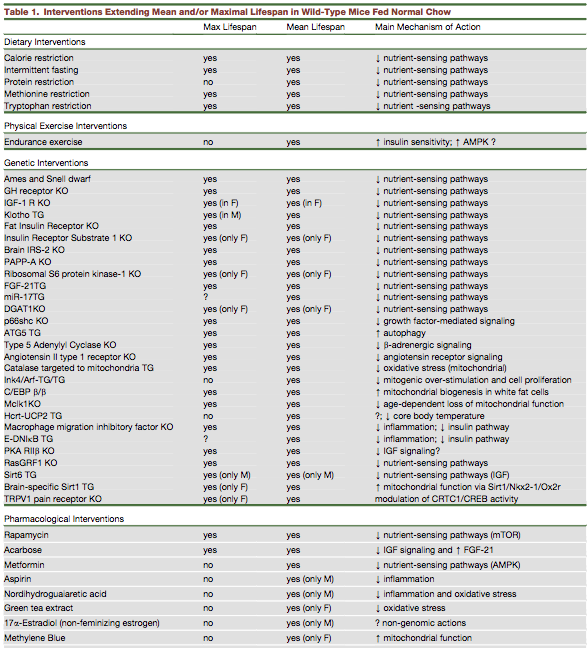
However, much of this data results from animal data as it is difficult to experiment on live humans. The table below illustrates the results from dietary, exercise, genetic and drug interventions and their main mechanism of action. Pay particular attention to the column ‘Main Mechanism of Action’. This is the best guess as to how all these different interventions may increase lifespan.
Did you notice something rather striking? Almost all of the interventions work through the same pathway — decreased nutrient sensing — which also includes decreased growth factor signalling and increased autophagy. As you may recall from our previous post on mTOR, the main 3 nutrient sensors of the human body, which is similar to most animals are
  1. mTOR
  2. AMPK
  3. Insulin
Most of these interventions affect one or more of these pathways. With TOR, less is more. Blocking mTOR improves protein handling, increases autophagy and enhances stem cell function. That is, from all the animal research, increased health span depends not on having more nutrients, it is having less. Increased longevity depends on decreasing the nutrient sensors (lower mTOR and insulin, higher AMPK) at least periodically. This is fascinating, because the most ancient dietary intervention is fasting — a clear form of decreasing nutrient sensing pathways. Humans have used fasting (or cleansing, detoxification, purification or whatever you call it) as a method of increasing wellness since antiquity. Benjamin Franklin, kind of a smart guy, said “The best of all medicines is resting and fasting”
In addition, there is a clear correlation between better mitochondrion functioning and decreased nutrient sensors. Mitochondrion are the powerplants of the cells, and it is obvious that cells need to have power to work properly. Activation of SIRT1 and AMPK activates PGC-1a, a key regulator of mitochondrial function, antioxidant defenses, and fatty acid oxidation.
AMPK is a highly conserved regulator of energy homeostasis and links energetics to aging. AMPK is a sort of reverse fuel gauge of the cell. ATP is the molecule that carries energy in a cell. When this level gets low, AMPK goes up. AMPK induces mitochondrial biogenesis (creation of new mitochondrion) as well as regulates mitochondrial metabolism and dynamics. In the 2017 study, Weir et al show that AMPK can maintain youthful mitochondrial network morphology even with aging. When they exposed animals to Intermittent Fasting, there was a striking change in mitochondrial networks. Both fission and fusion are required to maintain health and lifespan.
Recent (2017 Weir et al) work highlights the key role that dietary restriction may increase lifespan by affecting mitochondrial networks. Mitochondrion are part of networks that can fuse together (fusion) or break apart (fission) in constant remodeling. A dysregulation of these mitochondrial dynamics and abnormal morphology (shape) of these mitochondrion are hallmarks of aging and thought to contribute to many degenerative diseases such as Alzheimers and Parkinsons. With age, many studies report increased swollem fragmented mitochondria. Mitophagy, a process of degrading damaged mitochondrion and recycling, plays an important role in keeping the dynamics normal.
If this holds true for humans, then dietary interventions are the key to longevity. This has refocused attention to meal frequency, timing and intermittent fasting. During our evolutionary history, most large animals and humans ate only intermittently. Long periods of starvation were normal, whether due to seasonal changes or due to episodic weather events. Many animals developed forms of quiescence in response to the onset of food shortages. If food was not available, then most of the cells in our body stop growing. Importantly, the same genes that control quiescence also control lifespan. In rodents, fasting for 24 hours every other day or twice weekly extends lifespan up to 30%. Chronic caloric restriction may also have similar benefits. Fasting may promote mitochondrial function, trigger autophagy and DNA repair pathways.
But what is more controversial is whether the benefits relate to caloric restriction in general, or whether it relates to specific nutrients. Original studies from 1985 suggested that it was calories, rather than protein. However, a point overlooked originally was that these animals were not food restricted. Subsequent studies, (eg. Grandison et al, 2009,) Solon-Biet 2014, Nakagawa 2012 and others pointed specifically to protein restriction as the key to longevity in these animal studies. Most believe this is due to dietary protein’s key regulatory effect on mTOR and IGF1. In humans, unlike rodents, severe calorie restriction does not reduce serum iGF-1 concentration unless protein intake is also reduced.
Is it all protein or certain amino acids? The answer is not known. In animal studies the specific amino acid that is critical differs between species. In humans, branched chain amino acids seem to be a particularly strong activatory of mTOR.
Decreased Nutrients Sensors
Compared to other dietary interventions, intermittent fasting appears to be far more powerful because alone has the ability to affect all 3 nutrient sensors simultaneously, as well as stimulate autophagy and mitophagy. mTOR is sensitive to dietary protein. Insulin is sensitive to proteins and carbohydrates. So eating a pure fat diet (not realistic) may lower mTOR and insulin, but will not be able to raise AMPK, since that senses the energy status of the cells. If you are eat a very high fat diet (ketogenic) your body will still be able to metabolize this to energy — generating ATP and lowering AMPK. Only 2 of the 3 nutrient sensing pathways have been alerted. Only complete restriction of nutrients will have this effect (ie. fasting).
[caption id=”attachment_7879" align=”alignright” width=”320"]
Petri dish[/caption]
Theoretically, eating less frequently may significantly improve health. Most omnivorous mammals eat only intermittently, since we tend not to live on a Petri dish where nutrients are constantly available. Carnivores like lions and tigers often eat once a week or less. Ancestral humans tend to eat intermittently depending on food availability. Being able to function at a high level, both physically and intellectually, for extended fasting periods was fundamentally important to survival. This explains our well developed systems for food storage (glycogen in the liver, and body fat), and also our highly conserved nutrient sensors to slow cellular growth during a period of low nutrient availability.
Things changed somewhat with the agricultural revolution approximately 10,000 years ago. From a hunter-gatherer society, agriculture allowed populations of humans to stay in one area and resulted in more stable food availability. However, there would still be seasonal variation and possibly long weeks or months where food is less available. There would also be shorter periods of time, days — weeks, where food was restricted.
Most humans ate between 2–3 times per day. Without light, it would be difficult to eat a ‘midnight’ snack in the pitch blackness. So early humans still followed a tradition of a long overnight fasting period — hence the term ‘break-fast’.
Different nutrient sensors are sensitive to different time durations. That is, it would be useful for our body to know whether nutrients were restricted in the short term (overnight) in the medium durations (days) or long durations (weeks — months, seasons). You can see that our human body has evolved exactly those same capabilities in our nutrient sensors.
  1. Insulin (short term)
  2. mTOR (days)
  3. AMPK (weeks)
Insulin spikes quickly after a meal, but falls just as quickly during an overnight fast. It responds primarily to carbohydrates and proteins. While protein does not raise blood glucose, it raises insulin quite a bit. It also raises glucagon, so that blood glucose stays stable. mTOR is mostly sensitive to protein and particularly branched chain amino acids. It does not fall as quickly and takes somewhere from 18–30 hours to activate. AMPK is the reverse fuel gauge of the cell (AMPK goes up as cellular energy stores of ATP deplete) and only increases with prolonged energy deprivation. All macronutrients can contribute to ATP production, so AMPK is sensitive to all macronutrients.
These nutrient sensors overlap somewhat in their sensitivities and functions but each is also unique. In this manner, our cells are able to gain exquisite information about the particular macronutrient availability of the outside world. Crafted by millions of years of evolution, the biochemical wizardry of our nutrient sensors makes a mockery of our comparatively dull brain that can only say ‘Look like food to Grok. Grok eat.’ But we don’t need to understand all the complicated biology to gain the benefits. We can begin to regain some of our lost ancient wisdom by following the ancient food tradition of taking a break from eating once in a while. Give yourself a chance to digest the food you’ve eaten. Intermittent fasting. Boom.

Thursday, January 18, 2018

The Most Important Skill in Your Life


Humans have a tendency to overweight surface-level benefits.
Everybody wants to be more productive. Everybody wants to learn the hard skills that will make them more successful. Everybody wants to know how they can build smarter habits and cultivate better routines.
These skills have a visible reward that’s very apparent once they’re mastered, and as a result, they get a lot of attention and resources dedicated to them.
If you learn how to manage your time better, you’ll be more equipped to do something useful with it. If you learn to code or to write, you may have a career ahead of you that you can pursue beyond an office. If you build better habits, you can make a lot of difficult tasks easier.
These rewards are clearly valuable. That said, they’re ultimately not the highest leverage skills that you can nurture in yourself. In fact, the skill that is perhaps the most potent of all is also the most neglected.
It’s one that we all already engage with, but it’s also one that very few us of have truly mastered. It’s both easy and difficult at the same time.
The most important skill in your life is knowing how to think.

The Fundamental Meta-Skill

Much of western philosophy can be traced back to the mind of Socrates.
The only problem is that Socrates never wrote anything. The only record we have of the man comes from other writers and philosophers who knew him and engaged with him, most notably Plato.
In Plato’s work, much of the writing is presented in the form of dialogue, and a good portion of the dialogues are of Socrates engaged in conversation with others, which generally end with him out-reasoning them.
He is known to modern society for his Socratic method, which is essentially just a process of asking “Why?” over and over again until you have broken the argument down to its core. In a way, this simple method helps us get to the core promise made by philosophy.
The promise being that it will teach you more than just how to live well. It will teach you how to think, a skill perhaps even more important.
Unfortunately, however, this skill while responsible for everything from how you make decisions to how you face challenges is becoming increasingly disconnected from the institutions that are supposed to teach it to you.
Although the internet has helped by democratizing knowledge, there are few places that provide you with processes for making sense of it.
More than ever, it’s on us to hone this ability. Fortunately, there are ways you can do that. Here are three methods to improve your mental processing.

1. De-Habituate Yourself From Instinct

Most of the responses that we give to our surroundings are habitual.
We sense a cue in our environment, this cue is associated with something in our memory, and whatever is in our memory produces an automatic response.
Although this is efficient when it comes to tasks that don’t require a thought out response, it can be detrimental when applied to other situations.
Psychologists often differentiate between fast thinking and slow thinking, and fast thinking, while convenient, isn’t always completely optimal.
Whether it’s trying to control your anger or it’s making a deliberate effort to better evaluate an important decision at work, it’s worth reminding yourself to look at things like you’re seeing them for the first time.
A beginners mind, coupled with detached experience, produces a far better result than just an instinctual reaction to an event. It forces you to slow down and ask questions before proceeding to a final solution.
This not only works as a way to second-guess an otherwise rushed reaction, but looking at things like a beginner also helps you see and think about different outcomes from a unique and, sometimes, better angle.

2. Take Time to Think About Thinking

What is the core mental representation that you have of the world? How do your thinking patterns connect and interact with each other? What’s the process you go through when you make a decision?
These are important questions, and very few people take time to actually think about them. It’s worth creating some space to do that.
The relationship between the different mental models you have in your mind and how they interact with the world shapes everything else that occurs in your life. It’s the lens through which you make sense of reality.
It’s not something that should be happening in the background of your mind.
It’s something you should actively take time to understand and connect. It’s something you should deliberately manipulate by reading things of value and learning from people who are smarter than you.
As Warren Buffett says, “I insist on a lot of time being spent, almost every day, to just sit and think. That is very uncommon in American business. I read and think, and make less impulse decisions than most people in business.”
You should know how your brain works so you can better influence it.

3. Routinely Reflect on Your Decisions

Your day to day decisions are ultimately the core product of your thinking.
You can judge the quality of someone’s mind by the track record of their decisions over an extended period of time. If the record is consistent, then their mind is likely sharp. If it’s inconsistent, they have work to do.
Naturally, context matters, and so does their perception of the world, but generally speaking, your decisions tell you a lot of about yourself.
This doesn’t necessarily mean that you have to record every single choice you make, but you should routinely take moments to reflect on how the big things in your life turned out relative to your intention.
If things went well, you should trace back to see why they did so and how you can replicate that in the future. If they went poorly, the dissection of that decision will teach you about a blind-spot that you can avoid in the future.
It creates a feedback loop which, if approached well, self-corrects over time.
The best thing about the past is the wisdom it gives you to improve yourself for the future. That said, for it to do so, you have to actually seek it out.

Why Is It So Important?

While things like productivity and habit building can take you pretty far in life, alone by themselves, there is a limit to what they can do for you.
No matter how you spin it, everything in your life begins in your mind.
The personal outlook you have is shaped by how you think about the situations that you’re engaged with on a daily basis.
The choices you make are influenced by the thinking patterns that guide your attention when you’re deeply lost in thought.
The skills you learn are influenced at their core by what you currently understand about the world and how you reason with it.
In the words of Einstein,
“The world as we have created it is a process of our thinking. It cannot be changed without changing our thinking.”
Every idea, ambition, and possibility in your life is directly connected to your ability to adequately make sense of your interactions with reality.
There is no set place that’s going to teach you how to think, and it’s not just something that’s restricted to a particular time period in your life. It’s a skill that demands ongoing effort and commitment.
Fortunately, if mastered, it changes everything.

Thursday, January 11, 2018

Compassion Raises Us Up Above Ourself.


Photo by “My Life Through A Lens” on Unsplash
There is an appalling amount of real misery and suffering in the world. It is not far away from us. It lies at our very doors. All of us need a feeling of deep sympathy or sorrow for another who is stricken with misfortune, accompanied by the strong desire to alleviate the suffering.
Let your feelings be at hand, and feel and commiserate as soon as touched. Let your tenderest feelings come in contact with the miseries of the distressed as soon as ever they present themselves.
A feeling of their sorrows and weaknesses. A benevolence, which excludes no person, not even strangers or enemies, from its tender regards, which disdains no condescension, grudges no cost, in its labors of love! Inward pity and compassion to distressed objects, the most tender regard to persons in misery, and such compassion as is free from all hypocrisy and deceit is the need of the hour.
The heart, even more than the brain, determines you.
Real strength or weakness is closely linked with moral nature. One may have the beauty of Venus and the charms of Cleopatra, and another the figure of Adonis and still be void of “good” manners. Stand by the weak and defenseless. There is no nobler feature in anyone’s character than a determination to do this.
There is no good in a sour, misanthropic temper. None in rudeness, stiffness, and repulsiveness. None in violating the rules of good breeding.
Compassion prompts us to do good to all, to forget all national or sectional distinctions, and to aid all those who are in circumstances of poverty and want. It would be the most lovely and desirable principle on earth, and all, especially in their early years, should seek it. Nothing that a young person can gain will be so valuable as the feeling that regards all the world as one great family, and to learn early to do good to all. Be even to thy enemy in distress as kind, humane, and merciful. Let a young person have a large mental capacity, it will not weigh for much if that be all.
Compassion Heals.
All who are afflicted know how much it diminishes their sorrow to see others sympathizing with them. How sad would be a suffering world if there were none who regarded our griefs with interest or with tears! It would be miserable if every sufferer were left to bear their sorrows unpitied and alone and if all the ties of human sympathy were rudely cut at once, and people were left to suffer in solitude and unbefriended.
We owe sympathy to others because it is an effective means of contributing to their moral perfection, and because by withholding it we inflict on them a grave moral inquiry. We are tenderhearted or compassionate when we feel affection for someone else, when we look beyond our pain to see the pain of others. It not only lessens the misery of humanity but also unites humans to each other as to make them responsible for the good and comfort of one another.
While we differ in “opinions”, we should still treat each other kindly, that we should aid each other in necessity. A good thing done 3,000 years ago works now, and will work through all endless times and years. No good effort has ever been lost, or ever can be.