Education

Showing posts with label Education. Show all posts

Thursday, February 1, 2018

4 Reasons to Solve Your Life Problems on Paper



Originally published by Stephen Guise on his personal website.
The main, overarching reason? The paper is outside of your mind. This creates several advantages.

1. Paper can hold unlimited data

If I give you a sheet of paper containing 300 numbers, how much of the sequence can you memorize in 30 seconds? Most people will max out at probably 10–30 numbers. But the humble piece of paper “memorizes” all 300 the instant they’re written. Unlike your mind, you have no data limit for your pencil.

2. Complex problems are easier to solve on paper

I was a math wiz. I used to hate it when my teacher told me to show my work. But as impressed as I was with myself, it’s easier, more reliable, and equally correct to work out problems on paper. Some math and life problems are too complicated to solve in your head.

3. You can’t hide from the truth when it’s looking at you

The mind is easily distracted, especially when faced with an uncomfortable problem. Most problems we face in life are not urgent ones. They’re things like feeling lonely, not finding your work fulfilling, and wanting to lose 30 pounds. None of these problems will ruin your life today, they will slowly eat away at your soul over the course of many years.
Problems often resemble a weak poison. You know something’s not quite right, but in time, you can get used to the feeling of being “off.” It’s only when you address and solve your problem that you feel the massive difference of say, getting healthier.
If you put your problem to paper–it doesn’t have to be public–it will be there for a long time. This is significantly different than a thought, which can come and go in mere seconds.
When you think, “I should find a church that suits me,” and have the same unproductive and passive thoughts about it for the 33rd time this year, it’s exactly 32 times more than necessary. It’s also not solving your problem. Paper solves these wasted “duplicate thoughts,” and makes it easier to see what actions you can take to move forward.

4. It’s much easier to focus

I have spent double digit hours looking at screens before, whether they are computer screens or TV screens (video games). I don’t know if I’ve ever sat down on my bed and thought about something for even two hours straight. The mind wanders when the eyes see things in the physical environment, and even if not, the mind wanders on its own with no physical focal point.
It’s remarkable how much easier it is to focus on something in the physical world. It’s just the way our bodies are wired. So you can have the same problem, one on paper and one in your head, with the former being dramatically easier to focus on solving.

Paper = Written Word

Paper has some serious upsides! Of course, when I say paper, I really just mean the written word. You can write things down on a computer or cell phone, too. In fact, physical paper writing is usually a bad choice for me, given that I type so much faster on a keyboard.
Some people use journaling to directly or indirectly deal with life. This is a great practice because it will essentially bring your issues into the physical realm. That sounds bad, like you’re giving life to a monster, but it’s actually good because the single greatest attack against life problems is exposure. The problems that linger are those that remain in silence, safely away from any of those pesky solutions.
Aside from a journal or in addition to one, I’d consider some kind of challenge notebook in which you work out some of your struggles on paper and then come up with suitable challenges to overcome them. To start, just spill out your thoughts onto paper, and you’ll eventually find the root.

Solve It On Paper Example: “I Feel Lonely Sometimes”

Why am I lonely when I have so much to offer? I don’t see any difference between me and the people who are happily married with lots of friends. I make people laugh all the time, people seem to like me, and women respond positively to me and flirt when I actually talk to them (instead of my other move of trying to get to know them by occasionally glancing at them). Hmm… I suppose one difference between me and those with robust social networks is that their lifestyle, workplace, and personality naturally brought them relationships, whereas my lifestyle/career is naturally very isolated and my personality is sometimes (though not always) reserved.
I’ve definitely seen a difference while traveling. I find a lot more friends and romantic interests while traveling compared to home life. I’m significantly more outgoing when I travel. It seems then, that in order for me to obtain the sort of social life I desire, I need to adjust either my lifestyle/environment, my outgoingness, or both. There’s no evidence that I’m unlovable, and there’s a lot of evidence that good things happen when I put myself out there. So, the solution could be as simple as joining more groups that interest me, traveling, practicing being more outgoing, or making a greater effort to socialize with acquaintances to see if friendships form. It’s not that it’s difficult to do these things. But they require INTENTION, and I haven’t been intentional, so I haven’t done them! Makes sense.
  • Challenge: Join a group of interest (look at meetup.com, church groups, sports leagues)
  • Challenge: organize more pickup basketball games to expand my social network
  • Challenge: create a meetup group
  • Challenge: travel long term
See how it has a conversational and explorative tone to it? I’m not judging myself, I’m not pressuring myself, I’m just thinking my unpolished, raw, honest thoughts onto the page, and seeing where they lead me. It’s almost like I’m venting to a friend, but also playing the role of the friend, trying to be constructive and supportive. This is MUCH easier to do on paper than in your head.
When you do this, it should naturally lead you to challenges that could improve your situation. As for the challenges — this is important — they may or may not be the solution, but they are a START. And I wouldn’t say that I have to do them, either. I’m stating something I want to improve and saying, “Hey self, if you want to improve your life, now you know exactly where to begin.”
Starting is everything! Even if the challenges themselves aren’t THE solution, they will teach me a lot and likely lead to a solution down the road.
Having the challenges on paper makes them much harder to ignore, doesn’t it? They’re right there, looking at you. And a final note is that the challenges need not be intimidating! Make them mini! Another possible challenge for this example is to simply say “hi” to at least one stranger per day. That’s pretty easy, and who knows what might come of it? It could lead to meeting new people, developing conversation skills, boosting confidence, or becoming more outgoing.
When it doubt, write it down!

Thursday, January 18, 2018

The Most Important Skill in Your Life


Humans have a tendency to overweight surface-level benefits.
Everybody wants to be more productive. Everybody wants to learn the hard skills that will make them more successful. Everybody wants to know how they can build smarter habits and cultivate better routines.
These skills have a visible reward that’s very apparent once they’re mastered, and as a result, they get a lot of attention and resources dedicated to them.
If you learn how to manage your time better, you’ll be more equipped to do something useful with it. If you learn to code or to write, you may have a career ahead of you that you can pursue beyond an office. If you build better habits, you can make a lot of difficult tasks easier.
These rewards are clearly valuable. That said, they’re ultimately not the highest leverage skills that you can nurture in yourself. In fact, the skill that is perhaps the most potent of all is also the most neglected.
It’s one that we all already engage with, but it’s also one that very few us of have truly mastered. It’s both easy and difficult at the same time.
The most important skill in your life is knowing how to think.

The Fundamental Meta-Skill

Much of western philosophy can be traced back to the mind of Socrates.
The only problem is that Socrates never wrote anything. The only record we have of the man comes from other writers and philosophers who knew him and engaged with him, most notably Plato.
In Plato’s work, much of the writing is presented in the form of dialogue, and a good portion of the dialogues are of Socrates engaged in conversation with others, which generally end with him out-reasoning them.
He is known to modern society for his Socratic method, which is essentially just a process of asking “Why?” over and over again until you have broken the argument down to its core. In a way, this simple method helps us get to the core promise made by philosophy.
The promise being that it will teach you more than just how to live well. It will teach you how to think, a skill perhaps even more important.
Unfortunately, however, this skill while responsible for everything from how you make decisions to how you face challenges is becoming increasingly disconnected from the institutions that are supposed to teach it to you.
Although the internet has helped by democratizing knowledge, there are few places that provide you with processes for making sense of it.
More than ever, it’s on us to hone this ability. Fortunately, there are ways you can do that. Here are three methods to improve your mental processing.

1. De-Habituate Yourself From Instinct

Most of the responses that we give to our surroundings are habitual.
We sense a cue in our environment, this cue is associated with something in our memory, and whatever is in our memory produces an automatic response.
Although this is efficient when it comes to tasks that don’t require a thought out response, it can be detrimental when applied to other situations.
Psychologists often differentiate between fast thinking and slow thinking, and fast thinking, while convenient, isn’t always completely optimal.
Whether it’s trying to control your anger or it’s making a deliberate effort to better evaluate an important decision at work, it’s worth reminding yourself to look at things like you’re seeing them for the first time.
A beginners mind, coupled with detached experience, produces a far better result than just an instinctual reaction to an event. It forces you to slow down and ask questions before proceeding to a final solution.
This not only works as a way to second-guess an otherwise rushed reaction, but looking at things like a beginner also helps you see and think about different outcomes from a unique and, sometimes, better angle.

2. Take Time to Think About Thinking

What is the core mental representation that you have of the world? How do your thinking patterns connect and interact with each other? What’s the process you go through when you make a decision?
These are important questions, and very few people take time to actually think about them. It’s worth creating some space to do that.
The relationship between the different mental models you have in your mind and how they interact with the world shapes everything else that occurs in your life. It’s the lens through which you make sense of reality.
It’s not something that should be happening in the background of your mind.
It’s something you should actively take time to understand and connect. It’s something you should deliberately manipulate by reading things of value and learning from people who are smarter than you.
As Warren Buffett says, “I insist on a lot of time being spent, almost every day, to just sit and think. That is very uncommon in American business. I read and think, and make less impulse decisions than most people in business.”
You should know how your brain works so you can better influence it.

3. Routinely Reflect on Your Decisions

Your day to day decisions are ultimately the core product of your thinking.
You can judge the quality of someone’s mind by the track record of their decisions over an extended period of time. If the record is consistent, then their mind is likely sharp. If it’s inconsistent, they have work to do.
Naturally, context matters, and so does their perception of the world, but generally speaking, your decisions tell you a lot of about yourself.
This doesn’t necessarily mean that you have to record every single choice you make, but you should routinely take moments to reflect on how the big things in your life turned out relative to your intention.
If things went well, you should trace back to see why they did so and how you can replicate that in the future. If they went poorly, the dissection of that decision will teach you about a blind-spot that you can avoid in the future.
It creates a feedback loop which, if approached well, self-corrects over time.
The best thing about the past is the wisdom it gives you to improve yourself for the future. That said, for it to do so, you have to actually seek it out.

Why Is It So Important?

While things like productivity and habit building can take you pretty far in life, alone by themselves, there is a limit to what they can do for you.
No matter how you spin it, everything in your life begins in your mind.
The personal outlook you have is shaped by how you think about the situations that you’re engaged with on a daily basis.
The choices you make are influenced by the thinking patterns that guide your attention when you’re deeply lost in thought.
The skills you learn are influenced at their core by what you currently understand about the world and how you reason with it.
In the words of Einstein,
“The world as we have created it is a process of our thinking. It cannot be changed without changing our thinking.”
Every idea, ambition, and possibility in your life is directly connected to your ability to adequately make sense of your interactions with reality.
There is no set place that’s going to teach you how to think, and it’s not just something that’s restricted to a particular time period in your life. It’s a skill that demands ongoing effort and commitment.
Fortunately, if mastered, it changes everything.

Thursday, January 11, 2018

Compassion Raises Us Up Above Ourself.


Photo by “My Life Through A Lens” on Unsplash
There is an appalling amount of real misery and suffering in the world. It is not far away from us. It lies at our very doors. All of us need a feeling of deep sympathy or sorrow for another who is stricken with misfortune, accompanied by the strong desire to alleviate the suffering.
Let your feelings be at hand, and feel and commiserate as soon as touched. Let your tenderest feelings come in contact with the miseries of the distressed as soon as ever they present themselves.
A feeling of their sorrows and weaknesses. A benevolence, which excludes no person, not even strangers or enemies, from its tender regards, which disdains no condescension, grudges no cost, in its labors of love! Inward pity and compassion to distressed objects, the most tender regard to persons in misery, and such compassion as is free from all hypocrisy and deceit is the need of the hour.
The heart, even more than the brain, determines you.
Real strength or weakness is closely linked with moral nature. One may have the beauty of Venus and the charms of Cleopatra, and another the figure of Adonis and still be void of “good” manners. Stand by the weak and defenseless. There is no nobler feature in anyone’s character than a determination to do this.
There is no good in a sour, misanthropic temper. None in rudeness, stiffness, and repulsiveness. None in violating the rules of good breeding.
Compassion prompts us to do good to all, to forget all national or sectional distinctions, and to aid all those who are in circumstances of poverty and want. It would be the most lovely and desirable principle on earth, and all, especially in their early years, should seek it. Nothing that a young person can gain will be so valuable as the feeling that regards all the world as one great family, and to learn early to do good to all. Be even to thy enemy in distress as kind, humane, and merciful. Let a young person have a large mental capacity, it will not weigh for much if that be all.
Compassion Heals.
All who are afflicted know how much it diminishes their sorrow to see others sympathizing with them. How sad would be a suffering world if there were none who regarded our griefs with interest or with tears! It would be miserable if every sufferer were left to bear their sorrows unpitied and alone and if all the ties of human sympathy were rudely cut at once, and people were left to suffer in solitude and unbefriended.
We owe sympathy to others because it is an effective means of contributing to their moral perfection, and because by withholding it we inflict on them a grave moral inquiry. We are tenderhearted or compassionate when we feel affection for someone else, when we look beyond our pain to see the pain of others. It not only lessens the misery of humanity but also unites humans to each other as to make them responsible for the good and comfort of one another.
While we differ in “opinions”, we should still treat each other kindly, that we should aid each other in necessity. A good thing done 3,000 years ago works now, and will work through all endless times and years. No good effort has ever been lost, or ever can be.

Wednesday, January 10, 2018

Why Most People Won’t Ever Achieve Greatness


100/100 people can achieve greatness. Here’s why most won’t.

Anyone can achieve greatness. Anyone.
Greatness is relative, yes. The results might look different; for some, simply quitting an addiction means greatness. For others, creating a Fortune 500 company means greatness.
Anyone can do this. But most people won’t.
I’m not talking about simple averages and logistics, where “obviously everyone can’t be in the top 5%.” That’s bull. If you take a class of 100 students, 100 students could achieve greatness.
This is because we all have a choice, every moment of every day. As author Rebecca Eanes once wrote, “In between every action and reaction, there is a space.” In this moment, you choose how you will react.
This moment is very small, sometimes small enough we don’t believe it’s there. This is where phrases like “I had no choice” or “I couldn’t help it” come from. Yes, you could. You just chose not to. Stop lying to yourself.
More and more people are hiding behind the excuse that their behaviors, actions, and choices are out of their control. They claim the economy, Donald Trump, their boss, their landlord, the cops, societal norms, and a hundred other things control their life.
It’s time to unlearn this prison of a belief. Not dissect it, or analyze it, or debate it.
Just completely unlearn it.

Why Is So Much of the World Mediocre?

“Good is the enemy of great. And that is one of the key reasons why we have so little that becomes great. We don’t have great schools, principally because we have good schools. We don’t have great government, principally because we have good government. Few people attain great lives, in large part because it is just so easy to settle for a good life.” -Jim Collins
You may wonder: if 100 out of 100 people could achieve greatness, why do so few ever do?
It’s not even that they tried and failed, either; most people never even try at all. They spend their lives without even as much as an attempt to create their masterpiece.
Why do so few people ever achieve greatness (even when they could)?
It’s a good question. The answer is simple:
Because it’s easier to let someone else call the shots.
And as long as someone else is calling the shots, greatness isn’t attainable.
It’s scary to be the CEO of your life. It’s an enormous responsibility. It means you can’t blame other people for your problems anymore — every failure, every missed opportunity, and every failed attempt is on you.
Most people don’t want this heavy responsibility. So they begin stacking excuses like bricks, sealing themselves inside a box of explanations and rationalizations.
To this, author David Schwartz once quipped:
“The fellow who has gone nowhere and has no plans for getting anywhere always has a bookful of reasons to explain why.”
For most people, it’s just easier to blame unchangeable external factors for their lack of success.
It becomes extremely difficult to help people get out of this limiting mindset, too. In his book, Choose Yourself, James Altucher wrote: “If someone insists they need to be in prison even though the door is unlocked, then I am not going to argue. They are free to stay in prison.”
Why is so much of the world mediocre?
Because they choose to be.
Anyone can achieve greatness. And anyone who claims they can’t is simply trying to explain why they can’t leave their cell — even though the door is unlocked.
“The moment you accept total responsibility for EVERYTHING in your life is the day you claim the power the change ANYTHING in your life.” -Hal Elrod
Photo by Warren Wong on Unsplash

Increase Your Clarity to Avoid Settling For Second-Best

“We are kept from our goal not by obstacles but by a clear path to a lesser goal.” Robert Brault
No one wakes up, brushes their teeth, and puffs out their chest with a confident smile and yells, “Today, I am going to SUCK!”
I mean, maybe some people do.
No — most people would claim they want to live exciting, extraordinary lives. They might even appear to work very hard at it. But they never really make any progress.
These people make up what author Hal Elrod once labeled the “Mediocre Majority.” These are people that, despite their good intentions, still end up settling for second-best.
Their problem isn’t that they willingly and intentionally dive face-first into a brick wall of mediocrity. Their problem is that the path to mediocrity is simply more clear than the path to greatness.
You follow the path that is most clear.
And since most people have marked the path to mediocrity pretty well, that’s the one most people follow. It’s what they know.
If you want to live an extraordinary life, you need to develop clarity on exactly how to do that.
Extremely successful people have high levels of clarity on everything that is most important. These top-tier individuals know if you don’t know where you’re headed, there’s no telling where you’ll end up.
In the famous words of Bilbo Baggins:
“It’s a dangerous business, Frodo, going out your door. You step onto the road, and if you don’t keep your feet, there’s no knowing where you might be swept off to.”
Finding clarity isn’t always easy. In the past 5 years, I’ve had at least a dozen different ideas for my I wanted to do with my life — a Navy SEAL, a novelist, a career coach, even a chef at a 5-star restaurant. “Clarity” was rarely available.
Yet clarity is exactly what you need if you want to end up settling for the mediocrity most people slowly slip into. (This 20-minute exercise was incredibly helpful for me).

How to Achieve Greatness, Starting Today

“If you want to live an exceptional and extraordinary life, you have to give up many of the things that are part of a normal one.” -Srinivas Rao
Achieving greatness is simply a matter of consistently going from point A to point B, every single day.
In the words of Tim Grover, personal trainer to Michael Jordan and Kobe Bryant:
“People are always asking me about the secrets and tricks I use to get results. Sorry if this disappoints you: there are no secrets. There are no tricks. It’s simple. Ask yourself where you are now, and where you want to be instead. Ask yourself what you’re willing to do to get there. Then make a plan to get there. Act on it.”
This isn’t sexy advice. There are no shortcuts or “hacks.” It’s not easy.
But it’s simple: consistent progress, every day.
What does “greatness” mean to you? No one else can define that for you.
Once you determine what that means, what can you do today to get a little closer there?
By the way, we’ve stumbled upon the very formula that is responsible for the greatest accomplishments by the most successful the world has ever witnessed:
Moving one step closer, every day.
That’s it.
Hundreds other the world’s most prolific creators, rulers, humanitarians, and leaders have been saying this in different ways for thousands of years. Their advice is just as refreshingly relevant today as it was then. It will be in the year 3000, too.

In Conclusion

“Greatness is not a function of circumstance. Greatness, it turns out, is largely a matter of conscious choice, and discipline.” -Jim Collins
Greatness doesn’t happen by chance.
Settling for mediocrity doesn’t, either.
They’re both choices. Both require work. Sometimes, it takes just as much work — maybe more — to remain in mediocrity. Sitting with the mental stress and disappointment of mediocrity is an enormous daily drain.
If you’re reading this, you have a choice today — to move from point A to point B; to take a step closer to personal evolution.
Most people won’t ever achieve greatness.
But you can. And all you need to do is take one step today.

Tuesday, January 9, 2018

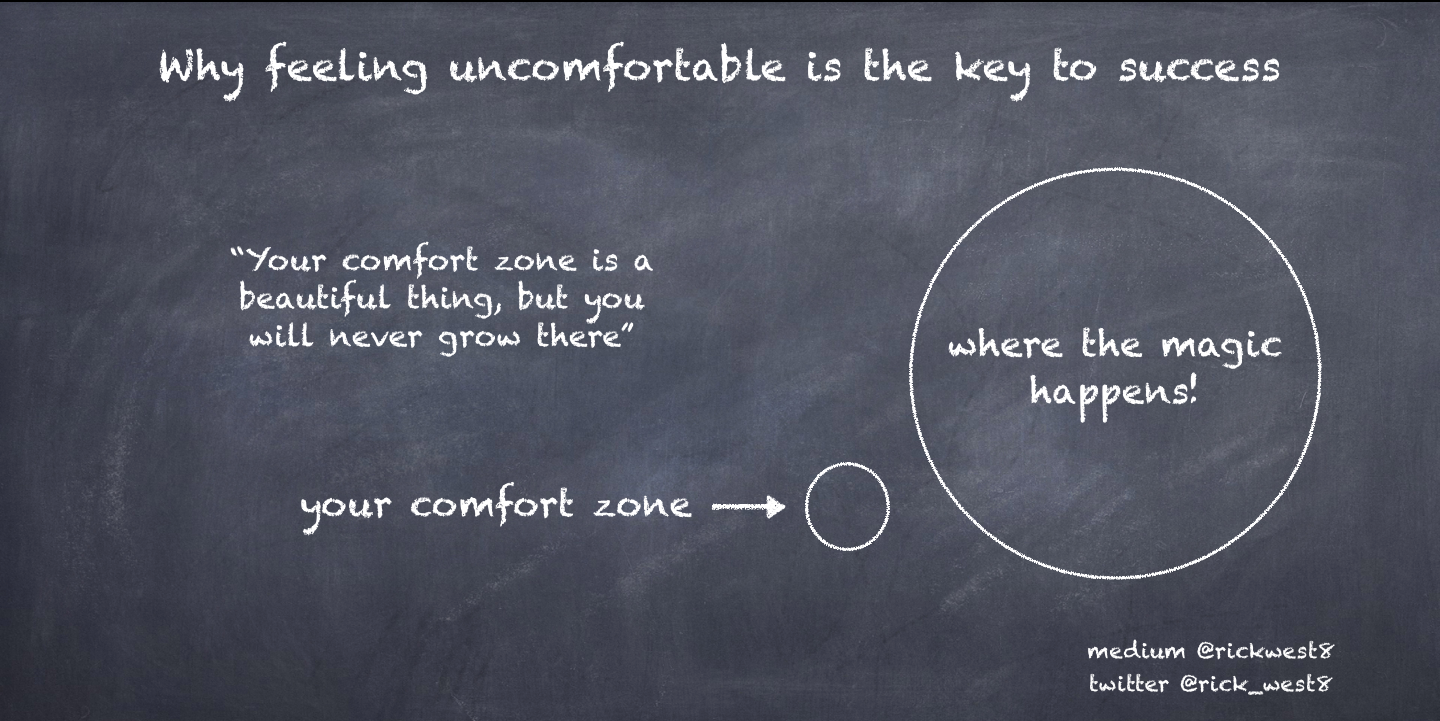
Why feeling uncomfortable is the key to success


Your comfort zone is a beautiful thing, but you will never grow there!
When I started learning web development, and especially since getting my first job, feeling uncomfortable has become a bit of a recurring theme.
I’m going to be honest, at first, it was a real struggle. Every time I would find myself in an uncomfortable situation, I would start second guessing myself — Is web development really for me? Maybe I’m just not intelligent enough? Will I ever be any good? Will I ever learn enough to actually get a job and get paid for this?
I’m sure many of you can relate.

If you want something in life that you have never had, you will have to do something that you have never done

Maybe you have been learning to code for a while but still don’t feel confident enough to apply for any developer jobs. You might not feel you are ready yet. You might fear rejection. Whatever the reason, that lack of self confidence will make you feel uncomfortable. And you’re not alone. We would all feel the same in that situation.
However, it’s the people who suck it up, apply for every job they can, contact companies asking for work, and face potential rejection after rejection who will win.
Hell, you might not be ready yet and you might not land your dream job straight away. But, by putting yourself out there — by stepping out of your comfort zone — you win. You win! You get the interview practice, the experience and you get vital feedback on where you need to improve.
At the end of the day, would you rather be someone who has been learning to code for 18 months, but hasn’t even started applying for jobs, because you don’t feel comfortable or ready yet?
Or would you rather be the person who’s been learning to code for 6 months, and starts applying for jobs? You might feel uncomfortable and maybe it takes you another 6 months to land a job, but 12 months after first opening a text editor and you are working in your dream career? Believe me, this can happen.

The uncomfortable feeling wont stop or get any easier once you get a job

I hate JavaScript. (Well, maybe hate is a strong word, but I’m not its biggest fan). Why? — Because it’s hard. I find it difficult.
I’m a fairly confident developer, but sometimes I find myself faced with a task or project, and the temptation is to reach for a technology that I feel comfortable with, rather than building with something new and challenging.
I might know that React will produce a better end product, but my initial reaction is that I don’t want to be in that uncomfortable situation where I don’t know what I’m doing and I have to reach for the documentation every 30 seconds.
However, by taking this approach, I do myself a disservice. I’m hindering my own learning, development and progression. I’m ultimately inhibiting my own success.

A comfort zone is a beautiful place, but nothing ever grows there.

What I have to tell myself in these situations is that whilst I might be uncomfortable. This is actually an opportunity. An opportunity to try new things, learn a new skill or further my career.

So…What’s the key to continued success?

Get comfortable feeling uncomfortable — Embrace it

When an opportunity presents itself you have to take it. You have to step out of your comfort zone.
At the end of the day, this is what web development is. A complex, constantly evolving industry where you can never know everything and you will repeatedly be faced with situations where you are made to feel uncomfortable doing something you haven’t done before. That’s the price of progression.
As a Web Developer, and in life in general, feeling uncomfortable is just something you have to get used to.
You cannot let the ‘fear’ of feeling uncomfortable dictate your life. If you do, it will limit what you are able to do and how much you are able to achieve.
Being in your comfort zone is synonymous with repetition. While repetition is easy, it’s also boring and un-motivating. If, however, you are striving for something more, want to get out of a rut, if you are searching for success, then you need to get out of your comfort zone. Doing that is what separates happy, passionate, successful people from those that are comfortable and bored.
Once you learn to embrace the fear you will be astounded by the progress that you will make, both within your web development career and also personally.

Success is not just about what you have done, it’s about what you inspire others to do.

Recently I watched a Ted talk, by @luvvie titled ‘Get comfortable with being uncomfortable’. I highly recommend it!
Awesomely Luvvie — ‘Get Comfortable with being uncomfortable’
Now this talk isn’t about tech or web development, but last night, while I was reading this article, the parallel between the talk and web development hit me.
One of the most important things for success in life, and web development, is pushing your boundaries and limits. What’s also important is that when you do step out of your comfort zone and do what make’s you feel uncomfortable, this in turn inspires similar change and inspiration for others to do the same.
This embodies what the whole freeCodeCamp community is about. By being part of a community, sharing your story and your successes, you inspire others to do the same.
You might have struggled to complete the Front-end certificate. You might have had periods where you felt uncomfortable and wanted to quit. But by pushing through, by becoming comfortable with being uncomfortable, and reaching that milestone, not only do you achieve you own success, you also motivate others that are struggling or feeling like giving up.
This is why it’s important to give back to the community. Share your projects, share your success, encourage fellow campers in the forums or on social media. Your success is freeCodeCamp’s success.

Step out of your comfort zone, get comfortable being uncomfortable, you owe it to yourself and the rest of us!

As Luvvie describes it — Be the domino.

Monday, January 8, 2018

Using Education to Design the Future


Why the In-Class Experience Matters in a Networked World

A bronze sculpture, ``The Entrepreneur,’’ created by sculptor Kermit Allison, located on the Minneapolis campus of the University of St. Thomas
Teaching is different in a digital age. I am convinced.
And discovering how it is different is always exciting. It is one of the joys of being an educator.
Take last week.
Over the past few years, I have spent the first weeks of the year teaching an intensive course at the University of St. Thomas in Minneapolis/St. Paul.
This year’s course is on how the digital world is changing the way we live, work and do business.
The course covers four topics:
  • The ‘platform’ economy.
  • The on-going technological revolution (AI, the Internet of Things and robotics).
  • Blockchain and smart contracts (including crypto-currencies and ICOs).
  • Data-analytics and storytelling.
The goal is to help students understand the opportunities and challenges of a digital age. It is important that the next generation understands that our digital world cannot be understood with traditional models. Doing so leads to misunderstanding, confusion or worse.
There is a lot more to say about the actual content of the course and I will do so in future posts. But what has been particularly interesting this year is how a simple change in the approach to teaching helped clarify how education can play a valuable role in inventing the future.

A New In-Class Experience

In the past, it always made sense to start my courses with the latest technological trends and developments. In the first classes, we dived into several different technologies. This way of teaching had always been interactive with lots of discussion.
But this year, we tried something different.
Rather than begin by introducing the technology, I instead started with some “personal stories”. I explained the real-world challenges that I face in my daily life as a business executive. I explained the impact of new technologies on my work in a large corporation. I gave examples of some of the problems we face integrating technologies into existing ways of working.
The result was to trigger immediate discussion amongst all participants. A mixture of questions, solutions, criticisms and proposals. Everybody was involved. The energy in the room was tremendous.
In short: we were creating something.
We were searching for solutions to the problems of today and in doing so we were working to invent models for a better future.
It was this sense of shared creativity that made it such an unforgettable experience. Something magical was happening in the room.
This might all sound a little over-dramatic, but I really felt that we were engaged in building a better world. We were thinking “out of the box”, sharing and learning. And we were doing this together, as a group.
There are several reasons why I think this approach worked
For a start, young people don’t want or need the technologies explained to them in detail. They don’t need the “facts”.
For instance, the group already knew about blockchain and — if not — they can get up to speed very quickly. Transmitting facts about technology (or anything else, for that matter) is not where education can add real value in a digital age where the facts are so readily available. Rather, we need to focus on how the technology can be deployed and what that means for our future.
Moreover, classrooms are increasing diverse places. The advantage of a group with different backgrounds, either in terms of nationality or prior experience (e.g. communications, technology, law, marketing, air traffic control) is that everyone can bring their own unique perspective that adds something to the discussion.
Of course, the risk with an open-ended and multi-disciplinary discussion of this kind is that it isn’t always easy to direct or control. And although we did stray off topic, it never became chaotic or irrelevant. And, it is true, that some of the solutions we came up with, even though they looked brilliant at first sight, already existed or could easily be shown to make no sense at all.
But for me, this is all just part of the process of co-creation in an uncertain world. We need to have this experience of “trial and error” in order to arrive at the best solution.
What matters is the process of building-reviewing-criticizing-iterating.
And this must be done in a safe space that is open, inclusive and respectful.
The whole experience reinforced my belief that in-class problem-solving is the future of education. Particularly in a fast-changing networked world characterized by constant technological disruption.

Why the In-Class Experience Matters in Designing the Future

There are several reasons why this observation is important. Here are three.

#1 — Face-to-Face Interaction

Recently, we see a trend towards “distance learning” and “online teaching”, and there is a lot of pressure inside universities to develop these new educational models. This is hardly surprising, given the educational possibilities that network technologies are creating. And, no doubt, such trends are important, particularly when they contribute to educational inclusion.
Nevertheless, in-class “teaching” must never disappear. Sure, in many cases, it may need disrupting. But, in a digital age, where teamwork and the open exchange of ideas have become more important than ever, we have to preserve such a learning environment and the unique experience that it offers.

#2 — Freedom & Flexibility

Schools and universities have always been places where we can discuss things in a more flexible and less stringent setting. But such safe spaces become even more important in a digital age. Individual educators and educational institutions all need to recognize the value of providing places where people can work, learn and create together.
Education needs to create opportunities that allows this kind of interaction to happen.
After all, we all have to study new technologies in order to become smarter. Not only to better identify, manage and mitigate potential risks, but also to take full advantage of the tremendous opportunities that new technologies offer across all fields of social life.
That might all sound obvious. But anyone who is familiar with educational institutions will know how there are many managerial pressures — accreditation, for instance — that can easily reduce freedom and flexibility in the classroom.

#3 — Responsibility & Ownership

My own feeling is that in recent decades university education, in particular, has become increasingly “irrelevant” for students. Potential employers feel that graduates have learned little that is useful for the realities of work today. Many professors even seem to share this sense that what they do no longer really matters.
In-class problem-solving of the kind described here can provide one way of making the educational experience more productive and relevant for all stakeholders.
The students in Minneapolis/St Paul certainly invested in the process and felt ownership over what they had created. The solutions were meaningful to them, both for their assignment, but also — more importantly — their futures.

What’s Next?

I know the experience felt more valuable for me. I feel I learnt more as well, and I will incorporate what I learnt the next time that I teach.
And, perhaps most importantly, I also believe that this approach is more relevant for potential employers and society in general.
If you work on technology directly, it makes sense to focus relentlessly on developing that technology. Think of this as invention.
But for those of us working in business or other professions, the real issue is how to integrate disruptive technologies into existing patterns of working. It is about understanding the meaning of technology and then designing or creating a better future built around that technology.
This is the daily reality of working in a world characterized by profound technological change.
Re-creating this experience is where the real value of education now lies.

Thank you for reading! Please click and hold the 👏 below, or leave a comment.
There is a new story every week. So if you follow me you won’t miss my latest insights about how the digital age is changing the way we live and work.