Longevity and Diet
Aging has always been considered an inevitable process. But the discovery that the aging process itself could be ‘hacked’
has led to the concept of ‘health span’ as opposed to merely
‘lifespan’. A long life is not necessarily marred by disability and
death and specific dietary interventions in particular may promote
healthy long life.
However,
much of this data results from animal data as it is difficult to
experiment on live humans. The table below illustrates the results from
dietary, exercise, genetic and drug interventions and their main
mechanism of action. Pay particular attention to the column ‘Main
Mechanism of Action’. This is the best guess as to how all these
different interventions may increase lifespan.
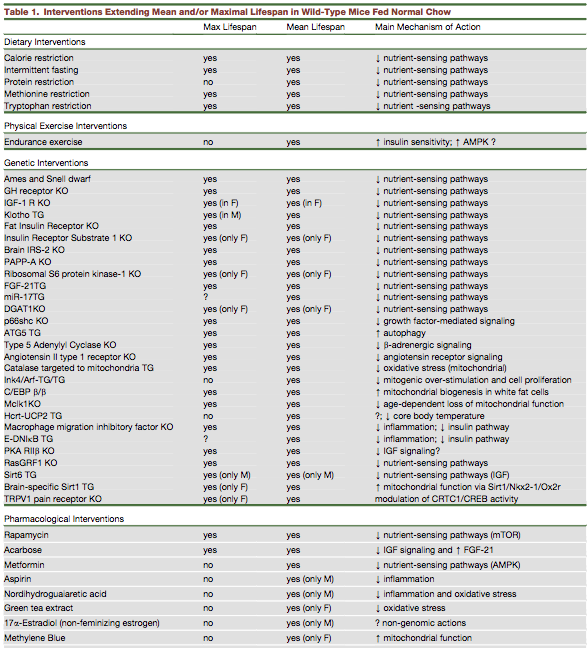
Did you notice something rather striking? Almost all of the interventions work through the same pathway — decreased nutrient sensing — which also includes decreased growth factor signalling and increased autophagy. As you may recall from our previous post on mTOR, the main 3 nutrient sensors of the human body, which is similar to most animals are
- mTOR
- AMPK
- Insulin
Most of these interventions affect one or more of these pathways. With TOR, less is more.
Blocking mTOR improves protein handling, increases autophagy and
enhances stem cell function. That is, from all the animal research,
increased health span depends not on having more nutrients, it is having less. Increased longevity depends on decreasing
the nutrient sensors (lower mTOR and insulin, higher AMPK) at least
periodically. This is fascinating, because the most ancient dietary
intervention is fasting — a clear form of decreasing nutrient sensing
pathways. Humans have used fasting (or cleansing, detoxification,
purification or whatever you call it) as a method of increasing wellness
since antiquity. Benjamin Franklin, kind of a smart guy, said “The best
of all medicines is resting and fasting”

In
addition, there is a clear correlation between better mitochondrion
functioning and decreased nutrient sensors. Mitochondrion are the
powerplants of the cells, and it is obvious that cells need to have
power to work properly. Activation of SIRT1 and AMPK activates PGC-1a, a
key regulator of mitochondrial function, antioxidant defenses, and
fatty acid oxidation.
AMPK
is a highly conserved regulator of energy homeostasis and links
energetics to aging. AMPK is a sort of reverse fuel gauge of the cell.
ATP is the molecule that carries energy in a cell. When this level gets
low, AMPK goes up. AMPK induces mitochondrial biogenesis (creation of
new mitochondrion) as well as regulates mitochondrial metabolism and
dynamics. In the 2017 study, Weir et al show that AMPK can maintain
youthful mitochondrial network morphology even with aging. When they
exposed animals to Intermittent Fasting, there was a striking change in
mitochondrial networks. Both fission and fusion are required to maintain
health and lifespan.
Recent (2017 Weir et al)
work highlights the key role that dietary restriction may increase
lifespan by affecting mitochondrial networks. Mitochondrion are part of
networks that can fuse together (fusion) or break apart (fission) in
constant remodeling. A dysregulation of these mitochondrial dynamics and
abnormal morphology (shape) of these mitochondrion are hallmarks of
aging and thought to contribute to many degenerative diseases such as
Alzheimers and Parkinsons. With age, many studies report increased
swollem fragmented mitochondria. Mitophagy, a process of degrading
damaged mitochondrion and recycling, plays an important role in keeping
the dynamics normal.
If this holds true for humans, then dietary interventions are the key to longevity.
This has refocused attention to meal frequency, timing and intermittent
fasting. During our evolutionary history, most large animals and humans
ate only intermittently. Long periods of starvation were normal,
whether due to seasonal changes or due to episodic weather events. Many
animals developed forms of quiescence in response to the onset of food
shortages. If food was not available, then most of the cells in our body
stop growing. Importantly, the same genes that control quiescence also
control lifespan. In rodents, fasting for 24 hours every other day or
twice weekly extends lifespan up to 30%. Chronic caloric restriction may
also have similar benefits. Fasting may promote mitochondrial function,
trigger autophagy and DNA repair pathways.
But
what is more controversial is whether the benefits relate to caloric
restriction in general, or whether it relates to specific nutrients. Original studies from 1985
suggested that it was calories, rather than protein. However, a point
overlooked originally was that these animals were not food restricted.
Subsequent studies, (eg. Grandison et al, 2009,) Solon-Biet 2014, Nakagawa 2012
and others pointed specifically to protein restriction as the key to
longevity in these animal studies. Most believe this is due to dietary
protein’s key regulatory effect on mTOR and IGF1. In humans, unlike
rodents, severe calorie restriction does not reduce serum iGF-1
concentration unless protein intake is also reduced.
Is
it all protein or certain amino acids? The answer is not known. In
animal studies the specific amino acid that is critical differs between
species. In humans, branched chain amino acids seem to be a particularly
strong activatory of mTOR.

Decreased Nutrients Sensors
Compared
to other dietary interventions, intermittent fasting appears to be far
more powerful because alone has the ability to affect all 3 nutrient sensors simultaneously,
as well as stimulate autophagy and mitophagy. mTOR is sensitive to
dietary protein. Insulin is sensitive to proteins and carbohydrates. So
eating a pure fat diet (not realistic) may lower mTOR and insulin, but
will not be able to raise AMPK, since that senses the energy status of
the cells. If you are eat a very high fat diet (ketogenic) your body
will still be able to metabolize this to energy — generating ATP and
lowering AMPK. Only 2 of the 3 nutrient sensing pathways have been
alerted. Only complete restriction of nutrients will have this effect
(ie. fasting).
[caption id=”attachment_7879" align=”alignright” width=”320"]

Petri dish[/caption]
Theoretically,
eating less frequently may significantly improve health. Most
omnivorous mammals eat only intermittently, since we tend not to live on
a Petri dish where nutrients are constantly available. Carnivores like
lions and tigers often eat once a week or less. Ancestral humans tend to
eat intermittently depending on food availability. Being able to
function at a high level, both physically and intellectually, for
extended fasting periods was fundamentally important to survival. This
explains our well developed systems for food storage (glycogen in the
liver, and body fat), and also our highly conserved nutrient sensors to
slow cellular growth during a period of low nutrient availability.
Things
changed somewhat with the agricultural revolution approximately 10,000
years ago. From a hunter-gatherer society, agriculture allowed
populations of humans to stay in one area and resulted in more stable
food availability. However, there would still be seasonal variation and
possibly long weeks or months where food is less available. There would
also be shorter periods of time, days — weeks, where food was
restricted.
Most
humans ate between 2–3 times per day. Without light, it would be
difficult to eat a ‘midnight’ snack in the pitch blackness. So early
humans still followed a tradition of a long overnight fasting
period — hence the term ‘break-fast’.
Different
nutrient sensors are sensitive to different time durations. That is, it
would be useful for our body to know whether nutrients were restricted
in the short term (overnight) in the medium durations (days) or long
durations (weeks — months, seasons). You can see that our human body has
evolved exactly those same capabilities in our nutrient sensors.
- Insulin (short term)
- mTOR (days)
- AMPK (weeks)

Insulin
spikes quickly after a meal, but falls just as quickly during an
overnight fast. It responds primarily to carbohydrates and proteins.
While protein does not raise blood glucose, it raises insulin quite a
bit. It also raises glucagon, so that blood glucose stays stable. mTOR
is mostly sensitive to protein and particularly branched chain amino
acids. It does not fall as quickly and takes somewhere from 18–30 hours
to activate. AMPK is the reverse fuel gauge of the cell (AMPK goes up as
cellular energy stores of ATP deplete) and only increases with
prolonged energy deprivation. All macronutrients can contribute to ATP
production, so AMPK is sensitive to all macronutrients.
These
nutrient sensors overlap somewhat in their sensitivities and functions
but each is also unique. In this manner, our cells are able to gain
exquisite information about the particular macronutrient availability of
the outside world. Crafted by millions of years of evolution, the
biochemical wizardry of our nutrient sensors makes a mockery of our
comparatively dull brain that can only say ‘Look like food to Grok. Grok
eat.’ But we don’t need to understand all the complicated biology to
gain the benefits. We can begin to regain some of our lost ancient
wisdom by following the ancient food tradition of taking a break from
eating once in a while. Give yourself a chance to digest the food you’ve
eaten. Intermittent fasting. Boom.