Innovation

Showing posts with label Innovation. Show all posts

Friday, January 26, 2018

The Best Route to Big Fitness? Small Steps



Here’s the thing no one tells you about the saying “go big or go home”: Most people who go big swiftly end up at home. “Massive training sessions might provide an emotional hook for an athlete to hang onto and perhaps even build some acute confidence in the moment,” says Matt Dixon, founder and head coach at Purplepatch Fitness and author of Fast-Track Triathlete. “But in the long-term, heroic efforts don’t work.”
The best way to achieve big results — in sport and other areas of life — is with small and incremental gains over a long period of time.
Here’s the thing no one tells you about the saying “go big or go home”: Most people who go big swiftly end up at home.
Habits build upon themselves, according B.J. Fogg, a researcher who studies human behavior at Stanford University, and someone I’ve heard present on this topic. If you want to make any kind of significant change, you’d be wise to take baby steps. In Fogg’s behavior model, whether someone takes action depends on both their motivation and their ability to complete a given task. If you regularly overshoot on the ability side of the equation, you’re liable to flame out. But if you gradually increase the challenge over time, what was hard last week will seem easier today. I’ve heard Fogg say that it’s the best way to create lasting progress. And it’s a rule that applies to fitness, too.
“Consistency is key,” says Dixon. “The surest way to real confidence and enduring performance is to progressively layer training — slowly building on what you did in the past, adding layers over time.”
The best way to achieve big results — in sport and other areas of life — is with small and incremental gains over a long period of time.
Dixon is not alone in his approach; it parallels that of the best distance runners on the planet, including Eliud Kipchoge, who won the Berlin Marathon in September and was the star of Nike’s Breaking2 marathon exhibition. (Kipchoge was just 25 seconds away from becoming the first human to run a marathon in under two hours.) Patrick Sang, who coaches Kipchoge and a stable of other elite Kenyan runners, told Wired that their strategy is simple: “Slowly by slowly…Every session is a building block.”
If the science is compelling and if an incremental approach is good enough for the top athletes in the world, then why do so many people still fall prey to a suboptimal cycle of big, in-over-your-head workouts followed by extended time off due to injury and fatigue? Dixon believes there are two primary reasons: a lack of self-confidence, and a lack of understanding the training process.
“Athletes feel the need to go search for confidence, and they do this by absolutely crushing themselves — but it takes so much time to recover from these sessions, or, even worse, they get injured,” says Dixon. “But when an athlete believes in overall progression, they don’t need to seek validation in mega-workouts. Instead, they execute day-in, day-out for weeks, months, and even years.”
Unfortunately, social media intensifies the urge to shortcut a consistent approach. It’s never been easier to seek and receive external validation for your workout, and it’s never been easier to compare your workout to those of others. On Twitter, Instagram, and Facebook, it seems everyone is keen to post their latest and greatest big training day. But as I’ve written before, this is the equivalent to a 21st-century fitness rat race — and it’s one that all too often leaves athletes anxious, injured, and downright burnt out.
“The surest way to real confidence and enduring performance is to progressively layer training — slowly building on what you did in the past, adding layers over time.”
Even so, we’re only human, which means impatience is an undeniable part of our underlying condition. So don’t be surprised if at some point or another you find yourself tempted to veer off the path of consistency. When this occurs, Jonathan Marcus, head coach of the elite running group High Performance West in Portland, Oregon, recommends pausing to think like a gardener: “Plants in a garden fully bloom when regularly nourished with sunlight and water. Any of our chosen endeavors, including athletic pursuits, flourish when nourished daily by concentration and positive action,” he says. “Investing too much in heroic training efforts is like watering your garden for an entire day to excess, and then starving the vegetation of any fluid for the following ten days.”
I asked Marcus how he came up with this analogy. “Consistency,” he explained, “is nature’s rule, not mine.”
Thursday, January 18, 2018

Why Business Design is the Most Important Skill of the Future


The times of pure Design Thinking are over: Certainly, the last years have seen the rise of Design Thinking and similar processes (most lately design sprints) that help entrepreneurs and managers to create more user-centered products and services. They are great tools to spawn desirability in customers. Nevertheless, they often fall short in creating a sustainable business model. Business Design is the remedy to this problem.
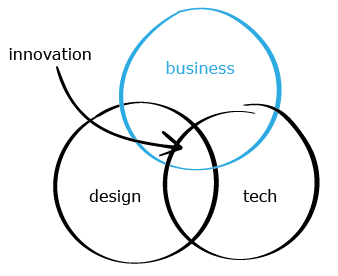
Fig. 1 — Innovation happens at the intersection of business (viability), design (desirability) and tech (feasability)

A business idea is not yet a business model

Business Design is on the rise. In the last years a series of influential books has been published with a clear focus on the creation and development of business models (see “further readings”). They got special notice in the startup scene and beyond.
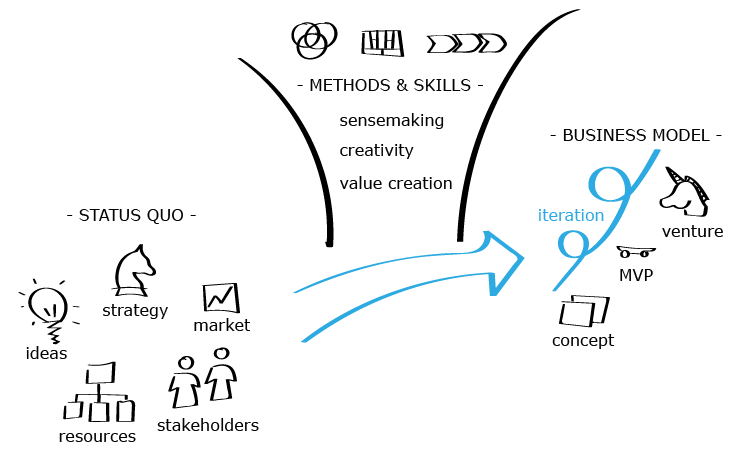
Fig. 2— Business Design uses a special skill set and information on the status quo to develop a business model. (This is the first of a series of representations of Business Design throughout the article that are based on discussions among Business Designers at our company.)
The business model has always been an important part of doing business, but recently the designing of businesses got a new urgency. It is the advance of startups, quickly changing markets, and evolving technological possibilities that make it ever more important to develop innovative business models and rethink traditional ones. These circumstances shorten the time that old business models can stay viable. Today there are technological opportunities that enable lean implementation of business models and make them change too fast for the long cycles of traditional R&D.
Business Design provides the tools and methods to develop and test a business model. At the same time it makes the difference between a service that is just a marketing stunt and one that is a sustainable business.
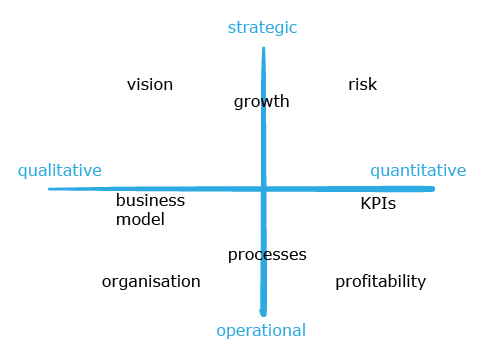
Fig. 3— The tools and methods of Business Design can be ordered on two axis to create a 2x2 matrix — one of our favorite charts.
There are the first schools that offer programs in Business Design (e.g. International Design Business Master at Aalto University in Helsinki, Leadership in Digital Communication at Berlin University of Arts) — but by large it is still a developing field and scarcely formalised.

Business Design — four working defintions

Following that openness, I will not give a fixed definition of Business Design but present variations that we use in in our daily work at Service Innovation Labs.
Business Design …
  • is the application of design methods and processes on the development and innovation of business models.
  • is about value creation and capturing.
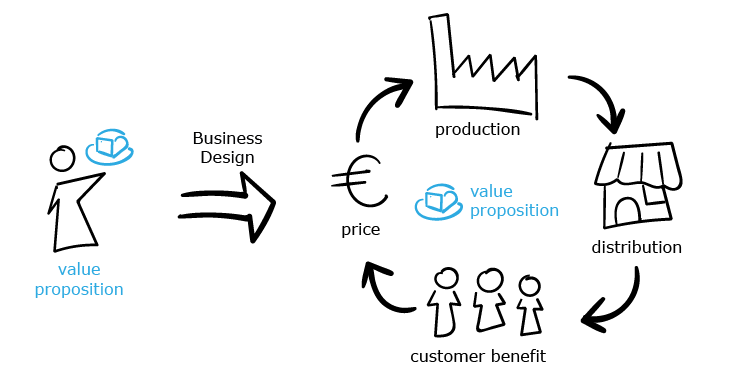
  • transforms a value proposition into real business value.
  • making sense of new value creation by thinking in relations.
Fig. 3 — Business Design realizes a value proposition in the system of production, distribution, customer benefit, and price.

The Business Design process

Business Design is foremost a new systematic approach. It is based on articulating assumptions, testing with prototypes, iteration and fast learning. Usually we follow these three steps:
  1. Understand the market, its players, constituents and forces; translate cross-industry best practices and articulate assumptions.
  2. Develop a business model prototype, evaluate it and identify the most critical assumptions.
  3. Test your model, learn, and iterate.
In our daily work we closely collaborate in teams with service designers and software developers to deeply integrate our business model with the value proposition of our product.
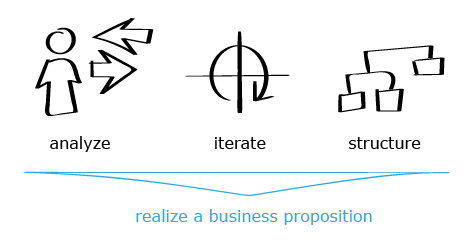
Fig. 4 — Business Design (1) analyzes outside-in capabilities and inside-out opportunities, (2) iterates with research, synthesis, concept and test, and (3) structures and orchestrate process and progress.

Conclusion

Business Design provides a perspective to entrepreneurs and managers to think creatively about their business model and develop it further. The systematic approach allows to test the viability of new ideas with few resources. In the future this will be the critical competence that decides on success in an accelerating market.
At the same time, Business Design is still a developing field. Join the discussion and tell us in the comments:
What is your (working) defintion of Business Design?

Further Readings

I collected a list of books that made contributions to the shaping of Business Design. I will publish another article with an extensive reading list on Business Design later.
  • Business Model Generation, Alexander Osterwalder — Osterwalder publicized the Business Model Canvas as an easy way to draft and iterate your business model.
  • Lean Startup, Eric Ries — Ries introduced the “scientific method” of experimenting, testing and iterating into the startup world.
  • The Business Model Navigator, Oliver Gassmann et al. — the book discusses the constituents of a business model and presents an (allegedly exhaustive) list, written by a team of St. Gallen University.
  • Blue Ocean Strategy, W. Chan Kim und RenĂ©e Mauborgne — the authors introduce a process to create a service or product in a blue ocean without competition.