Business

Showing posts with label Business. Show all posts

Thursday, January 10, 2019

If you work for a long time, then be careful


If you work continuously for long hours and do not take any kind of break, this can lead to health related problems. Scientists have said that there is still a need to study more about the continuous sitting and the most effective and practical way of reducing the work. This information was given by Linda Ignace of Texas University in Rio Grande Valley in the United States. Ianeyes said that the role of nurses is very important in spreading awareness about the bad effect of staying on for a long time.
In a recent study, it has been found that there is a direct relationship between working longer and fear of many serious diseases. Some people have been claiming that they have been able to compensate for this loss after exercising for a long time after exercising. But according to the American Journal of Nursing, using any exercise can not reduce the losses incurred by working for long periods of time.
Staying in one place for more time will keep the heart at risk. The cause of death of 4% of the world's total deaths was only because they used to sit continuously for 3 to 4 hours in a day. It can also be dangerous for a person to sit constantly, watch TV or work for a long time on a computer or working on a sleeper soda. It is very harmful for health, which is also becoming deadly. If you work on a chair for 3 hours continuously due to 1 work, it can be dangerous for health.
Based on a recent research conducted in 54 countries around the world, it is found that 3.8% of the world's deaths are due to sit on a continuous chair for 3 hours or more. This means that this study, which was recently created by the habit of 4.33 million people every year, was published in the American Journal of Preventive Medicine, which was done by San Jorge University of Spain, Zaragoza.
In this study, the change in statistics between 2003 and 2011 was noticed in the Chair Effect.
Due to continuous sitting, most of the deaths occurred in European countries, Middle Eastern countries, America and South Asian countries. The largest percentage in Lebanon is 11.6%, in the Netherlands 7.6% and Denmark in 6.9%. It has also been mentioned in the study that, if we reduce the two-hour time of continuous sitting, then it can reduce the risk of death for up to three times. That is, this risk can be reduced by 2.3 percent.

Wednesday, March 21, 2018

Your Success in Life


Without It, You’re Dead In the Water


You have to set big, hairy, and audacious goals to do great things.
But setting the goals themselves is only the first part of the equation. If you want to do anything great, you have to learn the art of following through.
That’s where we slip — because taking action is scary. It takes tenacity to follow through on our goals and you need the audacity to set a huge scary goal down and tell the world you’re going to achieve it no matter what.
It takes guts to claim a piece of the pie for your own. But you know what else it takes, and a lot of it?
It takes patience. So much patience. It can take years of patience, or even a decade of grueling work before you start to reap big results from all the time and hard work you’ve put in, and it can be frustrating as hell.
The solution? Learn how to be more patient than everybody else and revel in the hard work, no matter what anyone else tells you to do. That’s the only way to reach your personal success.

There’s No Clear-Cut, Easy Way to Success

You’ve heard all the clichés. Rome wasn’t built in a day, it’s a marathon not a sprint, you need 10,000 hours to be great, etc.
None of that helps, though. Neither does telling you to be patient because you want it all to come true now.
Who wouldn’t want that, right?
But even when looking down the vast tunnel where the light at the end signifies your future success, you still wonder why despite your best efforts, it’s just not happening for you. It’s only human to wonder and beat ourselves up for not being successful yet, after all.
I don’t care what you’re doing. Working on a novel, building an audience, creating a body of work… it all takes time. But time is our greatest asset. We have lots of it, even though we squander a lot of it.
The question becomes how to best use the time we have to fuel our progress, rather than hinder it.

How do you use your time?

How do you try to be patient, despite your best efforts to rush the job?
Ten steps over ten days are better than 1,000 steps in one day without any follow up for a month. Going small has its advantages and you can build it into something big.
But going big right out of the gate? It’s only a recipe for disaster and a guaranteed way to burnout.
I used to think I should only write epic, long-form content. Stuff that was at least a thousand words but preferably two to three thousand words long. So I’d occasionally write, waiting for the spark of a bright idea to take hold of me that was worthy of an ‘epic’ post.
It didn’t take long for these huge expectations to become too much and drive me into an oblivion of not creating a damn thing for weeks and months to come. Which wasn’t good for anybody, especially my own self-confidence.
My own vision of success had crippled me into a state of non-creation, a state of perpetual writer’s block; I was stuck in a fog of my own doubts, completely lost with nowhere to go but forward.
But I didn’t want to move forward. I just wanted to stay right here, doing what I always did… even though the spark was all but extinguished.

Block Out the Noise and Quiet Your Mind

Everyone has their own ideas of how you should best do something. Whatever you’re doing, there are hundreds or thousands of books on it, regardless of the size of your niche. Even with the internet, there are blogs on every topic imaginable, either small, free blogs or self-hosted personal blogs or posts right here on Medium.
The problem is they often contradict each other because advice is a dime a dozen these days. But being patient will never change. Patience is a virtue, yes, but let me be clear — there’s a difference between patience and hesitation. Between going for it and waiting it out.
Being patient is accepting that great things take a long time to build. And hesitation is looking down the hole of what you’d have to do to get to where you want to be and stopping dead in your tracks. Patience is accepting that creating your best work is going to take a while, and living with that — not complaining about it and bemoaning your situation, but just putting your head down and doing the work regardless of the outcome it gives you.
If you’re not patient and don’t give yourself fully to the work, you’ll never get anywhere at all. And even if you do, you won’t be able to sustain enough forward momentum to keep going every day. That’s part of the reason why blogging almost every day is helpful because it forces me to keep going no matter what.
Because no matter how good I thought yesterday’s piece was and how bad today’s is, I keep going. That’s all any of us can do.
Without that persistent plodding forward, I’d be stuck. I’d never learn to be patient with the process and accept the results as they come.
Despite the cost it takes, unless you’re doing the necessary work to keep yourself going every day, you’re only dooming yourself to fail and never reach your dreams at all.
Remember that, so when someone questions why you’re not where they think you should be, you can safely ignore them. Because there is only doing the work, and not doing it. And when you’re doing it, nothing else really matters.
Weirdly enough, when you consistently do the work over time, magic will start to appear in your life. If you have the patience and the awareness to see it, that alone will be enough to keep you going for the rest of your life to come.
Source

Monday, February 5, 2018

7 Horrible Ways to Lead a Team (and the 1 Mistake Everyone Makes)


When we think about leadership, we tend to think in terms of hierarchy — those at “the top” are considered “the leaders” and those at the bottom are considered “the followers.”
The problem with this sort of perspective is that, in all honesty, just because you hold a formal position on the ladder does not necessarily mean you are a “leader.” However, lots and lots of people wear their title and their badge of honor proudly — while at the same time ignoring the fact that they are, in fact, horrible leaders.
Don’t fall into the trap of doing any of the following, simply because you have a position of power — especially this first one:

1. You expect others to follow rules that you yourself do not follow.

This is, bar none, the most common mistake in leadership.
You cannot, and should not expect others to follow rules, codes, processes, and all the rest if you cannot follow them yourself.
If you’re not showing up on time, don’t expect others to as well. If you aren’t diligent and organized, don’t expect those beneath you to somehow cultivate better habits. When you are a leader, you do not realize how much of an influence you have on your team — even down to the smallest habit.
You are the leader for a reason.
Everything you do must have purpose, so that those who look to you for guidance will do everything with purpose as well.

2. You do not keep your word.

The fastest way to lose respect (and earn resentment) as a leader is to say you’re going to do something and then not do it.
First and foremost (going back to #1 here), it’s because it encourages a very bad habit in those around you — “If he/she can slack off, so can I.”
As a leader, it is so crucial that you do the things you say you are going to do. And if you cannot do them, you need to communicate that openly to your team in advance. For those looking to rise and become leaders, this is equally important advice.

If you want to climb the ranks, this is one of the most effective ways to do it.

Keep your word.
That’s it.
Keep your word and people will soon learn that you can be trusted — they can count on you, no matter what. And that in itself will propel you to where you want to go.

3. You do not (genuinely) admit when you are wrong.

Some “leaders” believe that admitting when they’re wrong is a sign of weakness.
It’s not.
In fact, being wrong or having made a mistake and yet being incapable of owning up to it reveals an even bigger weakness — and makes your team question whether or not they can trust you.
If you make a mistake, or were incorrect about something, just say so.
This will establish trust and an even playing field with you and your team, showing them that you embody the same traits you expect of them — a humility to be able to step back and take accountability.

4. You make promises you cannot keep.

This is a rabbit hole of disaster.
There is no worse habit as a leader than making promises you know you can’t keep. All this does is welcome in feelings of being let down. And the next time you say you’re going to do something for someone, they will not believe you — and even worse, they will become angry at you for thinking you can fool them again and again.
Where #2 is about following through with what you say you’re going to do on your end, #4 here is about keeping promises that you make to someone else.

5. You want to be the star.

As a leader, it’s your job to inspire, guide, direct, teach, motivate, and ultimately help others succeed.
It’s not to steal the spotlight.
The greatest leaders are the ones who, as Steve Jobs so eloquently put it, “play the orchestra.”

Fantastic leaders know how to step back and let others shine.

They know how to put others in positions to succeed themselves — which benefits the whole orchestra.
However, as long as you want to be the star, with the spotlight on you and no one else, you will squeeze the talent around you and keep it from ever unfolding.

6. You criticize others but cannot take criticism yourself.

Healthy criticism is how teams members push each other to improve and get better — iron sharpens iron.
Harsh criticism is what instills insecurity, fear, and an unwillingness to take chances. If your style of leadership is healthy and positive, expect others to do the same with you — which means you too will continue growing and improving.
But if your style of leadership is harsh, then expect the same to come back to you — or worse, cause your entire team to go silent.

7. You believe your way is the right (and only) way.

And finally, the oh-so-debated topic of what is “the right way” of doing something.
The truth is, there are very few things that have just one single “right” way of doing them. So much of life is subjective, and that goes for the work we do as well.
“Creative” to one person might be “boring” to another.
“Clean and sleek” to one is “dull and lackluster” to another.
If you are a leader looking to build and scale your team, it is important to learn and realize that your way is not necessarily “the right way.” It may be “one of the” right ways, but it is not the “end all.”
It’s important that you acknowledge this; otherwise, you will cultivate a team of people who aren’t searching for the best solution to the problem, but rather the best solution to appeal to your own unique subjective definition of what is “right.”

Thursday, January 18, 2018

Why Business Design is the Most Important Skill of the Future


The times of pure Design Thinking are over: Certainly, the last years have seen the rise of Design Thinking and similar processes (most lately design sprints) that help entrepreneurs and managers to create more user-centered products and services. They are great tools to spawn desirability in customers. Nevertheless, they often fall short in creating a sustainable business model. Business Design is the remedy to this problem.
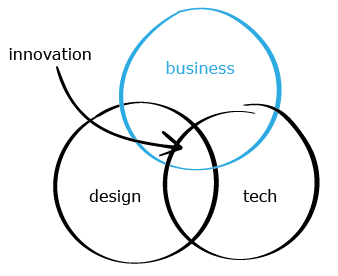
Fig. 1 — Innovation happens at the intersection of business (viability), design (desirability) and tech (feasability)

A business idea is not yet a business model

Business Design is on the rise. In the last years a series of influential books has been published with a clear focus on the creation and development of business models (see “further readings”). They got special notice in the startup scene and beyond.
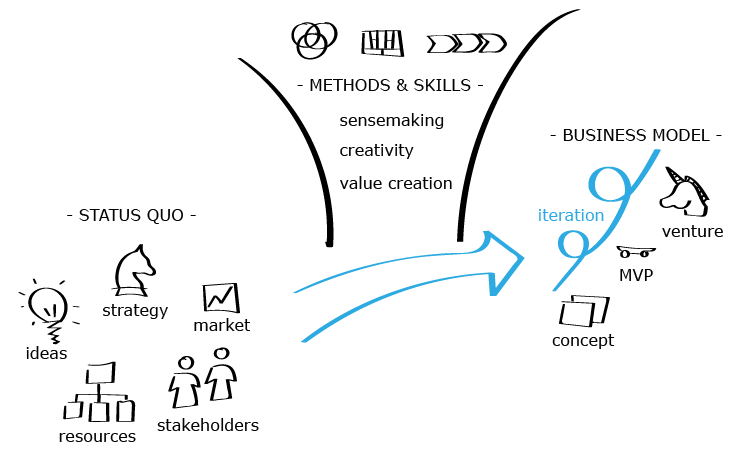
Fig. 2— Business Design uses a special skill set and information on the status quo to develop a business model. (This is the first of a series of representations of Business Design throughout the article that are based on discussions among Business Designers at our company.)
The business model has always been an important part of doing business, but recently the designing of businesses got a new urgency. It is the advance of startups, quickly changing markets, and evolving technological possibilities that make it ever more important to develop innovative business models and rethink traditional ones. These circumstances shorten the time that old business models can stay viable. Today there are technological opportunities that enable lean implementation of business models and make them change too fast for the long cycles of traditional R&D.
Business Design provides the tools and methods to develop and test a business model. At the same time it makes the difference between a service that is just a marketing stunt and one that is a sustainable business.
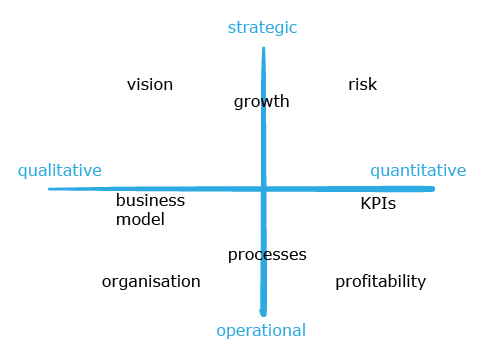
Fig. 3— The tools and methods of Business Design can be ordered on two axis to create a 2x2 matrix — one of our favorite charts.
There are the first schools that offer programs in Business Design (e.g. International Design Business Master at Aalto University in Helsinki, Leadership in Digital Communication at Berlin University of Arts) — but by large it is still a developing field and scarcely formalised.

Business Design — four working defintions

Following that openness, I will not give a fixed definition of Business Design but present variations that we use in in our daily work at Service Innovation Labs.
Business Design …
  • is the application of design methods and processes on the development and innovation of business models.
  • is about value creation and capturing.
  • transforms a value proposition into real business value.
  • making sense of new value creation by thinking in relations.
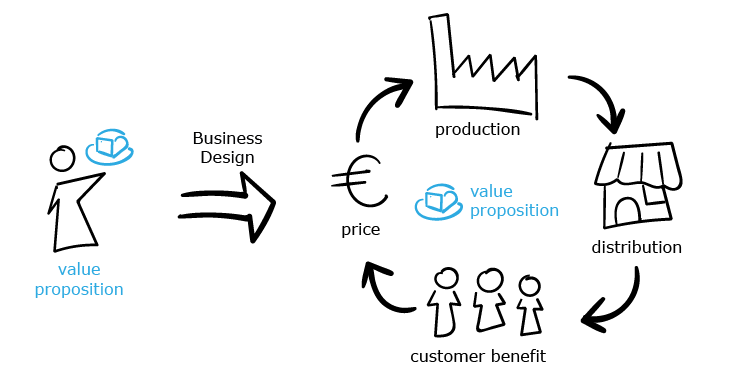
Fig. 3 — Business Design realizes a value proposition in the system of production, distribution, customer benefit, and price.

The Business Design process

Business Design is foremost a new systematic approach. It is based on articulating assumptions, testing with prototypes, iteration and fast learning. Usually we follow these three steps:
  1. Understand the market, its players, constituents and forces; translate cross-industry best practices and articulate assumptions.
  2. Develop a business model prototype, evaluate it and identify the most critical assumptions.
  3. Test your model, learn, and iterate.
In our daily work we closely collaborate in teams with service designers and software developers to deeply integrate our business model with the value proposition of our product.
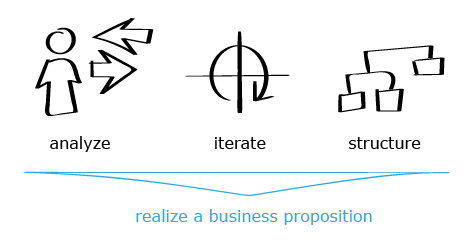
Fig. 4 — Business Design (1) analyzes outside-in capabilities and inside-out opportunities, (2) iterates with research, synthesis, concept and test, and (3) structures and orchestrate process and progress.

Conclusion

Business Design provides a perspective to entrepreneurs and managers to think creatively about their business model and develop it further. The systematic approach allows to test the viability of new ideas with few resources. In the future this will be the critical competence that decides on success in an accelerating market.
At the same time, Business Design is still a developing field. Join the discussion and tell us in the comments:
What is your (working) defintion of Business Design?

Further Readings

I collected a list of books that made contributions to the shaping of Business Design. I will publish another article with an extensive reading list on Business Design later.
  • Business Model Generation, Alexander Osterwalder — Osterwalder publicized the Business Model Canvas as an easy way to draft and iterate your business model.
  • Lean Startup, Eric Ries — Ries introduced the “scientific method” of experimenting, testing and iterating into the startup world.
  • The Business Model Navigator, Oliver Gassmann et al. — the book discusses the constituents of a business model and presents an (allegedly exhaustive) list, written by a team of St. Gallen University.
  • Blue Ocean Strategy, W. Chan Kim und Renée Mauborgne — the authors introduce a process to create a service or product in a blue ocean without competition.

Tuesday, January 16, 2018

Winning The War Of Depression.


Photo by Paola Chaaya on Unsplash
We are born to disappointments. All of us meet them. Some are more sensitive to their point and bitter than others. We are often lofty in our wish, or sanguine in our expectation, that disappointments cannot but come. They come from foes and friends. They come in prosperity and adversity.

There are two sides to the events which occur and which seem so discouraging to us a dark side and a bright side. We are prone to look only on the dark side, to see only what is gloomy and discouraging. We find a melancholy satisfaction in being miserable, and in making ourselves more unhappy, as if we had been wronged, and as if there were a kind of virtue in dejection and gloom — in refusing, to be comforted. We keep chewing some bitter morsel and rolling it under our tongues so as to suck all the bitterness out of it that we can. Many of us are in great darkness, without knowing, or being able to discover the reason.
A bee has an eye, for I do not know how many facets, which multiply the one thing it looks at into an enormous number. Some of us have eyes made on that fashion, or rather we manufacture for our eyes spectacles on that plan, by which we look at our griefs or our depressing circumstances, and see them multiplied and nothing but them.
We are not merely burdened, we are possessed by a feverish uncertainty. We no longer look at things calmly and therefore truly, and everything appears to us in monstrous and distorted guise. There is no more fatal minister in human life than the disquieted eye. So long as the eye can gaze at things with a cool and quiet vision we see things in their true perspective and proportion. But when the eye is shaken into restlessness its focus is perverted, and everything is seen awry. The disquieted soul is not only possessed of a restless eye, it is the possessor of a nerveless hand.
Nothing is so bad as a continued and allowed downheartedness. The conviction that the circumstances around us are stronger than we can handle. There are times when life itself becomes burdensome and is often shortened, by excessive grief. It magnifies troubles. It drags at and prevents work. It shadows blessings, making the hard things in life prominent rather than the ameliorating things. By recognition of the fact that downheartedness is worst for us, we ought to esteem it as bad for us as malignant tumour and do all we can to cure it before it grows and becomes fatal.

Some people constantly depreciate themselves, and they are thought sincere and humble persons. The truth is it is nothing more than a habit, or worse, an affected self-depreciation. The feeling of self-depreciation pervades the soul in the presence or recollection of some higher examples in matters of life and ambition. An artist of sensitive appreciation of superiority in the presence of a genuine piece of art depreciates to the dust his own performances. A poet with a true poetic sense, when they read or hear some grand poetry, feel very low in their own view. So is it in other things in life.
We Are Human. We Can’t Do Everything. We Can’t Control Everything. We Can’t Be Everywhere. We Can’t Understand Everything. We Can’t Be Someone Else. We Can Be What We Are. We Can Be The Best Of What We Are.
Learnings
  1. We cannot control our thoughts nor our moods directly. We can do a great deal to regulate, modify and diminish those of them that need diminishing. Increase those thoughts that need to be increased, by looking at the reasons for them.
  2. Question yourselves about your moods, and especially about your sad moods, and you will have gone a long way to make yourselves bigger and happier people than you have ever been before.
  3. Heaviness of heart is often caused by bringing the future into the present. We go out to meet the cares and difficulties of tomorrow, while we are bearing and battling with those of today. Planning is good. Over-anxiety is a pain. Sorrow in prospect is much more bitter and grievous than it is in actual experience.
  4. We are worth very little unless there is a tribunal in us to which we bring up our feelings and make them justify their existence and tell us what they mean by their noise and their complaining.
  5. Everything has two handles. The aspect of any event depends largely on the beholder’s point of view. There’s nothing either good or bad, but thinking makes it so.
  6. Despondency must have a cause. If we can discover it, in any case, the old proverb holds good that a knowledge of the disease is half its cure.
  7. What can your anxiety do for you? Can it avert what you dread? No. But it hastens it. In many respects, our health, our outward well-being, and that of our household are committed to our own keeping and can be safely kept only by a self-collected mind and a quiet heart.
  8. Look at the past and it will answer. The vast preponderance with us has always been on the side of happiness. If we have been long of this foreboding habit, not one in a hundred of the sorrows that we have apprehended has reached us. Those, also, that have overtaken us have been lighter than we feared.
  9. No effort at tranquilizing our hearts is wholly lost. Did you ever see a child upon a swing? Each oscillation goes a little higher. Each starts from the same lowest point, but the elevation on either side increases with each renewed effort until at last the destined height is reached. So we may if I might so say, by degrees, by reiterated efforts, swing ourselves and stand high above all that breeds agitation and gloom.
  10. Outward trouble will not hurt us much so long as it keeps to the outward. The sailor cares not because the green waves with crested heads curl over and dash against the ship, shaking it from stem to stern. Trouble for the sailor is when from one to another the whisper passes through the ship, “We have sprung a leak.” The water in the hold is more dreaded than all the ocean without. Let not what is outside and temporal affect you on the inside.

Thursday, January 11, 2018

Compassion Raises Us Up Above Ourself.


Photo by “My Life Through A Lens” on Unsplash
There is an appalling amount of real misery and suffering in the world. It is not far away from us. It lies at our very doors. All of us need a feeling of deep sympathy or sorrow for another who is stricken with misfortune, accompanied by the strong desire to alleviate the suffering.
Let your feelings be at hand, and feel and commiserate as soon as touched. Let your tenderest feelings come in contact with the miseries of the distressed as soon as ever they present themselves.
A feeling of their sorrows and weaknesses. A benevolence, which excludes no person, not even strangers or enemies, from its tender regards, which disdains no condescension, grudges no cost, in its labors of love! Inward pity and compassion to distressed objects, the most tender regard to persons in misery, and such compassion as is free from all hypocrisy and deceit is the need of the hour.
The heart, even more than the brain, determines you.
Real strength or weakness is closely linked with moral nature. One may have the beauty of Venus and the charms of Cleopatra, and another the figure of Adonis and still be void of “good” manners. Stand by the weak and defenseless. There is no nobler feature in anyone’s character than a determination to do this.
There is no good in a sour, misanthropic temper. None in rudeness, stiffness, and repulsiveness. None in violating the rules of good breeding.
Compassion prompts us to do good to all, to forget all national or sectional distinctions, and to aid all those who are in circumstances of poverty and want. It would be the most lovely and desirable principle on earth, and all, especially in their early years, should seek it. Nothing that a young person can gain will be so valuable as the feeling that regards all the world as one great family, and to learn early to do good to all. Be even to thy enemy in distress as kind, humane, and merciful. Let a young person have a large mental capacity, it will not weigh for much if that be all.
Compassion Heals.
All who are afflicted know how much it diminishes their sorrow to see others sympathizing with them. How sad would be a suffering world if there were none who regarded our griefs with interest or with tears! It would be miserable if every sufferer were left to bear their sorrows unpitied and alone and if all the ties of human sympathy were rudely cut at once, and people were left to suffer in solitude and unbefriended.
We owe sympathy to others because it is an effective means of contributing to their moral perfection, and because by withholding it we inflict on them a grave moral inquiry. We are tenderhearted or compassionate when we feel affection for someone else, when we look beyond our pain to see the pain of others. It not only lessens the misery of humanity but also unites humans to each other as to make them responsible for the good and comfort of one another.
While we differ in “opinions”, we should still treat each other kindly, that we should aid each other in necessity. A good thing done 3,000 years ago works now, and will work through all endless times and years. No good effort has ever been lost, or ever can be.

Monday, January 8, 2018

Using Education to Design the Future


Why the In-Class Experience Matters in a Networked World

A bronze sculpture, ``The Entrepreneur,’’ created by sculptor Kermit Allison, located on the Minneapolis campus of the University of St. Thomas
Teaching is different in a digital age. I am convinced.
And discovering how it is different is always exciting. It is one of the joys of being an educator.
Take last week.
Over the past few years, I have spent the first weeks of the year teaching an intensive course at the University of St. Thomas in Minneapolis/St. Paul.
This year’s course is on how the digital world is changing the way we live, work and do business.
The course covers four topics:
  • The ‘platform’ economy.
  • The on-going technological revolution (AI, the Internet of Things and robotics).
  • Blockchain and smart contracts (including crypto-currencies and ICOs).
  • Data-analytics and storytelling.
The goal is to help students understand the opportunities and challenges of a digital age. It is important that the next generation understands that our digital world cannot be understood with traditional models. Doing so leads to misunderstanding, confusion or worse.
There is a lot more to say about the actual content of the course and I will do so in future posts. But what has been particularly interesting this year is how a simple change in the approach to teaching helped clarify how education can play a valuable role in inventing the future.

A New In-Class Experience

In the past, it always made sense to start my courses with the latest technological trends and developments. In the first classes, we dived into several different technologies. This way of teaching had always been interactive with lots of discussion.
But this year, we tried something different.
Rather than begin by introducing the technology, I instead started with some “personal stories”. I explained the real-world challenges that I face in my daily life as a business executive. I explained the impact of new technologies on my work in a large corporation. I gave examples of some of the problems we face integrating technologies into existing ways of working.
The result was to trigger immediate discussion amongst all participants. A mixture of questions, solutions, criticisms and proposals. Everybody was involved. The energy in the room was tremendous.
In short: we were creating something.
We were searching for solutions to the problems of today and in doing so we were working to invent models for a better future.
It was this sense of shared creativity that made it such an unforgettable experience. Something magical was happening in the room.
This might all sound a little over-dramatic, but I really felt that we were engaged in building a better world. We were thinking “out of the box”, sharing and learning. And we were doing this together, as a group.
There are several reasons why I think this approach worked
For a start, young people don’t want or need the technologies explained to them in detail. They don’t need the “facts”.
For instance, the group already knew about blockchain and — if not — they can get up to speed very quickly. Transmitting facts about technology (or anything else, for that matter) is not where education can add real value in a digital age where the facts are so readily available. Rather, we need to focus on how the technology can be deployed and what that means for our future.
Moreover, classrooms are increasing diverse places. The advantage of a group with different backgrounds, either in terms of nationality or prior experience (e.g. communications, technology, law, marketing, air traffic control) is that everyone can bring their own unique perspective that adds something to the discussion.
Of course, the risk with an open-ended and multi-disciplinary discussion of this kind is that it isn’t always easy to direct or control. And although we did stray off topic, it never became chaotic or irrelevant. And, it is true, that some of the solutions we came up with, even though they looked brilliant at first sight, already existed or could easily be shown to make no sense at all.
But for me, this is all just part of the process of co-creation in an uncertain world. We need to have this experience of “trial and error” in order to arrive at the best solution.
What matters is the process of building-reviewing-criticizing-iterating.
And this must be done in a safe space that is open, inclusive and respectful.
The whole experience reinforced my belief that in-class problem-solving is the future of education. Particularly in a fast-changing networked world characterized by constant technological disruption.

Why the In-Class Experience Matters in Designing the Future

There are several reasons why this observation is important. Here are three.

#1 — Face-to-Face Interaction

Recently, we see a trend towards “distance learning” and “online teaching”, and there is a lot of pressure inside universities to develop these new educational models. This is hardly surprising, given the educational possibilities that network technologies are creating. And, no doubt, such trends are important, particularly when they contribute to educational inclusion.
Nevertheless, in-class “teaching” must never disappear. Sure, in many cases, it may need disrupting. But, in a digital age, where teamwork and the open exchange of ideas have become more important than ever, we have to preserve such a learning environment and the unique experience that it offers.

#2 — Freedom & Flexibility

Schools and universities have always been places where we can discuss things in a more flexible and less stringent setting. But such safe spaces become even more important in a digital age. Individual educators and educational institutions all need to recognize the value of providing places where people can work, learn and create together.
Education needs to create opportunities that allows this kind of interaction to happen.
After all, we all have to study new technologies in order to become smarter. Not only to better identify, manage and mitigate potential risks, but also to take full advantage of the tremendous opportunities that new technologies offer across all fields of social life.
That might all sound obvious. But anyone who is familiar with educational institutions will know how there are many managerial pressures — accreditation, for instance — that can easily reduce freedom and flexibility in the classroom.

#3 — Responsibility & Ownership

My own feeling is that in recent decades university education, in particular, has become increasingly “irrelevant” for students. Potential employers feel that graduates have learned little that is useful for the realities of work today. Many professors even seem to share this sense that what they do no longer really matters.
In-class problem-solving of the kind described here can provide one way of making the educational experience more productive and relevant for all stakeholders.
The students in Minneapolis/St Paul certainly invested in the process and felt ownership over what they had created. The solutions were meaningful to them, both for their assignment, but also — more importantly — their futures.

What’s Next?

I know the experience felt more valuable for me. I feel I learnt more as well, and I will incorporate what I learnt the next time that I teach.
And, perhaps most importantly, I also believe that this approach is more relevant for potential employers and society in general.
If you work on technology directly, it makes sense to focus relentlessly on developing that technology. Think of this as invention.
But for those of us working in business or other professions, the real issue is how to integrate disruptive technologies into existing patterns of working. It is about understanding the meaning of technology and then designing or creating a better future built around that technology.
This is the daily reality of working in a world characterized by profound technological change.
Re-creating this experience is where the real value of education now lies.

Thank you for reading! Please click and hold the 👏 below, or leave a comment.
There is a new story every week. So if you follow me you won’t miss my latest insights about how the digital age is changing the way we live and work.