Recognize you have control of this, if nothing else — Michael Marcus Jan 10 By JESHOOTScom on Pixabay I rem...
Business
5/Cars/feat-tab
Search This Blog
Author Details
Templatesyard is a blogger resources site is a provider of high quality blogger template with premium looking layout and robust design. The main mission of templatesyard is to provide the best quality blogger templates.
When we think about leadership,
we tend to think in terms of hierarchy — those at “the top” are
considered “the leaders” and those at the bottom are considered “the
followers.”
The
problem with this sort of perspective is that, in all honesty, just
because you hold a formal position on the ladder does not necessarily
mean you are a “leader.”
However, lots and lots of people wear their title and their badge of
honor proudly — while at the same time ignoring the fact that they are,
in fact, horrible leaders.
Don’t fall into the trap of doing any of the following, simply because you have a position of power — especially this first one:
1. You expect others to follow rules that you yourself do not follow.
This is, bar none, the most common mistake in leadership.
You cannot, and should not expect others to follow rules, codes, processes, and all the rest if you cannot follow them yourself.
If
you’re not showing up on time, don’t expect others to as well. If you
aren’t diligent and organized, don’t expect those beneath you to somehow
cultivate better habits. When you are a leader, you do not realize how
much of an influence you have on your team — even down to the smallest
habit.
You are the leader for a reason.
Everything you do must have purpose, so that those who look to you for guidance will do everything with purpose as well.
2. You do not keep your word.
The fastest way to lose respect (and earn resentment) as a leader is to say you’re going to do something and then not do it.
First
and foremost (going back to #1 here), it’s because it encourages a very
bad habit in those around you — “If he/she can slack off, so can I.”
As
a leader, it is so crucial that you do the things you say you are going
to do. And if you cannot do them, you need to communicate that openly
to your team in advance. For those looking to rise and become leaders,
this is equally important advice.
If you want to climb the ranks, this is one of the most effective ways to do it.
Keep your word.
That’s it.
Keep
your word and people will soon learn that you can be trusted — they can
count on you, no matter what. And that in itself will propel you to
where you want to go.
3. You do not (genuinely) admit when you are wrong.
Some “leaders” believe that admitting when they’re wrong is a sign of weakness.
It’s not.
In
fact, being wrong or having made a mistake and yet being incapable of
owning up to it reveals an even bigger weakness — and makes your team
question whether or not they can trust you.
If you make a mistake, or were incorrect about something, just say so.
This
will establish trust and an even playing field with you and your team,
showing them that you embody the same traits you expect of them — a
humility to be able to step back and take accountability.
4. You make promises you cannot keep.
This is a rabbit hole of disaster.
There
is no worse habit as a leader than making promises you know you can’t
keep. All this does is welcome in feelings of being let down. And the
next time you say you’re going to do something for someone, they will
not believe you — and even worse, they will become angry at you for
thinking you can fool them again and again.
Where
#2 is about following through with what you say you’re going to do on
your end, #4 here is about keeping promises that you make to someone
else.
5. You want to be the star.
As a leader, it’s your job to inspire, guide, direct, teach, motivate, and ultimately help others succeed.
It’s not to steal the spotlight.
The greatest leaders are the ones who, as Steve Jobs so eloquently put it, “play the orchestra.”
Fantastic leaders know how to step back and let others shine.
They know how to put others in positions to succeed themselves — which benefits the whole orchestra.
However,
as long as you want to be the star, with the spotlight on you and no
one else, you will squeeze the talent around you and keep it from ever
unfolding.
6. You criticize others but cannot take criticism yourself.
Healthy criticism is how teams members push each other to improve and get better — iron sharpens iron.
Harsh
criticism is what instills insecurity, fear, and an unwillingness to
take chances. If your style of leadership is healthy and positive,
expect others to do the same with you — which means you too will
continue growing and improving.
But
if your style of leadership is harsh, then expect the same to come back
to you — or worse, cause your entire team to go silent.
7. You believe your way is the right (and only) way.
And finally, the oh-so-debated topic of what is “the right way” of doing something.
The
truth is, there are very few things that have just one single “right”
way of doing them. So much of life is subjective, and that goes for the
work we do as well.
“Creative” to one person might be “boring” to another.
“Clean and sleek” to one is “dull and lackluster” to another.
If
you are a leader looking to build and scale your team, it is important
to learn and realize that your way is not necessarily “the right way.”
It may be “one of the” right ways, but it is not the “end all.”
It’s
important that you acknowledge this; otherwise, you will cultivate a
team of people who aren’t searching for the best solution to the
problem, but rather the best solution to appeal to your own unique
subjective definition of what is “right.”

We
are born to disappointments. All of us meet them. Some are more
sensitive to their point and bitter than others. We are often lofty in
our wish, or sanguine in our expectation, that disappointments cannot
but come. They come from foes and friends. They come in prosperity and
adversity.
There are two sides to the events which occur and
which seem so discouraging to us a dark side and a bright side. We are
prone to look only on the dark side, to see only what is gloomy and
discouraging. We find a melancholy satisfaction in being miserable, and
in making ourselves more unhappy, as if we had been wronged, and as if
there were a kind of virtue in dejection and gloom — in refusing, to be
comforted. We keep chewing some bitter morsel and rolling it under our
tongues so as to suck all the bitterness out of it that we can. Many of
us are in great darkness, without knowing, or being able to discover the
reason.
A
bee has an eye, for I do not know how many facets, which multiply the
one thing it looks at into an enormous number. Some of us have eyes made
on that fashion, or rather we manufacture for our eyes spectacles on
that plan, by which we look at our griefs or our depressing
circumstances, and see them multiplied and nothing but them.
We
are not merely burdened, we are possessed by a feverish uncertainty. We
no longer look at things calmly and therefore truly, and everything
appears to us in monstrous and distorted guise. There is no more fatal
minister in human life than the disquieted eye. So long as the eye can
gaze at things with a cool and quiet vision we see things in their true
perspective and proportion. But when the eye is shaken into restlessness
its focus is perverted, and everything is seen awry. The disquieted
soul is not only possessed of a restless eye, it is the possessor of a
nerveless hand.
Nothing
is so bad as a continued and allowed downheartedness. The conviction
that the circumstances around us are stronger than we can handle. There
are times when life itself becomes burdensome and is often shortened, by
excessive grief. It magnifies troubles. It drags at and prevents work.
It shadows blessings, making the hard things in life prominent rather
than the ameliorating things. By recognition of the fact that
downheartedness is worst for us, we ought to esteem it as bad for us as
malignant tumour and do all we can to cure it before it grows and
becomes fatal.
Some people constantly depreciate themselves, and
they are thought sincere and humble persons. The truth is it is nothing
more than a habit, or worse, an affected self-depreciation. The feeling
of self-depreciation pervades the soul in the presence or recollection
of some higher examples in matters of life and ambition. An artist of
sensitive appreciation of superiority in the presence of a genuine piece
of art depreciates to the dust his own performances. A poet with a true
poetic sense, when they read or hear some grand poetry, feel very low
in their own view. So is it in other things in life.
We
Are Human. We Can’t Do Everything. We Can’t Control Everything. We
Can’t Be Everywhere. We Can’t Understand Everything. We Can’t Be Someone
Else. We Can Be What We Are. We Can Be The Best Of What We Are.
Learnings
We
cannot control our thoughts nor our moods directly. We can do a great
deal to regulate, modify and diminish those of them that need
diminishing. Increase those thoughts that need to be increased, by
looking at the reasons for them.
Question
yourselves about your moods, and especially about your sad moods, and
you will have gone a long way to make yourselves bigger and happier
people than you have ever been before.
Heaviness
of heart is often caused by bringing the future into the present. We go
out to meet the cares and difficulties of tomorrow, while we are
bearing and battling with those of today. Planning is good. Over-anxiety
is a pain. Sorrow in prospect is much more bitter and grievous than it
is in actual experience.
We
are worth very little unless there is a tribunal in us to which we
bring up our feelings and make them justify their existence and tell us
what they mean by their noise and their complaining.
Everything
has two handles. The aspect of any event depends largely on the
beholder’s point of view. There’s nothing either good or bad, but
thinking makes it so.
Despondency
must have a cause. If we can discover it, in any case, the old proverb
holds good that a knowledge of the disease is half its cure.
What
can your anxiety do for you? Can it avert what you dread? No. But it
hastens it. In many respects, our health, our outward well-being, and
that of our household are committed to our own keeping and can be safely
kept only by a self-collected mind and a quiet heart.
Look
at the past and it will answer. The vast preponderance with us has
always been on the side of happiness. If we have been long of this
foreboding habit, not one in a hundred of the sorrows that we have
apprehended has reached us. Those, also, that have overtaken us have
been lighter than we feared.
No
effort at tranquilizing our hearts is wholly lost. Did you ever see a
child upon a swing? Each oscillation goes a little higher. Each starts
from the same lowest point, but the elevation on either side increases
with each renewed effort until at last the destined height is reached.
So we may if I might so say, by degrees, by reiterated efforts, swing
ourselves and stand high above all that breeds agitation and gloom.
Outward
trouble will not hurt us much so long as it keeps to the outward. The
sailor cares not because the green waves with crested heads curl over
and dash against the ship, shaking it from stem to stern. Trouble for
the sailor is when from one to another the whisper passes through the
ship, “We have sprung a leak.” The water in the hold is more dreaded
than all the ocean without. Let not what is outside and temporal affect
you on the inside.
We
tend to think of life in terms of accomplishments, rather than
experiences. But life is meant to be live with the “goal” of being
present in the moment.
This
is how to live a meaningful life. Not by having goals and doing things
merely to reach those goals, but to live in awareness.
For the most part, society is distracted from this principle. Society tries to derive meaning through status, material wealth, and arbitrary goals.
Take the pressure off. Forget about your goals and plans and just be in the moment. Let each moment guide you.
This
isn’t about being undisciplined. That’s a different type of letting go.
This is about not trying to control everything. It’s about allowing
inner wisdom to guide you.
Goals
and plans are often disrupted by reality anyway. Having a general
direction makes sense, but details written in stone don’t.
There
is an appalling amount of real misery and suffering in the world. It is
not far away from us. It lies at our very doors. All of us need a
feeling of deep sympathy or sorrow for another who is stricken with
misfortune, accompanied by the strong desire to alleviate the suffering.
Let
your feelings be at hand, and feel and commiserate as soon as touched.
Let your tenderest feelings come in contact with the miseries of the
distressed as soon as ever they present themselves.
A
feeling of their sorrows and weaknesses. A benevolence, which excludes
no person, not even strangers or enemies, from its tender regards, which
disdains no condescension, grudges no cost, in its labors of love!
Inward pity and compassion to distressed objects, the most tender regard
to persons in misery, and such compassion as is free from all hypocrisy
and deceit is the need of the hour.
The heart, even more than the brain, determines you.
Real
strength or weakness is closely linked with moral nature. One may have
the beauty of Venus and the charms of Cleopatra, and another the figure
of Adonis and still be void of “good” manners. Stand by the weak and
defenseless. There is no nobler feature in anyone’s character than a
determination to do this.
There
is no good in a sour, misanthropic temper. None in rudeness, stiffness,
and repulsiveness. None in violating the rules of good breeding.
Compassion
prompts us to do good to all, to forget all national or sectional
distinctions, and to aid all those who are in circumstances of poverty
and want. It would be the most lovely and desirable principle on earth,
and all, especially in their early years, should seek it. Nothing that a
young person can gain will be so valuable as the feeling that regards
all the world as one great family, and to learn early to do good to all.
Be even to thy enemy in distress as kind, humane, and merciful. Let a
young person have a large mental capacity, it will not weigh for much if
that be all.
Compassion Heals.
All
who are afflicted know how much it diminishes their sorrow to see
others sympathizing with them. How sad would be a suffering world if
there were none who regarded our griefs with interest or with tears! It
would be miserable if every sufferer were left to bear their sorrows
unpitied and alone and if all the ties of human sympathy were rudely cut
at once, and people were left to suffer in solitude and unbefriended.
We
owe sympathy to others because it is an effective means of contributing
to their moral perfection, and because by withholding it we inflict on
them a grave moral inquiry. We are tenderhearted or compassionate when
we feel affection for someone else, when we look beyond our pain to see
the pain of others. It not only lessens the misery of humanity but also
unites humans to each other as to make them responsible for the good and
comfort of one another.
While
we differ in “opinions”, we should still treat each other kindly, that
we should aid each other in necessity. A good thing done 3,000 years ago
works now, and will work through all endless times and years. No good
effort has ever been lost, or ever can be.
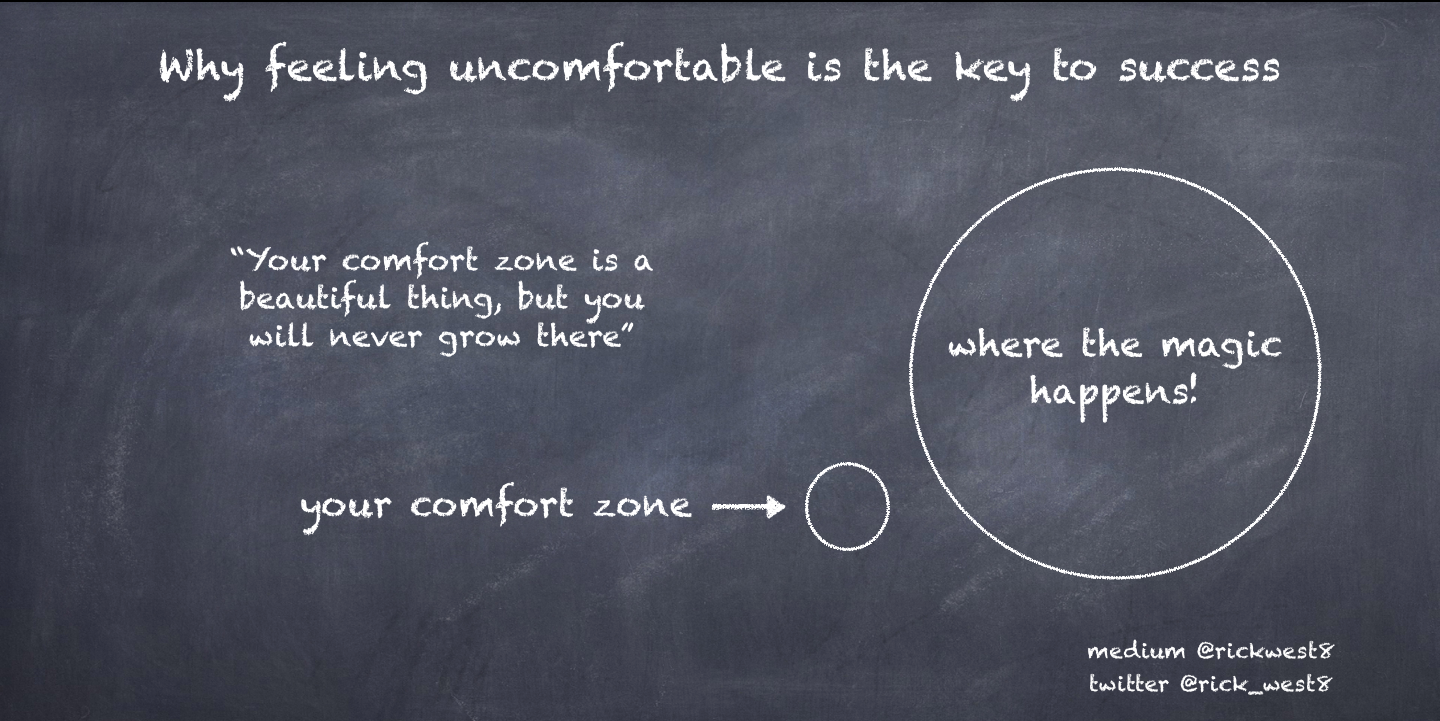
Your comfort zone is a beautiful thing, but you will never grow there!
When
I started learning web development, and especially since getting my
first job, feeling uncomfortable has become a bit of a recurring theme.
I’m
going to be honest, at first, it was a real struggle. Every time I
would find myself in an uncomfortable situation, I would start second
guessing myself — Is web development really for me? Maybe I’m just not
intelligent enough? Will I ever be any good? Will I ever learn enough to
actually get a job and get paid for this?
I’m sure many of you can relate.
If you want something in life that you have never had, you will have to do something that you have never done
Maybe
you have been learning to code for a while but still don’t feel
confident enough to apply for any developer jobs. You might not feel you
are ready yet. You might fear rejection. Whatever the reason, that lack
of self confidence will make you feel uncomfortable. And you’re not
alone. We would all feel the same in that situation.
However,
it’s the people who suck it up, apply for every job they can, contact
companies asking for work, and face potential rejection after rejection
who will win.
Hell,
you might not be ready yet and you might not land your dream job
straight away. But, by putting yourself out there — by stepping out of
your comfort zone — you win. You win! You get the interview practice,
the experience and you get vital feedback on where you need to improve.
At
the end of the day, would you rather be someone who has been learning
to code for 18 months, but hasn’t even started applying for jobs,
because you don’t feel comfortable or ready yet?
Or
would you rather be the person who’s been learning to code for 6
months, and starts applying for jobs? You might feel uncomfortable and
maybe it takes you another 6 months to land a job, but 12 months after
first opening a text editor and you are working in your dream career?
Believe me, this can happen.
The uncomfortable feeling wont stop or get any easier once you get a job
I
hate JavaScript. (Well, maybe hate is a strong word, but I’m not its
biggest fan). Why? — Because it’s hard. I find it difficult.
I’m
a fairly confident developer, but sometimes I find myself faced with a
task or project, and the temptation is to reach for a technology that I
feel comfortable with, rather than building with something new and
challenging.
I
might know that React will produce a better end product, but my initial
reaction is that I don’t want to be in that uncomfortable situation
where I don’t know what I’m doing and I have to reach for the
documentation every 30 seconds.
However,
by taking this approach, I do myself a disservice. I’m hindering my own
learning, development and progression. I’m ultimately inhibiting my own
success.
A comfort zone is a beautiful place, but nothing ever grows there.
What
I have to tell myself in these situations is that whilst I might be
uncomfortable. This is actually an opportunity. An opportunity to try
new things, learn a new skill or further my career.
So…What’s the key to continued success?
Get comfortable feeling uncomfortable — Embrace it
When an opportunity presents itself you have to take it. You have to step out of your comfort zone.
At
the end of the day, this is what web development is. A complex,
constantly evolving industry where you can never know everything and you
will repeatedly be faced with situations where you are made to feel
uncomfortable doing something you haven’t done before. That’s the price
of progression.
As a Web Developer, and in life in general, feeling uncomfortable is just something you have to get used to.
You
cannot let the ‘fear’ of feeling uncomfortable dictate your life. If
you do, it will limit what you are able to do and how much you are able
to achieve.
Being
in your comfort zone is synonymous with repetition. While repetition is
easy, it’s also boring and un-motivating. If, however, you are striving
for something more, want to get out of a rut, if you are searching for
success, then you need to get out of your comfort zone. Doing that is
what separates happy, passionate, successful people from those that are
comfortable and bored.
Once
you learn to embrace the fear you will be astounded by the progress
that you will make, both within your web development career and also
personally.
Success is not just about what you have done, it’s about what you inspire others to do.
Recently I watched a Ted talk, by @luvvie titled ‘Get comfortable with being uncomfortable’. I highly recommend it!
Now this talk isn’t about tech or web development, but last night, while I was reading this article, the parallel between the talk and web development hit me.
One
of the most important things for success in life, and web development,
is pushing your boundaries and limits. What’s also important is that
when you do step out of your comfort zone and do what make’s you feel
uncomfortable, this in turn inspires similar change and inspiration for
others to do the same.
This
embodies what the whole freeCodeCamp community is about. By being part
of a community, sharing your story and your successes, you inspire
others to do the same.
You
might have struggled to complete the Front-end certificate. You might
have had periods where you felt uncomfortable and wanted to quit. But by
pushing through, by becoming comfortable with being uncomfortable, and
reaching that milestone, not only do you achieve you own success, you
also motivate others that are struggling or feeling like giving up.
This
is why it’s important to give back to the community. Share your
projects, share your success, encourage fellow campers in the forums or
on social media. Your success is freeCodeCamp’s success.
Step out of your comfort zone, get comfortable being uncomfortable, you owe it to yourself and the rest of us!
These are the 3 areas to focus on in order to ensure your company’s success #ShortcutYourStartup
One
of the greatest feelings an entrepreneur can experience is when his or
her product or service finally gains traction and begins to gain product
market fit. It takes an immense amount of effort and time to get to
this stage, and you may be tempted to pause, reflect, and enjoy the
moment.
Don’t.
This
is the time when you should be putting your foot on the gas and trying
to relentlessly improve. This is one of the things we learned running
our company and something we talk a lot about in Shortcut Your Startup.
While
the marginal improvements may seem smaller at this stage compared to
the ones you faced when you were initially starting your company, the
magnitude of their effects will now be greater.
To
make this more palatable, consider the analogy on the power of compound
interest, or what Albert Einstein (may or may not have) called “the
eighth wonder of the world.” It’s well known that incrementally adding
to your retirement account when you’re just entering the workforce in
your 20s has huge ramifications on your savings when you retire 40–50
years later.
This
same logic applies to the incremental decisions you make at your
company — seemingly small improvements (and mistakes, too!) have huge
effects down the road.
From
our perspective as both the founders of VEEV and investors in companies
like Pinterest, Lyft, Bonobos, and Warby Parker, we realize how crucial
the small, 1 percent improvements can be to a company’s success.
We realize that these changes can be difficult to identify, so we have outlined 3 key areas to keep your eyes on:
Your Team
Your Product
Yourself
Your team is your company’s most important asset. Always think how it can be improved.
It’s
worth reiterating that your team is something that should always be
focused on building a culture of improvement. Specifically, we cannot
overstate the importance of hiring team members possessing an
ownership-building mindset, which means that they have a vested interest
in the company’s success and don’t solely focus on performing their
daily tasks.
Next, consistently test your product. Adopt the mind of a customer: what could be improved to make your life easier?
Testing
your product, your landing page, or your cart checkout page is often
easier said than done. We recommend dividing the responsibilities into
three parts. Assign somebody to own and oversee the test, another party to design the test, and a third one to analyze the results of the test.
Why?
Clearly dividing responsibilities engages more of your team and sets
the stage for your company to review its product more objectively and
critically. Iterations are a necessary part of any business, and your
team must have a systematic decision to implement and make sense of
these tests. While these processes will help keep track of your
business, we also must stress the importance of keeping track of
yourself.
Finally, continuously focus on improving yourself.
If
two of your goals are to improve your business and your team, it’s only
natural that you pay attention to improving yourself. This is something
that is always ongoing but is extremely worthwhile to pay attention to.
Know
your strengths and weaknesses. Beyond that, realize how your strengths
and weaknesses can affect your company. Part of your hiring strategy
should revolve around hiring team members that complement your skillset.
In addition to your strengths and weaknesses, seek to expand your
network. While connections in your industry are important, consider how
you can learn from others in a completely unrelated field, as invaluable
lessons aren’t solely constrained to your industry.
In
the end, launching your product, receiving favorable press, or reaching
a financial milestone is no reason to let up on the gas — in fact, it
is the time to keep pushing. This desire to constantly improve is a
shared trait of successful companies.
If
you focus on your product, your team, and yourself, your odds of
success will increase dramatically! We talk more about this in our book,
Shortcut Your Startup. Join the conversation!
The most productive, wealthy and highly efficient people devote at least 30 minutes a day to reading. If it works for them, it could work for you. You can make 2018 your best year yet.
These
are the books many people will read to get better, smarter, improve how
they think or change how they work. They are books I am most excited
about. This year, make a better resolution: Read more books.
From
high-profile names to lesser-known authors whose books are worthwhile
reads, the list below is a roundup of 18 titles coming in the first half
of the year to consider adding to your bookshelf.
“The Origins of Happiness
is a wonderful book. It presents a new look at what causes human
well-being, and carefully analyzes the policies and programs that can
enhance it.” — Ed Diener, coauthor of Happiness: Unlocking the Mysteries of Psychological Wealth
“The most significant contribution of The Origins of Happiness
lies in its integrated approach to life satisfaction over the life
cycle. The authors combine cohort studies, longitudinal panels, and
cross-section surveys to provide fuller perspectives. No one else has
done this in such a systematic way.”— John F. Helliwell, University of British Columbia
Poker
champion turned business consultant Annie Duke teaches you how to get
comfortable with uncertainty and make better decisions as a result.
By
shifting your thinking from a need for certainty to a goal of
accurately assessing what you know and what you don’t, you’ll be less
vulnerable to reactive emotions, knee-jerk biases, and destructive
habits in your decision making. You’ll become more confident, calm,
compassionate and successful in the long run.
The
heart of the book features stories about successful entrepreneurs,
CEOs, organizational leaders, and forward-looking thinkers from a
variety of professions. They describe the factors and conditions that
ignited their lives and helped them become achievers.
“Add this book to your library! Firestarters
gives you a smart new way to achieve positive behavioral change that
will improve your life and the world around you.” — Marshall Goldsmith, New York Times–bestselling author of Triggers and What Got You Here Won’t Get You There
“Your Best Year Ever is
full of compelling, real-life stories of average people who have
achieved extraordinary results. Please take my advice and only buy this
book if you want to be able to look back in twelve months and say, ‘Now
that was my best year ever!’” — John C. Maxwell, author, speaker, and leadership expert
“Generous
goals work (if you write them down) and powerful books work (if you
read them). Michael Hyatt has created a fun, fast way to find your
dreams and then turn them into reality.” — Seth Godin, author, Linchpin
Timing, it’s often assumed, is an art. In When: The Scientific Secrets of Perfect Timing, Pink shows that timing is really a science.
“Pink
should change many people’s understanding of timing with this book,
which provides insights from little-known scientific studies in an
accessible way… By the book’s end, readers will be thinking much more
carefully about how they divide up theirs days and organize their
routines.” — Publishers Weekly
In his most provocative and practical book yet,one
of the foremost thinkers of our time redefines what it means to
understand the world, succeed in a profession, contribute to a fair and
just society, detect nonsense, and influence others.
“The
most prophetic voice of all . . . [Taleb is] a genuinely significant
philosopher . . . someone who is able to change the way we view the
structure of the world through the strength, originality and veracity of
his ideas alone.”— John Gray, GQ
“I have to recommend Michelle Dean’s Sharp: The Women Who Made an Art of Having an Opinion,
a delicious cultural history that comes out in April. It brings
together some of the most influential social critics of the 20th
century, including Dorothy Parker, Mary McCarthy, Hannah Arendt, Susan
Sontag and Joan Didion, and shows how these glamorous iconoclasts forged
their singular careers. Dean makes the convincing argument that women’s
voices―if not necessarily feminist ones―did far more to define the last
century’s intellectual life than we realize.”―Michelle Goldberg, New York Times
“In this groundbreaking book, Morten Hansen delivers on the genius of “and:” rigorous and relevant, research-driven and well-written, empirical and empowering, timeless and practical, full of big concepts and
useful tips. Hansen’s work is truly distinctive in the genre of
professional effectiveness, and a tremendous contribution. This is a
book I will read more than once, and reference forever.” — Jim Collins,
author of Good to Great, co-author of Built to Last and Great by Choice
Haden
shows us how to reframe our thinking about the relationship of
motivation to success. He meets us at our level — at the beginning of
any big goal we have for our lives, a little anxious and unsure about
our way forward, a little burned by self help books and strategies that
have failed us in the past — and offers practical advice that anyone can
use to stop stalling and start working on those dreams.
Casey
and Vigna expose the challenge of replacing trusted (and
not-so-trusted) institutions on which we’ve relied for centuries with a
radical model that bypasses them. The Truth Machine
reveals the empowerment possible when self-interested middlemen give
way to the transparency of the blockchain, while highlighting the job
losses, assertion of special interests, and threat to social cohesion
that will accompany this shift.
The #1 bestselling author of The Future of the Mind
traverses the frontiers of astrophysics, artificial intelligence, and
technology to offer a stunning vision of man’s future in space, from
settling Mars to traveling to distant galaxies.
Formerly
the domain of fiction, moving human civilization to the stars is
increasingly becoming a scientific possibility — and a necessity.
Whether in the near future due to climate change and the depletion of
finite resources, or in the distant future due to catastrophic
cosmological events, we must face the reality that humans will one day
need to leave planet Earth to survive as a species.
Based
on the authors’ experience and new research with 1,500 organizations,
the book reveals how companies are using the new rules of AI to leap
ahead on innovation and profitability, as well as what you can do to
achieve similar results.
It
describes six entirely new types of hybrid human + machine roles that
every company must develop, and it includes a “leader’s guide” with the
five crucial principles required to become an AI-fueled business. Human + Machine provides the missing and much-needed management playbook for success in our new age of AI.
Drawing
on her deep network of Silicon Valley insiders, Chang opens the
boardroom doors of male-dominated venture capital firms like Kleiner
Perkins, the subject of Ellen Pao’s high-profile gender discrimination
lawsuit, and Sequoia, where a partner once famously said they “won’t
lower their standards” just to hire women.
“If
you want to get more done, don’t worry about willpower — focus on
motivation. Challenging the dominant view of self-control as a muscle,
Benjamin Hardy reveals that productivity is really about clarity and
commitment.”―Adam Grant, New York Times bestselling author of Originals and Give and Take
“In an age when few people think deeply about life, Benjamin Hardy is the exception. Read this book if you want to be better.”―Jeff Goins, bestselling author of The Art of Work
“Transcendental Meditation is the single most important reason for any success I have had in my life. Bob Roth’s Strength in Stillness masterfully distills the essence of this technique so that anyone can understand how it works — and why they should learn it.” — Ray Dalio
“My
wife and I love Bob. He’s really helped us and our son, Oscar, who was a
stressed, anxious kid. Now I see him blossoming and owning the things
that make him unique. In many ways, Bob saved him during a difficult
time.” — Hugh Jackman
“Mike
has long been a sought after mentor and revered manager, and for
obvious reason: his practical, inspirational, no-nonsense advice works.
This is the book that I will give to all of the motivated professionals
that come through my door with questions about how to achieve their
career, and life, aspirations.” — Jesse Haines, Director of Marketing, Google
In his highly anticipated follow-up to The Happiness Advantage,
Achor reveals a better approach. Drawing on his work in 50 countries,
he shows that success and happiness are not competitive sports. Rather,
they depend almost entirely on how well we connect with, relate to, and
learn from each other.
Just
as happiness is contagious, every dimension of human
potential — performance, intelligence, creativity, leadership ability
and health — is influenced by those around us.
“Read The Million-Dollar, One-Person Business to
learn strategies you can start using now to build a high-revenue
business that gives you the freedom to lead the life you want. Pofeldt
will convince you that you have more power to do so than you
think!” — Stew Friedman, author of Total Leadership and Leading the Life You Want, practice professor of management at Wharton, and director of Wharton Work/Life Integration Project
“In
an era when freelancing, small office/home office, and one-person
businesses are exploding, Elaine Pofeldt has written a definitive
guidebook for any would-be entrepreneur who is looking to brainstorm,
grow, sell, and succeed.” — Gene Marks, CPA at the Marks Group PC
As
we start the new year, many people are looking to lose weight. Fasting,
the voluntary abstention from eating is an ancient weight loss method
with a long track record of success. However, many people forget the
cardinal rule of fasting, or indeed, of any kind of dietary change — always make sure you are doing it safely.
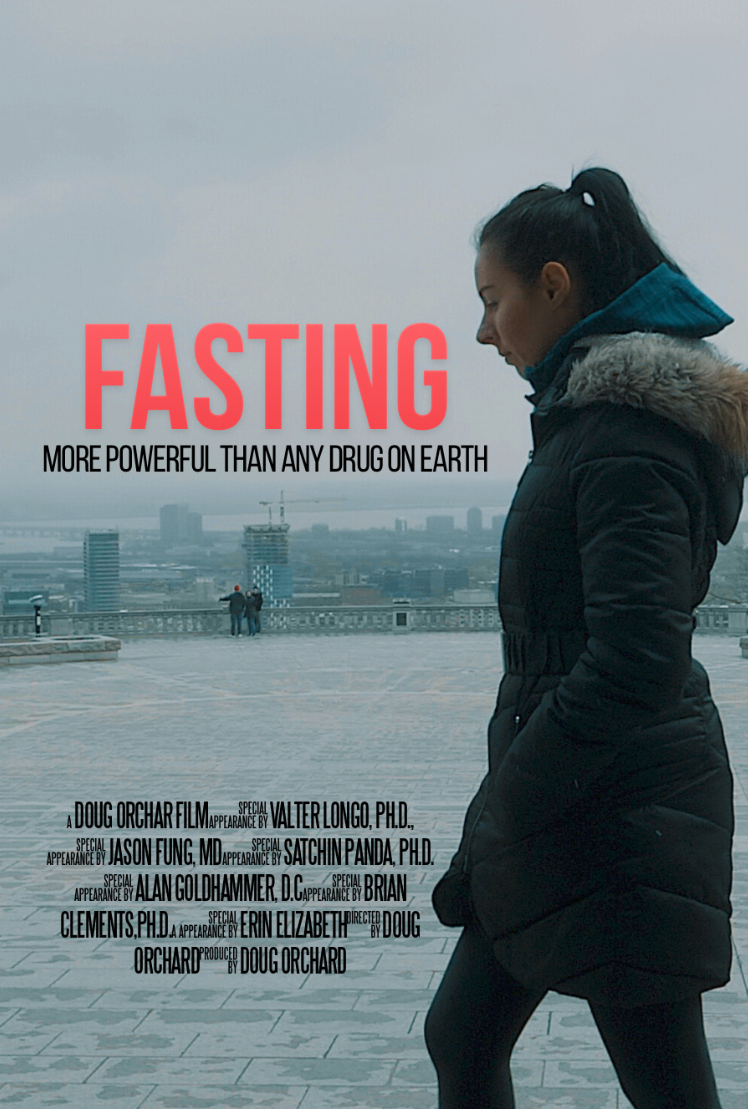
I highly recommend a great new documentary now available for purchase/ rent online called Fasting — The Movie.
It presents the science of fasting and how people can lose weight and
even reverse many metabolic diseases such as type 2 diabetes and its
related conditions. Given the importance of these diseases in modern day
medicine, this is nothing short of revolutionary. However, taken to an
extreme, fasting can also have its dangers. This is true not just for
fasting but for anything. If you take veganism to an extreme, you may
put yourself in danger, for example, of vitamin B12 deficiency. If you
take the low fat diet to an extreme, you are at danger of vitamin D
deficiency. If you take salt restriction to an extreme, you may be at
danger of volume depletion. If you take exercise to an extreme, you may
put yourself at danger of rhabdomyolysis (muscle breakdown). Everything
must be done responsibly, with knowledge and with common sense.
Fasting
is no different. Because fasting is already more intensive than most
diets, taking fasting to an extreme can be problematic. The movie goes
into some of the dangers of fasting and explores many of the variants of
fasting that are popular and may be beneficial for people. Simply put,
fasting is a weapon to be used in the fight against obesity related
conditions and perhaps some aging related conditions.
But,
like any weapon, it has two edges. It has real power, and that power
can be used constructively and it can also, in the wrong hands, be used
destructively. It is all a matter of context and applicability. Much of
the resurgence of interest in fasting as a therapeutic option centers
around intermittent fasting
— generally of shorter duration done consistently and frequently. The
5:2 diet, popularized by Dr. Michael Mosley is 2 days of fasting per
week, but those ‘fasting’ days still allows 500 calories per day. Time
restricted eating such as a 16:8 schedule, allows you to eat during only
8 hours of the day, so 16 hours are spent fasting. Many of the patients
in my Intensive Dietary Management program use 24 hour to 36 hour fasts 2–3 times per week, and this is done under medical supervision with their physician.
Certainly
I use extended fasting as well, but generally limited to 7–14 days,
only in the appropriate person and with supervision. Clients are always
instructed to stop immediately if not feeling well, and we also check in
with them regularly. Longer fasts have more power, but more risk. To
me, there is no reason to fast for 30 consecutive days just for the sake
of argument. Why not do 4 separate 7-day fasts instead? It will have
roughly the same beneficial health effects with far less risk.
By contrast, in Fasting — the movie, director Doug Orchard
tells the story of a young lady who decided to join a 30 day water-only
fasting retreat. As far as I can tell, there was no medical
supervision, and there was no bloodwork being checked and there was no
professional who even determined whether this was appropriate. One of my
primary rules for fasting is that if somebody is underweight or there
is concern about malnutrition, then they should not fast. Underweight is
defined by Body Mass Index < 18.5, but for a margin of safety, I
don’t recommend that anybody fast longer than 24 hours if they have a
BMI< 20. The reasoning seems rather obvious. During the fasting
period, the body must survive on the nutrients and energy stored. If you
have lots and lots of body fat (stored food energy), then you should be
fine. If you do NOT have lots and lots of body fat, then it’s NOT fine.
It’s stupid.
People
get into trouble with extended fasts because they don’t follow common
sense. Many of these fasting retreats offer 30 day water only fasts. If
you become depleted of sodium (quite common), there are no doctors there
to monitor for warning signs. If you become very weak and unable to get
out of bed, there is very clearly something wrong, and you should not
continue fasting. This is common sense. In my IDM program, clients know
that they may feel hungry, maybe a little irritable, constipated
perhaps, but they should not feel UNWELL. If you are really feeling
poorly, you must
stop. There is no reason to continue, because fasting is free. It is
far better to stop and try it again (if you want) in a few days when you
are feeling better. The problem with these fasting retreats is that
people have paid money to be there and therefore they push on far beyond
the limits of good safety practice and far beyond the limits of common
sense.
Further,
people undertake extreme fasting without any kind of preparation.
Instead of undertaking shorter fasts and gradually extending it, they
immediately opt for a full on water-only extended fast. This is like a
rookie mountaineer that decides that he/she will tackle Mount Everest,
without oxygen and push on to the summit irregardless of weather. The
experience mountaineer would immediately recognize this as a death wish,
but the rookie has no inkling of the dangers and may come home in a
body bag. It’s pure stupidity. Yet fasting clinics promote this very
same idea. Taking the most extreme fast (water-only fasting, as opposed
to allowing some bone broth or some caloric intake), to an extended
period of time (30 days instead of 1–2 days), in anybody irregardless of
whether this is medically appropriate, without any adequate medical
supervision or access to bloodwork? I can tell you right now, that’s
pure stupidity.
Consider
the story of the marathon. According to legend, in 490 BC the Greek
soldier Pheidippides ran approximately 26 miles from the battlefield
near the town of Marathon to Athens to deliver the news of the defeat of
the Persians. He shouted Niki! (Victory) and then promptly keeled over
and died.
Suppose
a sedentary, middle aged, out of shape man decided to run a full 26
miles at maximum speed tomorrow, without any type of preparation or
knowledge. He might very well keel over and die, too. Indeed, in 2014, a
42 year old man died after the London Marathon,
the event’s second death in 3 years. Later that year, a 31 year old man
and a 35 year old man died in a North Carolina event. Since marathon is
a relatively extreme event for most people, it takes some preparation
to do safely. That’s easy to understand so you don’t see hysterical
headlines saying “Running, the most dangerous thing ever”. If you want
to run a few minutes, that probably won’t kill you. Running a marathon
in an untrained state could very well do so.
So
the bottom line is that fasting, done properly and with knowledge and
experience is a powerful tool in the fight against metabolic disease and
obesity. But tools can cut both ways and can sometimes harm the user. A
chainsaw is a powerful tool for cutting trees. It may also kill you if
used improperly. But the proper lesson is not to abandon the chainsaw.
Instead, we need to learn how to properly use the tool. Fasting, used
responsibly can be a powerful force for health. Fasting, used
inappropriately can hurt or kill you. Fasting by starting out skipping a
meal here and there — good idea. Fasting by starting out 30 day water
only fast come hell or high water — bad idea. There’s a ton of free
information on fasting that I’ve written extensively on my blog. Just search for the 40+ posts I’ve labelled with ‘Fasting’. I’ve also posted free videos and podcasts, too. So cost is not an issue. Be safe, everybody.
Garry Kasparov, Serena Williams, James Patterson, Christina Aguilera, and others . . .
Note:
If you decide to purchase anything, using the links below, you’ll be
financially supporting the Personal Growth publication. Thanks for your
support.
At
age 22, Garry Kasparov became the youngest world chess champion. After
beating Bobby Fischer’s peak rating, he outranked his fiercest
competitors for over twenty years. Through detailed lessons, including
his favorite openings and advanced tactics, you will develop the
instincts and philosophy to become a stronger player.
Serena
Williams, the world’s #1 ranked women’s tennis player and winner of 23
Grand Slam singles titles, teaches you tennis and reveals the secrets of
her game. This is as close as you can get to a private lesson with one
of the world’s greatest tennis players.
James
Patterson, the author of 19 consecutive №1 New York Times bestsellers,
reveals his tricks of the trade for the very first time. In this course,
he guides you through every part of the book writing process.
Join
Herbie at the piano as he shares his approach to improvisation,
composition, and harmony. Gain access to 10+ original piano
transcriptions, including 5 exclusive solo performances.
One
of Steve’s first gigs was at the drive-in movies. When the audience
liked a joke, they honked. In this class, Steve shares insights from
performing for cars and humans over a 50-year career spanning sold-out
arenas and blockbuster films. Learn how to find your voice, gather
material, develop an act, and take your comedy to the next level.
At
19 years old, Frank Gehry was a truck driver taking sculpture classes
at night school. His vision for what architecture could accomplish went
on to reshape city skylines, and the imaginations of artists and
designers around the world. Now this master builder invites you into his
never-before-seen model archive for a look into his creative process.
Judy
Blume broke the rules. Her refreshingly honest children’s books were
banned by hundreds of libraries — and loved by generations of readers,
who bought 85 million copies. In her first online class, the
award-winning author teaches you how to invent vivid characters, write
realistic dialogue, and turn your experiences into stories people will
treasure.
Annie
was the first woman to be named chief photographer at Rolling Stone. In
her first online class, Annie shows us that what makes a picture
stunning isn’t the gear or technology — it’s the story. Annie teaches
you her philosophy on photography — how to develop concepts, work with
subjects, shoot with natural light, and bring images to life in
post-production.
For
the first time, the Oscar nominated star teaches how he creates
memorable characters, powerful performances, and a long-lasting career.
Learn to master auditions, analyze scripts, and find the truth in every
role you play.
This
is Gordon Ramsay like you’ve never experienced. The seven-star Michelin
chef takes you into his home kitchen to learn everything from kitchen
setup and buying the freshest ingredients to constructing unforgettable
dishes. In this MasterClass, you’re not just learning recipes, you’re
learning how to take your cooking to the next level.
Dr.
Jane Goodall teaches how you can conserve the environment. She also
shares her research on the behavioral patterns of chimpanzees and what
they taught her about conservation. You’ll learn how to “act locally”
and protect the planet.
Aaron Sorkin wrote his first movie on cocktail napkins. Those napkins turned into A Few Good Men, starring Jack Nicholson. Now, the Academy Award winning writer of The West Wing and The Social Network
is teaching screenwriting. You’ll learn his rules of storytelling,
dialogue, character development, and what makes a script actually sell.
Join
Stephen on the court in his first-ever online class as he teaches you
how to improve your shooting mechanics, and leads you through
ball-handling, footwork, and scoring drills. Then see the game through
Stephen’s eyes as he analyzes NBA game footage to help you elevate your
basketball IQ.
Christina
teaches you how to expand your range, find your voice, and master the
techniques that have earned her six Grammy Awards. You’ll learn warm-up
exercises, breath control, vibrato, her signature growls, and hear
Christina break down her biggest hits.
When
the legendary director Werner Herzog was 19, he stole a camera and made
his first movie. 70 films and 50 awards later, Werner is teaching
documentary and feature filmmaking. You’ll learn storytelling,
cinematography, locations, self-financing, documentary interview
techniques, and how to bring your ideas to life.