Technology

Showing posts with label Technology. Show all posts

Saturday, January 20, 2018

How to be a leader in the Fourth Industrial Revolution



Currently, many jobs involve long commutes and little opportunity for professional development. Image: REUTERS/Simon Dawson
Jennifer Artley, President, Americas, BT Group Plc

We often underestimate the scale and speed of change that occurred in the 20th century. Wave upon wave of scientific discovery and technological advance has transformed many aspects of our daily and working lives. As we strike out into the digital age it is our responsibility as business leaders to navigate these changes with integrity and to provide positive, impactful leadership as the business landscape takes a new shape.
Currently, many jobs involve long commutes, hard physical labor, or low pay, and little opportunity for professional development or personal fulfilment. But what if that all could change? The digital age will create an opportunity to reinvent work and to reinvent the workplace.
Connectivity is a by-product of technology. It leads to a more inclusive workspace, a chance for co-workers to collaborate despite miles and oceans between them. The digital era now allows us to work anywhere at any time, playing a vital role in the work/life balance for families. It is now fully possible to swap long commutes to the office for the precious moments of being available to run our kids to school and still be online for a full day of work.
While we are improving our lifestyles in some ways, there are many of us who feel uneasy in the face of such momentous and rapid change. We have seen examples in the news of companies that have automated labor-intensive tasks and reduced their workforce as a result. It’s only natural to wonder if our jobs are vulnerable.
It’s impossible to predict the future, but we can look to the past to find similarities that might provide indicators of where we are heading. The Industrial Revolution of the 1900s brought forth new technologies and different ways of working. Many skilled workers found themselves replaced by machines.
While there were certainly displacements during this shift, the situation created an opportunity for education, previously not available for agricultural workers living in rural areas, and prompted the adoption of a whole new skill set needed to handle the then-modern machinery.
We certainly will face our own set of labour-force consequences as this Digital Revolution progresses. But, if history is to be our guide, business leaders must consider what skill sets will be most favourable, and then help their employees develop those proficiencies.
Supercharged human beings and a more human leadership
Technology democratises human capabilities — physical and intellectual. We might be able to hand over labor-intensive or highly analytical tasks to machines and robots. We’ll likely use digital technologies such as artificial intelligence and machine learning to boost the skills, talent and outputs of our people.
In some sectors and some markets, a lack of IT skills is already holding back digital transformation. Many governments and employers, including BT, are actively encouraging young people to study science, math, and engineering in order to increase the pool of future candidates.
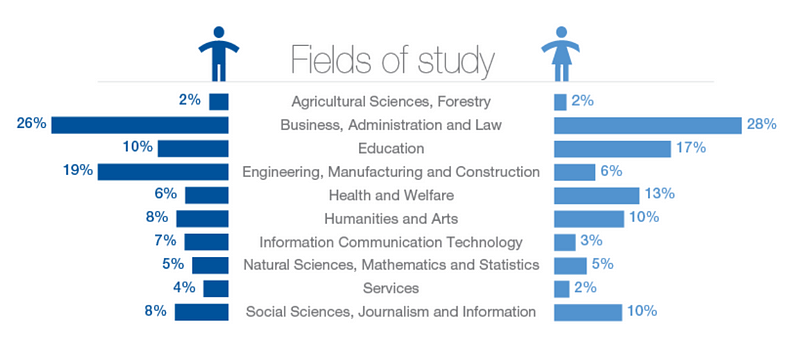
Image: Global Gender Gap Index, 2017, World Economic Forum
We can also fill the pipeline by attracting more women into the technology industry. As of now, women are drastically under-represented in the global technology sphere — just 24% of the information and communication technology (ICT) workforce is female, according to the World Economic Forum report, The Industry Gender Gap.
Jobs should always go to the best and most-qualified candidate, but it is important that we not overlooks the rich differences between men and women, and the space where diversity of thought and approach encourage creativity and innovation.While we don’t need everyone to be a software engineer, we do need employees who can learn, who can share, who can connect the dots and build good relationships with colleagues inside and outside of the organisation. Just as important, we need employees who understand how technology and society interact to drive progress for all stakeholders.
If we need employees who can do all of that, then we need leaders to match. We will need to learn new ways of leading: how to successfully manage people who are not sitting in the office where you can see them; how to measure and reward in a virtual work place and how to virtually connect diverse skill sets that will lead to optimum results.
As Professor Klaus Schwab notes, “We need leaders who are emotionally intelligent, and able to model and champion co-operative working. They’ll coach, rather than command; they’ll be driven by empathy, not ego. The digital revolution needs a different, more human kind of leadership”.

Monday, January 15, 2018

Forget Goals, Be Present


We tend to think of life in terms of accomplishments, rather than experiences. But life is meant to be live with the “goal” of being present in the moment.
This is how to live a meaningful life. Not by having goals and doing things merely to reach those goals, but to live in awareness.
For the most part, society is distracted from this principle. Society tries to derive meaning through status, material wealth, and arbitrary goals.
Take the pressure off. Forget about your goals and plans and just be in the moment. Let each moment guide you.
This isn’t about being undisciplined. That’s a different type of letting go. This is about not trying to control everything. It’s about allowing inner wisdom to guide you.
Goals and plans are often disrupted by reality anyway. Having a general direction makes sense, but details written in stone don’t.
To get more posts like this visit LivingWithConfidence.net and subscribe. It’s free.
One clap, two clap, three clap, forty?
By clapping more or less, you can signal to us which stories really stand out.

Thursday, January 11, 2018

Get it right, or try again and again.


Following my thoughts from problem to solution, including the steps along the way, and the problems with each of them.

Or: How to login as a user from the Admin panel.

Photo by rawpixel.com on Unsplash
Yesterday I got a phone call from a client, whom I built a Time Tracking system for calculating the salaries of his ~800 employees.
Joe: Hi Shuki.
Me: Hi Joe.
Joe: Remember the app you built me the other day?
Me: Of course.
Joe: Can you build me an option to login as any user from my Admin panel?
Me: Hmm. May I ask why?
Joe: For QA testing, anyways there is no sensitive data.
Me: I dunno.
Joe: Common, you’ll find a way.
Me: I’ll try.
In the following post, I will follow my path to a solution, with the ideas that came to my mind, and the problems with each of them, and in the end I will share the final solution I came up with.

If Stories & pictures aren’t your thing, you can jump to the solution.


Photo by Agence Producteurs Locaux Damien Kühn on Unsplash
My first thought was that on the users page in the Admin panel, clicking any username will open a new window, and login as that user.

The problem:

My site uses cookies to keep the user logged in, so if the Admin logs in as a user, his cookies will be replaced, and he will have to re-login as an Admin.

Photo by Mike Kotsch on Unsplash
Building on my first thought, I can add a link back from the user window, to return to the Admin panel.

The problem:

If any of our users find this link, they will have free access to login as an Admin, that surely is not something we can afford happening.

Photo by Raul Petri on Unsplash
So we need a new window, and we can’t override the cookies, Lets open the user in incognito mode.

The problem:

According to this stack-overflow answer it is impossible to do this via code, And I don’t have the patience to teach him how to do it manually.

Photo by Jason Blackeye on Unsplash
If incognito mode is not an option, we can add parameters to our site like: mysite.com/?user=john&pass=123, and auto login when the page loads.

The problem:

Usernames and passwords in the browser history, doesn’t seem to me like a plan, and if someone overlooks his shoulder…

Photo by rawpixel.com on Unsplash
Now that I knew what I needed, I texted the DevHelps whatsapp group, where I got a quick and efficient solution.
If you want to save parameters on the window, and can’t use cookies because you want each window to have it’s own parameters, just use window.name — Bnaya Peretz.

So My final Solution Has the following steps.

  1. On page loading check for a token saved in the window.name object,
    if it exists, auto-login. Otherwise continue to login page.
  2. After successful login, save the token to window.name for reloading.
  3. When the admin, clicks on a username, open a new window named with that user’s token, which will auto login as the user.
  4. In the Admin panel display a popup to reload the page, and since window.name has the Admin’s token reloading will auto login as Admin.

How you can turn your ‘to do’ list into your quest


‘To do’ lists can be deadening and demotivating. We all have things we have to do and some of those things are routine and don’t set the world on fire. But all too often we allow those things to take far too much time and energy. So what can we do to transform ‘to do’ lists so we don’t get stuck spending most of our time on the small, time-consuming stuff?

1. Think about your use of time

A great journalling exercise I did recently was to make a huge list of all the ways I spend my time. Then I divided the list into three groups:
  • routine things that have to get done, but which are uninspiring and can multiply to take up lots of time ©
  • essential tasks that use my skills and are enjoyable (B)
  • the core goals that I’m most passionate about (A)
For me, the category C activities are things like emails and routine admin. This includes organising book launches, doing business accounts, buying train tickets etc.
I estimated I was spending around 40% of my time on category C activities. With another 40% on work, that left 20% of my time for family, relaxation, writing … How can core goals and values be so squeezed and thrive? Of course, they can’t. So the questions then became, what could I eliminate? What could I automate or streamline? And what could I delegate?
One of the things I noticed was that I was repeating the same information to lots of people in serial emails. I set about writing a series of information sheets for authors. These covered what to expect during the publishing process, information for launches etc.
They are all online and available for authors to download on a resource page.
We added an invaluable office manager to our team at Cinnamon Press. We employed a virtual assistant to do a routine task uploading competition details. And I started time blocking so that emails are all answered once a day. I batched other admin too, so I’m not wasting time going back and forth between different types of activity.
My category B is either work-related (editing and mentoring, for example). Category B activities are harder to limit in some ways as they are more essential and more enjoyable.
I love my work, but I don’t want to be co-terminus with it. Having supportive authors who help with these tasks makes a huge difference. I gain a lot from editing the work of others, but I’m also grateful to have trusted editors to delegate part of the process to.
I get huge satisfaction from teaching and mentoring, but sharing the load is also rewarding. I have no desire to cut the category B activities from my timetable, but a team can achieve much more than an individual. Once again, time-blocking enables me edit and mentor when I’m most focussed.
And I’m learning to say no. Loving my work does not mean I have to take on more and more until it overwhelms me. Greg McKeown asks:
Have you ever said yes when you meant no, simply to avoid conflict or friction? … the very thought of saying no brings us physical discomfort. We feel guilty. We don’t want to let someone down. … But these emotions muddle our clarity. They distract us from the reality of the fact that either we can say no and regret it for a few minutes or say yes and regret it for days, weeks, months or even years.
We all have the same amount of time each day, but how we use it makes the difference. We can spend a bigger percentage of our time on the important things if:
  • we eliminate non essential activities (no one needs to be available to a phone or messages every minute of the day)
  • streamline and/or delegate some of the routine activities
  • use blocks of time for different types of activity so you focus on the important things first and one task at a time
  • build a team to share the more essential and rewarding work
  • don’t imagine we can do it all and learn to say no
These strategies have helped me shift from spending 40% of my time on the routine ‘to do’ list to around 20% and I aim to get that down further this year.
This frees much more time for editing and mentoring, but also for my category A activities. These include writing, travel, learning, family time and relaxation.

2. Think about why certain activities are important to you

We all have different goals, different category A activities that are more ‘quest’ than ‘to do’. It’s sad that the pace of life often relegates these to the ‘add-ons’ that we hardly have any time for. But the more passionate we are about these things, the less we will find excuses for not doing them.
As I said in recent post:
Your goals should be your passion and, if they are, then it’s no longer a matter of forcing yourself on by dogged willpower.
It helps to know why we we value certain activities over others. This is what Benjamin Hardy advises:
Think about what it is you want, and ask yourself this simple question:
What about ___________ is important to me?
If your goal is to work from home, then ask yourself the question:
What about “working from home” is important to me?
Your answer might be something like, “to have a more flexible schedule.”
You then put THAT into the previous question.
It’s good to go at least 7-questions deep into this exercise.
Don’t overthink it. Let the answers come and move on and you’ll find your thinking is much clearer than you imagined.
For me:
Writing is the most meaningful and transformative activity I undertake. It’s fundamental to how I reflecting on life and connect with others. Becoming a different story is my life’s work.
Travel puts me in unfamiliar places and situations. This in turn stimulates creativity, writing, thought and deeper work.
Family (including an extended family of close friends) makes my world make sense. These are the people who teach me to live from abundance rather than scarcity. These are the people who confirm for my that generosity is the key virtue.
Keeping fit facilitates other goals. I’m less than 5 feet tall and have a slow metabolism so to maintain my energy I need to be fit, of moderate weight, flexible and well-nourished. It’s about valuing my most basic resource: myself, so that I can give.
Personal development is also foundational to my goals. When my daily rituals, habits, learning, attention to values and relaxation are in harmony, the rest follows.
If we are clear about what matters most and why these things matter, we are more likely to live life as an exciting quest rather than a tedious to do list.

3. Think about building your life on values rather than ‘oughts’

When we face a long list of things we have to do, resistance sets in. Life becomes drudgery sustained by a diminishing supply of willpower. Even if we manage to achieve everything on the list, we’re not likely to take much pleasure of pride from it.
When we manage our time by eliminating, streamlining, delegating, sharing, time blocking and saying no, we find we have ‘more time’.
When we know what we are passionate about and why, we release energy that is much more effective than willpower.
And when we act from our deepest values rather than ‘oughts’ imposed on us from outside, then this energy increases beyond our imagining.
Living from values gives us this bigger vision. Living from values comes from intrinsic motivation rather than from something imposed on us.
As with goals, we will each have different value sets. But something I’ve found useful is to use a system attributed to Benjamin Franklin. He decided on thirteen key virtues and each week of the year would focus on one of them so that over the year he’d concentrate on each value four times.
I’ve written my values into a tiny book (less than two inches square) that I can carry with me. The first two for me are generosity and abundance. It was fascinating to spend time journalling to reach my list of thirteen. And starting each day thinking about how I can show that value in my life is much more motivating than starting the day thinking about a to do list. It doesn’t mean that there are no routine jobs to do, but it keep them in perspective.

4. Think about taking time out

When you know how you want to live and why; when you know the values your life rests on, life becomes a quest rather than a mundane list of demands on your time. This is exhilarating and motivating and it demands that we redirect our energy to what matters to us. How do we do that?

i. We need to take space to think

I’m currently rereading Virginia Woolf’s A Room of One’s Own—  it’s an important text and the idea that we need a dedicated space in which to write is essential. Over the last week I’ve set up a dedicated writing room in which to work. It has 23 years of past journals, all the books I’ve bought but still need to read, and important texts that have informed my current thinking. It’s a place I can go to think or write. If you can’t take a whole room, find a desk, a corner, any space that you can call your own and where you can think and write.

ii. We need to create a mindset that helps us to focus

Whatever your daily commitments, journalling morning and evening can make all the difference. Five minutes of writing about how you envisage your future. Five minutes of reflecting on how you have used your time, lived your ‘why’ or values, makes an enormous impact on how you see the world and interact with it. Take time every day to affirm and reflect and watch your world change.
Environment is crucial to our perspective and when we take control of it, things happen.,

iii. We need time in other environments

This is why travel is so important to me. It places me in unfamiliar places and stimulates creativity, writing, thought and deeper work. If you can’t leave the country, go for a long walk; swap houses with a friend for a week. Do something that shifts your perspective and in the unfamiliar situation you will find yourself having new thoughts.

In short

If you want your life to be a quest rather than a mere ‘to do’ list; and want to make a difference, there are a few simple strategies:
  • think about your use of time — you have as much time as anyone else and it’s up to you how you use it.
  • think about why certain activities are important to you — dig deep until you find what matters to you.
  • think about your values and build your life around intrinsic motivation, not what someone says you ‘ought’ to do.
  • think about taking time out, whether in daily journalling or unfamiliar environments that challenge you to adopt new perspectives.
When you begin to make these changes you’ll find life is no longer a mundane to do list, but a quest of your own making. Enjoy!

Call to action

If you’d like to keep thinking differently about writing, creativity and life, please sign up to follow my blog and for the Becoming a Different Story Newsletter.

Tuesday, January 9, 2018

How To Develop Amazing Confidence In All Aspects Of Life


Can You Feign Confidence?

“Optimism is the faith that leads to achievement. Nothing can be done without hope and confidence.” — Helen Keller
In order to develop amazing confidence in aspects of life, you’ll need to relinquish the need for control and allow life to lead you where it needs to.
After all, confidence is a state of mind whereby your attitudes and beliefs correspond with your actions.
It appears in many forms, although you can easily recognise it in someone’s body language and verbal cues.
Life can impair your confidence during difficult times. Moreover, you may have faced hardships long ago which may affect parts of your present life.
“Confidence is a somatic memory of competence. Interestingly, research shows that even if we have an inflated sense of that earlier competence, it still serves as a resource of confidence now,” states Linda Graham MFT in Bouncing Back: Rewiring Your Brain for Maximum Resilience and Well.
You cannot feign confidence.
Perhaps for the short-term. But over the long-term, confidence must originate from within and be accompanied by a desire for self-improvement.
To develop confidence, take massive action frequently. It is no use sitting back hoping for things to change while doing little about it.
Action creates momentum and reinforces self-belief and the feedback from minor successes that contributes to lasting confidence.
Many believe a confident leader is an extrovert, one who is self-important although this is usually not the case.
Confident people have a high emotional intelligence (EQ) and are empathic, compassionate and modest. This flies in the face of what narcissists consider confident; one who is self-involved and regards their personal achievements over others.
It is sensible to cultivate a compassionate side and nurture it if you wish to gain confidence in life.

The Power Of Positive Self Talk

“All you need in this life is ignorance and confidence, and then success is sure.” — Mark Twain
Your inner talk should reflect a success mindset because you get to be your own motivator and leader. It is vital to approach this with the right frame of mind, rather than exercising military-style motivation, which only works temporarily.
Setbacks and disappointments are inevitable in the game of life. Do not allow frustrations to impact your confidence, but accept them as feedback.
Successful people have overcome innumerable obstacles and prevailed.
“Confidence allows you to sail into the uncharted places, and meet up with those dragons without having to get burned,” affirms author Colette Baron Reid in Uncharted: The Journey Through Uncertainty to Infinite Possibility.
Be familiar with your internal dialogue. Look for possibilities within your failures, and I assure you there is something to be gained even in the direst conditions.
Successful people see opportunity in the bleakest conditions and take advantage of it, leaving no time to contemplate what might have been.
Confidence arises when you connect with your deepest intentions and pursue it vehemently.
You cannot help but grow passionately towards something you enjoy. The better you become, the more confidence you will gain.
This will flow into other areas of your life, so if you are confident in your career this is likely to reflect in other life zones.
Confidence means being content with your uncertainties and shortcomings. It involves working in partnership with these attributes but not allowing them to subdue you.
To build lasting confidence, develop a degree of focus, commitment and dedication. Find an unwavering commitment to see something through until the end.
Those who give up halfway, take a blow to their confidence because they reinforce a defeatist attitude. However, even if you fail yet see the task through to completion you’ll grow confident knowing you’re moving closer to victory.
Author Larry Weidel says in Serial Winner: 5 Actions to Create Your Cycle of Success, “The best form of confidence is the confidence that comes from achievement.”

An Unwavering Commitment

“Believe in yourself! Have faith in your abilities! Without a humble but reasonable confidence in your own powers you cannot be successful or happy.” — Norman Vincent Peale
Self-confidence proceeds from pursuing goals greater than yourself and maturing into them. Whilst you may or may not succeed, the personal growth that takes place is paramount to the person you will become.
Ultimately, confidence appears as you inch closer to victory, rather than admit defeat.
Develop a growth mindset instead of a fixed mindset advocates Stanford University psychologist Carol Dweck. She states, “A remarkable thing I’ve learned from my research is that in the growth mindset, you don’t always need confidence.”
I spoke earlier of the need to cultivate powerful self-talk. This is a catalyst for the confident person because they prime their subconscious mind to be on the lookout for success.
Motivational speaker Tony Robbins believes that success leaves clues.
Referring to the fixed mindset, those who torment themselves because of previous failures focus on their faults instead of the lessons gained. This delays progress because attention is given to what is not working, which then becomes a person’s reference point.
True confidence stems from knowing yourself beyond the superficial likes and dislikes. You understand aspects of your character and manage your weaknesses while exploiting your strengths.
In Steven Covey’s acclaimed book, The Seven Habits Of Highly Effective People two habits emerge essential to lasting confidence: Be Proactive and Put First Things First.
The proactive person takes charge of their life. They are accountable for their actions and make decisions based on the outcomes, regardless of whether they are successful.
To Put First Things First, manage yourself to the best of your ability and concentrate on what is important. Prioritise your day-to-day activities in the pursuit of your objectives with an unwavering commitment, notwithstanding impediments and roadblocks.
Remember, “Confidence is the belief that no matter what happens, you’ll find a way,” states author Larry Weidel.
Confidence arises when you overcome your limitations.
This requires conquering your fears so they don’t overpower you. What you give life to occupies importance in your mind.
I enjoy the wisdom echoed by author Bernard Roth in The Achievement Habit: Stop Wishing, Start Doing and Take Command of Your Life: “Make a pact with yourself to not use reasons unless you have to. This is actually an incredibly empowering position to come from. Be confident enough in your actions not to need to explain yourself. Trust yourself and act.”
With that premise, I invite you to find the confidence to live a truly amazing life with a powerful state of mind.

Monday, January 8, 2018

Using Education to Design the Future


Why the In-Class Experience Matters in a Networked World

A bronze sculpture, ``The Entrepreneur,’’ created by sculptor Kermit Allison, located on the Minneapolis campus of the University of St. Thomas
Teaching is different in a digital age. I am convinced.
And discovering how it is different is always exciting. It is one of the joys of being an educator.
Take last week.
Over the past few years, I have spent the first weeks of the year teaching an intensive course at the University of St. Thomas in Minneapolis/St. Paul.
This year’s course is on how the digital world is changing the way we live, work and do business.
The course covers four topics:
  • The ‘platform’ economy.
  • The on-going technological revolution (AI, the Internet of Things and robotics).
  • Blockchain and smart contracts (including crypto-currencies and ICOs).
  • Data-analytics and storytelling.
The goal is to help students understand the opportunities and challenges of a digital age. It is important that the next generation understands that our digital world cannot be understood with traditional models. Doing so leads to misunderstanding, confusion or worse.
There is a lot more to say about the actual content of the course and I will do so in future posts. But what has been particularly interesting this year is how a simple change in the approach to teaching helped clarify how education can play a valuable role in inventing the future.

A New In-Class Experience

In the past, it always made sense to start my courses with the latest technological trends and developments. In the first classes, we dived into several different technologies. This way of teaching had always been interactive with lots of discussion.
But this year, we tried something different.
Rather than begin by introducing the technology, I instead started with some “personal stories”. I explained the real-world challenges that I face in my daily life as a business executive. I explained the impact of new technologies on my work in a large corporation. I gave examples of some of the problems we face integrating technologies into existing ways of working.
The result was to trigger immediate discussion amongst all participants. A mixture of questions, solutions, criticisms and proposals. Everybody was involved. The energy in the room was tremendous.
In short: we were creating something.
We were searching for solutions to the problems of today and in doing so we were working to invent models for a better future.
It was this sense of shared creativity that made it such an unforgettable experience. Something magical was happening in the room.
This might all sound a little over-dramatic, but I really felt that we were engaged in building a better world. We were thinking “out of the box”, sharing and learning. And we were doing this together, as a group.
There are several reasons why I think this approach worked
For a start, young people don’t want or need the technologies explained to them in detail. They don’t need the “facts”.
For instance, the group already knew about blockchain and — if not — they can get up to speed very quickly. Transmitting facts about technology (or anything else, for that matter) is not where education can add real value in a digital age where the facts are so readily available. Rather, we need to focus on how the technology can be deployed and what that means for our future.
Moreover, classrooms are increasing diverse places. The advantage of a group with different backgrounds, either in terms of nationality or prior experience (e.g. communications, technology, law, marketing, air traffic control) is that everyone can bring their own unique perspective that adds something to the discussion.
Of course, the risk with an open-ended and multi-disciplinary discussion of this kind is that it isn’t always easy to direct or control. And although we did stray off topic, it never became chaotic or irrelevant. And, it is true, that some of the solutions we came up with, even though they looked brilliant at first sight, already existed or could easily be shown to make no sense at all.
But for me, this is all just part of the process of co-creation in an uncertain world. We need to have this experience of “trial and error” in order to arrive at the best solution.
What matters is the process of building-reviewing-criticizing-iterating.
And this must be done in a safe space that is open, inclusive and respectful.
The whole experience reinforced my belief that in-class problem-solving is the future of education. Particularly in a fast-changing networked world characterized by constant technological disruption.

Why the In-Class Experience Matters in Designing the Future

There are several reasons why this observation is important. Here are three.

#1 — Face-to-Face Interaction

Recently, we see a trend towards “distance learning” and “online teaching”, and there is a lot of pressure inside universities to develop these new educational models. This is hardly surprising, given the educational possibilities that network technologies are creating. And, no doubt, such trends are important, particularly when they contribute to educational inclusion.
Nevertheless, in-class “teaching” must never disappear. Sure, in many cases, it may need disrupting. But, in a digital age, where teamwork and the open exchange of ideas have become more important than ever, we have to preserve such a learning environment and the unique experience that it offers.

#2 — Freedom & Flexibility

Schools and universities have always been places where we can discuss things in a more flexible and less stringent setting. But such safe spaces become even more important in a digital age. Individual educators and educational institutions all need to recognize the value of providing places where people can work, learn and create together.
Education needs to create opportunities that allows this kind of interaction to happen.
After all, we all have to study new technologies in order to become smarter. Not only to better identify, manage and mitigate potential risks, but also to take full advantage of the tremendous opportunities that new technologies offer across all fields of social life.
That might all sound obvious. But anyone who is familiar with educational institutions will know how there are many managerial pressures — accreditation, for instance — that can easily reduce freedom and flexibility in the classroom.

#3 — Responsibility & Ownership

My own feeling is that in recent decades university education, in particular, has become increasingly “irrelevant” for students. Potential employers feel that graduates have learned little that is useful for the realities of work today. Many professors even seem to share this sense that what they do no longer really matters.
In-class problem-solving of the kind described here can provide one way of making the educational experience more productive and relevant for all stakeholders.
The students in Minneapolis/St Paul certainly invested in the process and felt ownership over what they had created. The solutions were meaningful to them, both for their assignment, but also — more importantly — their futures.

What’s Next?

I know the experience felt more valuable for me. I feel I learnt more as well, and I will incorporate what I learnt the next time that I teach.
And, perhaps most importantly, I also believe that this approach is more relevant for potential employers and society in general.
If you work on technology directly, it makes sense to focus relentlessly on developing that technology. Think of this as invention.
But for those of us working in business or other professions, the real issue is how to integrate disruptive technologies into existing patterns of working. It is about understanding the meaning of technology and then designing or creating a better future built around that technology.
This is the daily reality of working in a world characterized by profound technological change.
Re-creating this experience is where the real value of education now lies.

Thank you for reading! Please click and hold the 👏 below, or leave a comment.
There is a new story every week. So if you follow me you won’t miss my latest insights about how the digital age is changing the way we live and work.